
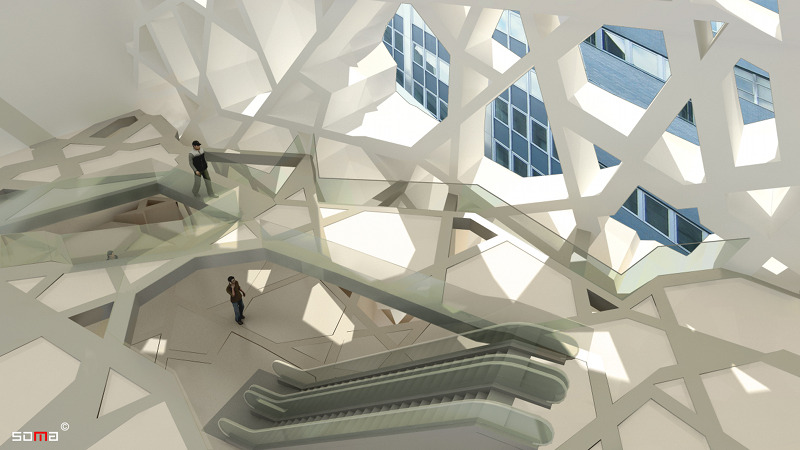
Park51 has been called many things, but to call it Superman's Fortress of Solitude, as in a recent AP article, is both misleading and condescending. Such descriptions undermine any serious discussion of the building's connection to contemporary architecture. It also unfairly dismisses its significance as a potentially progressive and sustainable urban development.
Phillip Kennicott, writing for The Washington Post (October 7, 2010) declared the design "enlightened" in both literal and metaphoric terms. Once built into the dense grid of Lower Manhattan, it could offer a degree of spatial and visual openness unmatched by any neighboring buildings.
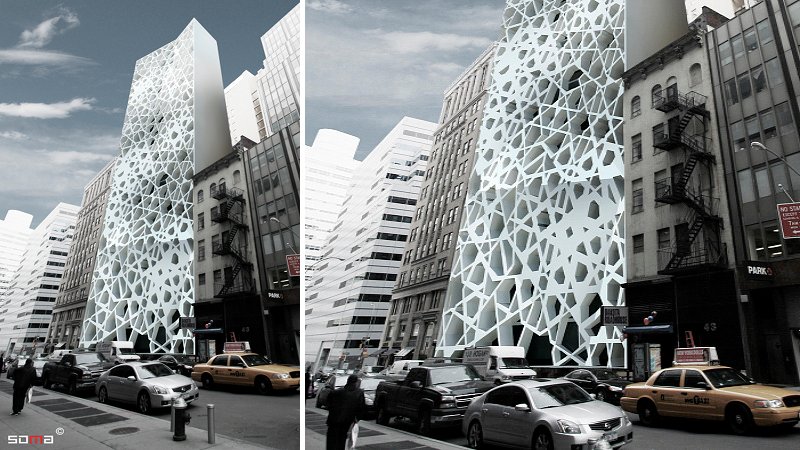
The most recent conceptual images compellingly show a building that, if built, could be positioned amongst some of the finest examples of global architecture. One obvious reference is Toyo Ito's Tod's Headquarters in Tokyo, with its criss-crossing, ribbon-like skin. Park51 takes the idea of this wrap to the next level by making it a structural exoskeleton rather than merely a novel strategy for transparency and lightness.
Park51's lattice fuses contemporary sustainable design principles with traditional Islamic and Arabic references. In this way, the architect, Michel Abboud, Principal of SOMA, was able to invoke Islamic themes while abiding by the urban logic of what Rem Koolhaas, in Delirious New York, called "Manhattanism."
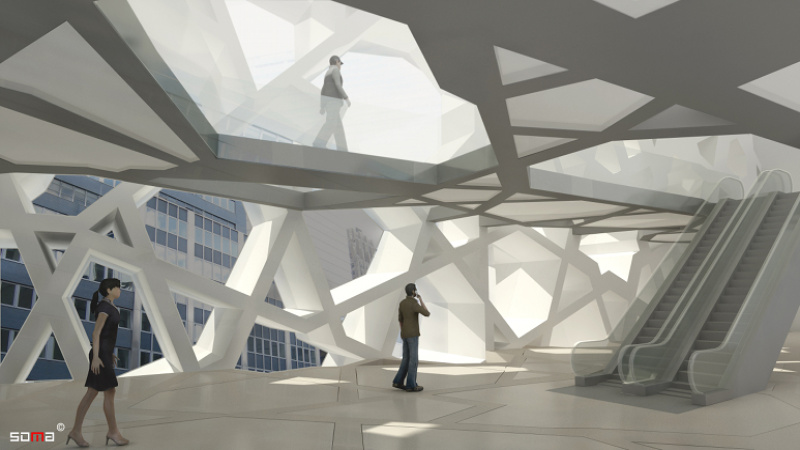
Rather than serving as mere ornamentation cultural symbols are the starting point for structural innovation. This may be compared to Herzog & de Meuron's somewhat kitschy and literal "Birds Nest" stadium in Beijing. There, the "nest" structure is culturally relevant as well as game-changing on an architectural level. Park51 is adventurous enough to be game-changing for New York.

The intuitive, informal process of nest building tamed in steel. Herzog & de Meuron's "Bird's Nest" National Stadium in Beijing. Photo ©Alexander F. Yuan/AP
Through this language of contemporary architecture, the current design fosters the very sense of community that is at the core of the Park51 Center's mission. This is not merely a superficial gesture. Good architecture articulates and spatializes social and cultural aims while challenging and re-energizing the surrounding environment. It this sense it is right at home in Manhattan.
The real fortresses are two blocks away, at ground zero. The new World Trade Center towers, with their blast-proof concrete bases and elaborate security measures are examples of what Stephen Graham, in his book, Cities Under Siege, defines as "militarized urbanism." Park51 sharply contrasts with this post-9/11 approach. Its transparent design and friendly relationship to the street makes it a welcoming haven.
Hopefully, this architectural gesture will now draw attention away from the loud and uninformed discourses (such as blogger Pamela Geller's) that simply deride the Center as a mega-mosque.
"The profundity of this design," says religion scholar, Sherin Wing, "is that it addresses the foundations of religious freedom: the principal of accepting all religions and their expression so long as they do not infringe on the civil and human rights of others. It is ironic that by embodying the principal of acceptance and openness, Park51 has activated exactly the kind of persecution that the right of religious freedom was trying to address."
Pamela Geller might sing, "I gotta be me," (New York Times, October 8, 2010) but, more importantly, New York has to be New York. With a design like this it can be both ways: she can be whatever she wants while the great city reaffirms its dynamism and America's founding principles through good design.