
iPhone app iPad app Android phone app Android tablet app More

Featuring fresh takes and real-time analysis from HuffPost's signature lineup of contributors
Harlan Green

GET UPDATES FROM Harlan Green
 

What Happened to the Bush Tax Cuts?

Posted: 06/04/2012 6:24 pm

The debt-ceiling debate is about to begin again, and House Speaker Boehner has said he will continue to press for more tax cuts without raising additional revenues, reviving the possibility of more budget gridlock and credit downgrades. "I believe that raising taxes at this point in our recovery is a big mistake," Boehner told reporters. "At a time when we're trying to help small businesses create jobs, this proposal would kill jobs."

But it is a mistake to cut taxes without raising revenues. We know G.W. Bush's tax cuts enacted in 2001 and 2003 to revive an economy flattened by the dot-com bubble bust have cost plenty. And we know what happened to all that money saved by corporations and individuals.

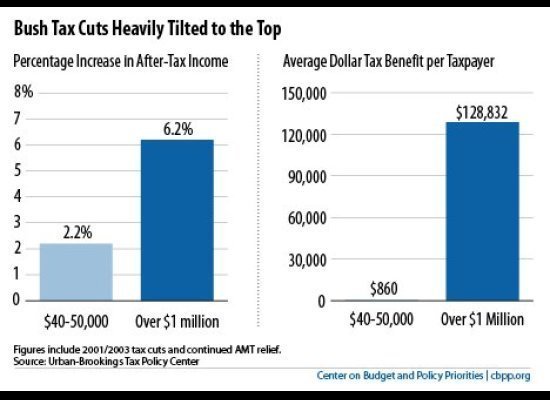
Not much. Just three million jobs were created during Bush's eight years, household incomes did not even keep up with inflation, and yet corporate profits are up more than 14 percent as a percentage of GDP -- the highest in history.

So most of the money flowed to corporations -- who are currently hoarding more than $2 trillion in cash -- and the top 1 percent income earners who benefited most from the tax cuts. And since the top 1 percenters spend less of their money than the 99 percenters, much of it is being held in banks that have over $1 trillion in excess 'zero sum' deposits that aren't being put to work to revive this economy.
2012-06-04-benefits.jpg
Graph: CBPP


Then what would really put all that cash back to work to grow jobs and the economy? We know the answer is to invest more money to grow the future, but how without even more debt? Dr. Robert Shiller of Irrational Exuberance fame, and Cornell Professor Robert Frank have written wonderful New York Times op-eds on just how to do it.

It's almost absurdedly simple in principle. Dr. Shiller says that William Salant, then a member of President Franklin D. Roosevelt's White House staff, and Nobelist Paul Samuelson, then of M.I.T., developed a "balanced-budget theorem":

"It asserts that if a country raises taxes and expenditures by the same amount in a time of high unemployment, and if monetary policy is accommodating, the national income grows by exactly the amount of the tax, so that after-tax income is unchanged."

Professor Frank also disputes austerity proponents who say governments can't spend beyond their means indefinitely, any more than businesses or families can. He says:

It's a fair statement if we're talking about the long run. But in the short run, it's utterly false... Consider an indebted family that must decide whether to borrow $5,000 to install additional insulation in its attic, a project that would reduce its utility bills by an average of $100 a month and require loan payments of $50 a month. In the short run, obviously, the project would increase the family's indebtedness. But can there be any doubt that the family would be better off, in both the short and the long run, by going ahead with it?

In other words, one must spend money to make money, and it can be done in a balanced way. That also means it can be done with either public or private monies that gives a public benefit, such as making up the $2 trillion deficit in infrastructure repairs. And if private business won't invest sufficient funds, as at present, then public monies must be used.
2012-06-04-nogrowth.jpg
Graph: CBPP


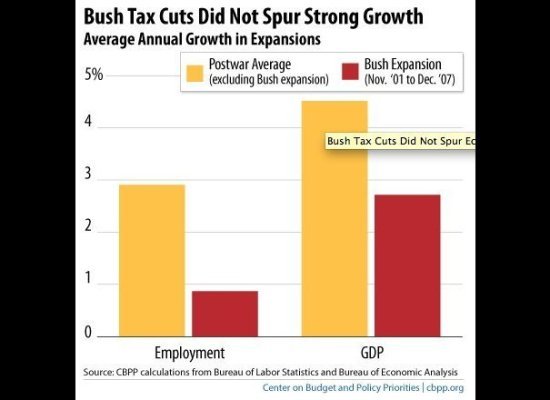
So we also know that tax cuts don't create jobs or spur growth by themselves. The Bush tax cuts are the most current example; in fact they helped to cause the Great Recession. For much of the excess profits were spent on market speculation -- especially in subprime loans and payday lending to the poorest among us -- that caused the housing bubble.

An excellent book by Gary Rivlin, Broke, USA: From Pawnshops to Poverty, Inc.: How the Working Poor Became Big Business, documents that. According to a Bloomberg News review:

Poverty Inc. was a "roughly $150 billion-a-year industry at its peak," Rivlin calculates, after totting up revenue at pawnbrokers, payday lenders, money-wirers, rent-to-own operators, tax preparers who offer instant tax "refunds," subprime credit-card providers, subprime-mortgage lenders and all the rest.
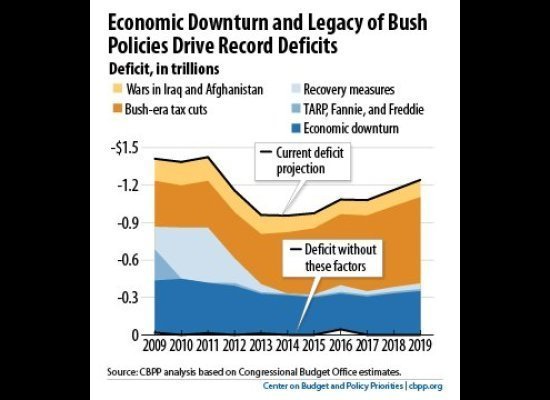
We also know the cost of the Bush tax cuts, which had to be paid for with taxpayer dollars. They were one of the major causes of the deficit due to the lost revenues at a time we were paying for 2 wars.
2012-06-04-taxcuts.jpg
Graph: CBPP


It's more than $3 trillion to date, according to the CBPP, and would cost taxpayers another $3.6 trillion if extended over the next 10 years. In fact, if the Bush tax cuts were allowed to 'sunset' this year, the federal budget deficit would stabilize. So it makes no economic sense to advocate tax cuts without revenue enhancers, and there are plenty, from closing loopholes, to certain interest exemptions. So austerity is not the answer -- neither here nor in Europe.

Harlan Green © 2012


Follow Harlan Green on Twitter: www.twitter.com/HarlanGreen

FOLLOW BUSINESS
The debt-ceiling debate is about to begin again, and House Speaker Boehner has said he will continue to press for more tax cuts without raising additional revenues, reviving the possibility of more bu...
 
 
  • Comments
  • 10
  • Pending Comments
  • 0
  • View FAQ
Comments are closed for this entry
View All
Favorites
Recency  | 
Popularity
02:59 PM on 06/05/2012
It is easy to agree with Prof. Frank's analysis for a family considering insulation. But when was the last time we've seen the gov't do a cost benefit analysis like that? The reality is that most incremental gov't spending is for rewarding one's political supporters. Just consider the 2009 stimulus; there were over 800 earmarks in select districts.
02:45 PM on 06/05/2012
Mr. Green apparently does not know that the Bush tax cuts went overwhelmingly to the middle class, not to the wealthy. He also confuses tax cuts for individuals vs. businesses when he says the profits from the tax cuts went mostly for bets on subprime mortgages. In any case, corporate investments in subprime mortgages were a very small percentage of all such investors.
HUFFPOST SUPER USER
BobbyNCorpus
01:28 PM on 06/05/2012
My God what willo our poor billionaires do?Its unthinkable to think that they should contribute to America by paying taxes . Lers abolish All social security benefits, all medicae, all food stamps and while we are at it, all expenses for the military.The nerve of the lower middle classes thinking they should be paid when they sserve in the military.People like Audie Murphy should have served for free so the KOCH brothers could salt away more billions.
09:40 AM on 06/05/2012
Just one more powerful argument for allowing the Bush tax cuts to expire, for all of us.
photo
HUFFPOST COMMUNITY MODERATOR
tacevad
American SS Card Carrying Socialist
09:20 AM on 06/05/2012
Bush tax cuts will pale in comparison to the Romeny tax cuts that promise Mitt a personal $5 million raise,money which will be trickling down to the Cayman Islands no doubt
08:03 AM on 06/05/2012
“Bush's tax cuts enacted in 2001 and 2003 to revive an economy flattened by the dot-com bubble bust have cost plenty.”

These tax cuts gave us the jobless recovery. It wasn’t until his second term that economic activity started creating a significant number of jobs. This was based solely on Greenspan’s housing bubble and we all know how that turned out. Even Obama’s payroll tax cut which targets those earning less than $110,000 per year are ineffective. Only 40 cents of each tax cut dollar is spent with the rest either saved or used to pay down debt.

Other than their meager Keynesian stimulus wholesale tax cuts are ineffective in promoting growth. So called supply side cuts are totally inappropriate at this time as they are designed to facilitate production. Without demand there is no need to stimulate production.

Finally although everyone likes their tax cut every penny that has been rebated has been borrowed. The bill so far is about $4.4 trillion. As has been said a deficit is a tax on future incomes and our Republican friends and their Democratic partners in crime have sentenced us to the biggest tax hike in history. This will be paid with real money or inflated away destroying all of the Nation’s existing wealth.
07:33 AM on 06/05/2012
Unemployment in construction is 21.2%, I wish these guys would tell the truth. We all need to education ourself in this tough market only way is a degree or change your career.. search online for High Speed Universities for career advice
photo
KarmaPatrol
Riverboat Gambler, satellite whisperer. Independe
12:00 AM on 06/05/2012
I'd imagine it would go towards these alternative type investments (payday loan types as illustrated above) but also preferred stocks (though they may not be that preferential if interest rates rise). I wonder (1) how much (or how little) is in very aggressive micro-cap companies (private equity, etc...) and (2) if they've put very little into aggressive companies, is it as a "dumbbell" to minimize any sort of financial "Black Swan" event?
photo
HUFFPOST BLOGGER
HarlanGreen
09:55 AM on 06/05/2012
No, but we already had a Black Swan event, called the Great Recession...It was and is a once in several generations event that now is roiling Europe, because they are living through the same excesses, such as Spain's housing bubble that we lived through. They just don't understand that austerity won't work. They really need another Marshall Plan, rather than being 'spanked' by Germans. Editor
photo
HUFFPOST SUPER USER
rontheking
Legitimate ape here to deliver your gift from Dog.
07:02 PM on 06/04/2012
Unfortunately at this point, with our government firmly in the control of the plutocracy, it seems unlikely that they will raise taxes on themselves...but will continue to bash the poor, feed on (what's left of) the Middle Class, and chip away at our safety nets in the name of austerity....