More

Featuring fresh takes and real-time analysis from HuffPost's signature lineup of contributors
Harlan Green

GET UPDATES FROM Harlan Green

Don't Blame Fannie and Freddie!

Posted: 07/20/11 04:42 PM ET

Please don't blame Fannie Mae and Freddie Mac, guarantors of most of the housing market's conventional mortgages and reason the housing market continues to function at all, for the housing bust. The bust was caused by the oversupply of housing built during the bubble, and aggravated by many commercial banks and hedge funds cooking up every kind of 'liar' loan they could think of to sell to Wall Street securitizers -- including to themselves.

Sure, Fannie/Freddie had to be taken over by the federal government and are being subsidized with approximately $167 billion to date, but that is because banks and other commercial lenders then withdrew from financing the housing market, leaving government to clean up the mess. So the government subsidy is a very cheap price to pay to keep housing from collapsing completely.

Credit was too cheap in early 2000, as Fed Chairman Alan Greenspan's Federal Reserve kept short term interest rates below the inflation rate to pay for the Bush tax cuts and wars. I.e., when short term interest rates were 1-2 percent and inflation in the 3 percent range at the time, it was borrowers who actually profited since inflation deflated the value of the debt This meant it was interest free money!

Economists have estimated that below inflation interest rates were probably also responsible for the double digit housing price rises during the height of the bubble. Don't take my word for it. Almost everyone, including the nonpartisan Government Accountability Office, the Harvard Joint Center for Housing Studies, the Financial Crisis Inquiry Commission majority, the Federal Housing Finance Agency, and virtually all academics, have rejected the argument of conservative think tanks such as the American Enterprise Institute that it was federal affordable housing policies designed to make housing available to a broader public, that created so many high risk loans.

Fannie and Freddie created and have always maintained the gold standard of mortgage qualification standards, with the highest income, credit, and ability to pay requirements. As a mortgage banker/broker for 30 years, I have never originated or underwritten a conforming mortgage that didn't meet those standards.

So why do conservatives hate Fannie and Freddie so much? Because of their ties to the Democratic Party, mainly. As Gretchen Morgenson and Joshua Rosner detail in their book, Reckless Endangerment, Fannie Mae and Freddie Mac grew hugely under Democratic Administrations eager to encourage more affordable housing. And they did buy subprime mortgages from Countrywide Financial that were not underwritten to their conforming underwriting standards, thus fattening their portfolios in a bid to play catchup to the issuers of so-called 'private label' mortgages. But the subprime purchases were a drop in the bucket; just $60.8 billion for Freddie Mac, according to David Min of the Center for American Progress, with borrowers who had FICO scores under 620, a common definition of subprime mortgages.

In fact, the current delinquency and foreclosure rates of Fannie and Freddie, guarantors of Agency Prime mortgages, are close to the historical norm. Fannie Mae reported that the serious delinquency rate decreased to 4.27 percent in March, close to the long term historical average. This is down from 5.47 percent in March 2010. The Fannie Mae serious delinquency rate peaked in February 2010 at 5.59 percent. Freddie Mac reported that the serious delinquency rate decreased to 3.57 percent in April. (Note: Fannie reports a month behind Freddie). This is down from 4.06 percent in March 2010 and Freddie's serious delinquency rate also peaked in February 2010 at 4.20 percent.
2011-07-20-lpsdelinq
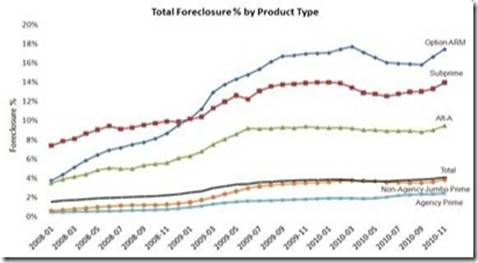
And their foreclosure rates are approaching the 1 percent historical average of all conventional loans. The Calculated Risk graph shows the latest foreclosure rates for all mortgage categories. It may not be surprising that Option ARMs (those with negative amortization that caused the principal loan balance to increased substantially in many cases) have the highest foreclosure rates, even above the Subprimes.

Sadly, Lender Processing Services, Inc. (NYSE: LPS) Mortgage Monitor report shows the number of mortgages 90 or more days delinquent, combined with the foreclosure inventory at the end of June, still totaled 4,073,00 down very slightly from its May 4,084,557 total. so it looks like without additional government help, which doesn't seem likely (see Renae Merle at Washington Post: Obama administration not planning another big housing program), most of those units will be added to the existing home inventory over the next 2 years.

Then why doesn't the Obama Administration spend more of the reportedly $11 billion set aside for the HAMP loan modification program? It may be because Timothy Geithner's Treasury Department isn't requiring banks holding the delinquent loans to get them off their books more quickly. And that means not much upside potential for housing prices until when, maybe 2014?

Harlan Green © 2011


Follow Harlan Green on Twitter: www.twitter.com/HarlanGreen


  • Comments
  • 28
  • Pending Comments
  • 0
  • View FAQ
Comments are closed for this entry
View All
Favorites
Recency  | 
Popularity
02:12 PM on 07/22/2011
Home prices should reflect "real world conditions" such as real income, material costs, construction labor costs and more. Any attempt to force prices to reflect "other considerations" is bound to end up badly.

The one common factor that caused the housing bubble was greed, so much of it to the point of criminality. The home buyer was motivated by the false notion that housing prices will continue a steep incline forever. Real estate agents, brokers and assessors found ways to make more money by promoting the hype. Buyers were steered towards more costly loans and towards short term thinking.

And of course, when Wall Street got their thieving crooked hands on it, the mess became huge. The financial trickery and theft is almost beyond comprehension.

Yet, some people tend to blame one factor or another for that mess. If one wishes to simplify, it is easy to just pick one thing and point at it. I see many factors at play, and if one wants to find one common thread, it is greed.

The only real and solid way to have a working housing market is to let home prices reflect income, material costs, labor costs... Trying to hold home prices artificially with government help, always end up in transfer of money from those that have nothing to do with the mess to the hands of those that created it.

The big banks bailout is one example of such activity.
01:26 PM on 07/22/2011
I congratulate you Mr. Green for this article. I would hope that the media and politicians read this carefully and try to understand it, but alas, it is too easy to blame Fannie and Freddie as a simplistic reason for the housing crisis. There is no doubt Fannie and Freddie made mistakes, but to blame them for the housing crisis is so far-fetched it is not too be believed. As noted, Fannie and Freddie did not purchase subprime mortgages--their underwriting standards were too high (and remain so). The subprime mortgages were created to feed the Wall Street beast. The executives at Fannie and Freddie were not crooks---they were managing risk and shareholder expectations as do executives at every other major US company. If any company, be it GE, Exxon Mobil, Google, MicroSoft, etc were held under the govenrment and media microscope these two companies were under for many years, they would find the same accounting and financial issues (if not more) as were found at Fannie and Freddie. I wish more people would look into the real story and facts instead of just jumping at the sound bites that simple people tend to use when they cannot easily explain complex issues.
09:12 AM on 07/22/2011
This article makes no sense financially. If Fannie & Freddie only accepted loans that were appropriately investigated for due-diligence and which the borrowers could repay b/c they were appropriate, we would not have had the housing mess. You know - conservative lending practices. I EXPECT that from a quasi-governmental semi-private entity. The private lenders withdrew b/c the loans were neither. Only the greed of Fannie/Freddies management explains their behaviors.

This is not about conservative/liberal or out of work -> this is about buying loans that people could not pay back b/c you get bigger bonuses for volume and your management policies were too slack.
photo
HUFFPOST BLOGGER
HarlanGreen
12:37 PM on 07/22/2011
My point was that Fannie/Freddie's purchase of 'private label' mortgages was late in the game, and only small fraction of their business. Therefore they were neither creators of subprime products nor caused the housing bust. Their own conforming loan programs are the best performing sector. Editor
10:40 PM on 07/22/2011
Again, of course they are the best performing sector, but that is definitional. They had the most stringent standards and if any loan met those standards it was sold to the GSEs because the rate was too low for a Bank to put on their balance sheet and make any money on. Basically they set the rules. Whatever they published as their standards became the de facto "line in the sand" between the private label and the GSE securitization. So if they could cherry pick the best borrowers, to whom would the rest of the lending world give money? By definition, the worst borrowers. The desire to grow at the GSEs squeezed everyone else into the subprime market.
08:47 PM on 07/21/2011
“As a mortgage banker/broker for 30 years, I have never originated or underwritten a conforming mortgage that didn't meet those standards.â€

Of course you did not, that is the definition of “conforming mortgageâ€, if it did not meet Freddie or Fannie standards it is not conforming.

“… the current delinquency and foreclosure rates of Fannie and Freddie, guarantors of Agency Prime mortgages, are close to the historical norm. Fannie Mae reported that the serious delinquency rate decreased to 4.27 percent in March, close to the long term historical averageâ€

What??? The delinquency rate was 0.4% in April of 2007 and 0.77% in March of 2008 according to their press releases. It was between 0.7% and 0.4% from 2005 to 2008 and the last peak was in 2003 at 0.86%. No, they are currently 4 to 5 times higher than the long term average.
08:29 PM on 07/21/2011
“… but that is because banks and other commercial lenders then withdrew from financing the housing market …â€

Fannie and Freddie had (have) two advantages. First, they can borrow more cheaply than any other commercial lender as they had an implicit (now explicit) government guarantee. Second, they operated at capital ratios of 2%, producing an ROE that outperformed commercial lenders even at tighter spreads. So is it a surprise that when commercial lenders decided to get out of the non-conforming loan business (which you think they never should have been in) they could not compete with the two GSEs? There was no other mortgage market where commercial lenders could be competitive other than non-conforming.

Therefore banks are only in the mortgage market indirectly, by buying the MBS and debt issued by Freddie and Fannie. In other words, without the commercial lenders buying this stuff, the market would not exist at all (even with the government subsidy).

Freddie and Fannie guaranteed or owned more than 50% of the total mortgage market right before the collapse, how do you assume that they did not help precipitate the events that occurred? They drove the pricing, they drove the structures, they lobbied congress for the rules that allowed them to buy securities that did not meet their own underwriting standards and they were run by management and boards appointed by congress.

To imply they were innocent bystanders is incredulous.
02:28 PM on 07/21/2011
You're argument is somewhat overstated. I believe Fannie and Freddie came under major scrutiny due to the failure of their mgmt. The executives of these semi-public companies reaped millions in annual salaries. Their annual incomes were in the multi-millions; this includes borad members and top executives. We believed they were being paid handsomely becasue they knew what they were doing. The collapse exposed this old-boy network of executives for what they were. The were freeloaders who were milking the system for huge salaries & benefits, and who had no conception of what was truly driving the market. I feel they deserve our scorn but not for reasons related to party affiliation or other such trivial notions.
photo
HUFFPOST SUPER USER
frank day
Republican = FAIL
10:04 AM on 07/21/2011
Thanks for an excellent article.

I just bookmarked it.
SeriesSeven
Libs Love Unproven Counterfactuals
10:01 AM on 07/21/2011
Your article is beyond preposterous. If you had to point to a single entity that was primarily responsible for the housing bust, it would be Fannie and Freddie. You claim that the reason for the bust was because of oversupply. However, Fannie and Freddie were the cause of the oversupply. They are the ones that pump liquidity into the housing sector by enabling underwriters to move risk off their books. F&F are one of the major contributors to the oversupply. The exact same thing that you lament about Wall Street banks (i.e. securitizing mortgage risk and not keeping a large enough capital ratio) is ENTIRELY FACILITATED BY FANNIE AND FREDDIE!!!! It's their entire purpose. It's the reason that they exist in the first place!
photo
HUFFPOST BLOGGER
HarlanGreen
12:30 PM on 07/21/2011
Please provide some evidence of your contention, reader...we welcome all pro and con comments and you seem to be convinced that it was all Fannie/Freddie's fault, so where are your facts? Editor
SeriesSeven
Libs Love Unproven Counterfactuals
02:45 PM on 07/21/2011
http://www.washingtonpost.com/wp-dyn/content/article/2008/06/09/AR2008060902626.html

This article provides a good summary. I won't reiterate everything here, but...

"For Wall Street, high profits could be made from securities backed by subprime loans. Fannie and Freddie targeted the least-risky loans. Still, their purchases provided more cash for a larger subprime market.

"That was a huge, huge mistake," said Patricia McCoy, who teaches securities law at the University of Connecticut. "That just pumped more capital into a very unregulated market that has turned out to be a disaster."
photo
HUFFPOST SUPER USER
Tekkdude
Battling Republican lies one post at a time.
03:32 PM on 07/21/2011
Spoken as someone who has clearly not studied the topic at all but gotten all of their information from Fox News, Limbaugh,and Beck. As you may have read the author cited numerous authorities including the Financial Crisis Inquiry Commission about the true cause of the mortgage meltdown. Fannie and Freddie had almost no exposure to sub-prime mortgages. The majority of sub-prime and securitized mortgages were written by commercial banks and sold to investment banks. In fact, it was the rise in securitization which allowed banks to take the risk off their balance sheets that caused the market to explode. You can look at the correlation of the rise in securitization and sub-prime loans and the value of homes.
04:22 AM on 07/21/2011
There is plenty of blame to go around including Bush's speech about being an "ownership society" before the NAACP to get more morgages to minorities.

Obama can do nothing to spend the HAMP modification funds. He isn't God. The banks refuse to follow the HAMP directives in their participation agreements which was forced upon them for getting TARP funding (now repaid at huge profit to taxpayers).

The banks commit consumer fraud in their deception to avoid HAMP modifications (sees AZ AG lawsuits vs BOA) for those that clearly qualify. Since there is no HAMP law, only an agreement which the banks refuse to follow that is why housing mess will continue for years.

The banks as servicers make huge profits from delaying and foreclosing. On most 1st morgtages the taxpayers take the huge loss on foreclosures (Fannie/Freddie/Ginnie) and the banks just bank all their fees and laugh all the way to their banks.
01:19 AM on 07/21/2011
...because Fanny/Freddie didn't purchase loans and securitize them.
10:36 PM on 07/22/2011
Huh? That is exactly what Freddie and Fannie do. The difference between a GSE and a private label securitization are the underwriting standards. If it qualifies to the GSE standards the originator sells it to the GSE. That is what has happened to 95% of the fixed rate mortgages originated since the bubble burst.
11:23 PM on 07/20/2011
As someone who is 200k underwater living in a part of CA where a ton of foreclosures have taken and are still are taking place I can say for a fact the fannie and freddie are 100% complicit and as responsible for the state of this economy just as much as the oligarchy, robo signing, mortgage fraud settlement (no verdicts just settlements! wtf wells fargo!) banksters. As long as fannie and freddie are allowed to suck off of the tit of the american tax payer and take bailout money, pay bonuses and refuse to participate in ANY principal reduction program that the Treasury department has approved thenTHEY DESERVE PLENTY OF BLAME.
07:35 PM on 07/20/2011
I would agree that artificially low interest rates were the biggest contributor to the housing bubble. Poor, and fraudulent, lending practices put it over the top.

But, decades of government policies to encourage homeownership and real estate investment in general didn't help either. The US is one of the few countries that allow mortgage deduction, capital gain roll over, capital gain exclusion etc.. When you supercharge it with "federal affordable housing policies designed to make housing available to a broader public" (translation: policies designed to get people into buying homes that otherwise have no business buying them), the whole thing goes into hyper drive and .....here we are.

The government shouldn't be encouraging people to buy bigger homes (or homes at all) and take on more debt that they otherwise would. Hopefully we have learned a lesson, but I doubt it. Maybe if they lower income tax rates and eliminate a bunch of deductions ....but...nah.
This user has chosen to opt out of the Badges program
09:08 AM on 07/21/2011
I couldn't get my thoughts down to under 250 words, good post. And I say that as a homeowner who owes a lot of money on my house. It's MY choice, no one elses. I would rather lose my deduction for mortgage interest when filing for Federal Income Taxes, than as a taxpayer be on the hook for bailing out the housing market NEXT time it tanks.

Federal Government shold not be involved in the housing market. Let the chips fall where they may.
photo
HUFFPOST SUPER USER
Tekkdude
Battling Republican lies one post at a time.
03:36 PM on 07/21/2011
The federal affordable housing policies were not designed to get people into houses that couldn't afford them or to get them into bigger houses than they could afford since this would defeat the purpose. The policies were designed to get banks to serve areas that were typically ignored and under served and in that light they were a great success. Most of the loans that were made through these programs were through the FHA and had very stringent qualifying standards. They mostly involved helping people who could otherwise afford the monthly payment on a house be able to afford the down payment also. Those policies had been ongoing since the 1970's and didn't suddenly cause an explosion in the 2000's.
05:30 PM on 07/20/2011
I COULD NOT DISAGREE MORE WITH HARLAN GREEN AND HERE IS WHY:

“1977 Congress passed The Community Reinvestme nt Act (House/ Senate/Pres. Dem), encouraged banks to halt the practice of lending discrimina tion

NOW PEOPLE THAT MOST LIKELY CANNOT AFFORD MORTGAGES CAN GET THEM.

1982 Congress passed The Alternative Mortgage Transactions Parity Act (House/Pres. Repub, Senate Dem), ending the rule that banks can only make fixed-rate mortgages.

NOW WE HAVE VARIABLE-R ATE MORTGAGES THAT CAN SKYROCKET AT ANYTIME.

1995, Government Sponsored Enterprises began receiving gov't tax incentives for purchasing mortgage backed securities including loans to low income borrowers. This made Fannie Mae and Freddie Mac part of the subprime market. In 1996, the Department of Housing and Urban Development (Dem) set a goal for Fannie Mae and Freddie Mac that at least 42% of the mortgages they purchase be issued to borrowers whose household income was below the median in their area. Increased to 50% in 2000 and 52% in 2005.

NOW THE GOV'T IS ON THE HOOK FOR HUNDREDS OF BILLIONS IN BAD MORTGAGES.

2000 Congress passed The Commodity Futures Modernizat ion Act, (House/Sen ate Repub, Pres. Dem), exempted derivatives from regulation , supervision, trading on established exchanges, and capital reserve requirements for major participants.

NOW BIG BANKS HAVE NO RESTRICTION FROM BLOWING UP THE ECONOMY.

Harlan decided to leave out some important facts that happened before the year 2000. The Government (Repubs/Dems) are both responsible don't be fooled.
ThePeacemakers
Concerned Citizen
04:33 PM on 07/20/2011
One element of financial bubbles is over inflated prices.
Why subsidize over inflated prices?
HUFFPOST SUPER USER
Awake-and-Sing
named after a great play written by Clifford Odets
04:16 PM on 07/20/2011
Conservatives want people to blame the poor (a.k.a. "minorities") to distract from the fact this economic downturn was caused and then perpetuated by their failed ideology.
HUFFPOST SUPER USER
hangdogit
Progressive with some Libertarian (abolish DEA).
11:40 PM on 07/20/2011
There is more to it. It is about focusing anger.

By focusing (justified) middle-class anger downward -- on the poor, welfare recipients, immigrants, ACORN, minorities whatever the bogeyman of the day and not always poor -- they (the financial elite and their GOP puppets) can distract that anger away from themselves as they continue to plunder and shrink that same middle class by systematically dismantling its underpinnings (schools, jobs, pensions, health care, etc).

In sum: screw the middle class and keep them mad at the even lower class.

Carlin said it well.
1. The middle class does most of the work.
2. The rich (increasingly) keep most of the money.
3. The poor are there just to make sure that #1 still applies.

It is class warfare called Reaganomics. The only question is: when will the middle class catch on to the charade? The good news -- it IS happening with the Ryan plan and in WI.
07:26 AM on 07/21/2011
'Trickledown' economics with a new & perverse twist, more (metaphorically) accurate to be referred to as 'Golden Showers' economics. For Pan's sake, what's next?
This user has chosen to opt out of the Badges program
09:14 AM on 07/21/2011
"Their ideology" would not have allowed the government to subsidize home ownership in the first place. Government intervention (tax credits and Fannie and Freddie) were a violation of market principals. To blame "conservative economic theory" is really ignoring the underlying factors that caused the bubble in the first place.

Which is not to say that a lot of banks figured out a way to make money off of the whole thing, maybe even illegally. But the government meddling in the market preceded the banks making the money. Thats why the government didn't, and hasn't, really nailed the banks to the wall, and why the government (i.e. taxpayers) is footing the bill for the bubble bursting. Because the government was complicit in creating the bubble, because the end result looked acheivable (higher home ownership rates).

That my friend, is NOT conservative economic theory.
photo
HUFFPOST SUPER USER
frank day
Republican = FAIL
10:11 AM on 07/21/2011
Big business has captured and defanged the regulators.

Look at the current all out attack on the already watered down attempts at

regulation.