What was the reason for Fed Chairman Bernanke's almost pathetic plea to understand real world economics, in his latest speech at the Atlanta IMF Conference? He said in essence that the Fed is caught between worries about inflation and an economy that is sputtering along. But in fact he was really calling for help! -- that he needed help from Obama and Congress to keep economic growth going, because there is really no danger of inflation.
If politicians want to obsess over the possibility of future inflation, in other words, then let them tackle the longer term entitlement problems -- like Medicare, or foreign wars. But instead they are doing all the wrong things, as are the Europeans. They keep advocating drastic austerity measures while cutting taxes, when that will only depress growth further and expand the deficit (via less tax revenues), not shrink it.
Economic growth has slowed at the moment. But much of this is because of geopolitical uncertainty -- the Arab Spring, Mideast oil, the euro bailouts of Greece, Portugal and Ireland, and maybe even our own debt ceiling problem.
But the Federal Reserve's Beige Book report says most of the U.S. is still growing, retail sales are getting better, consumers and homeowners are paying down debt, and service sector activity in general that provides up to 70 percent of our growth is expanding faster.
Then why the obsession with inflation when it is just gasoline prices that are boosting the CPI index at the moment? Without gas prices the CPI has risen just 1.2 percent in a year. It is the classic battle between creditors and debtors that heats up during recessions. Creditors hate any inflation, since it devalues existing debt. And right now creditors -- bankers and other holders of debt on Wall Street -- seem to control the agenda. That is why we are hearing cries of austerity and budget cutting -- all deflationary measures. Such policies drive down prices, all right, into deflationary spirals such as caused the Great Depression if done at the wrong time -- like during this weak recovery.
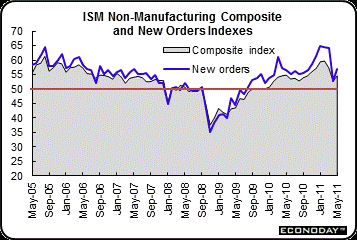
The best weekly news was the jump in the Institute of Supply Management non-manufacturing (i.e., service-sector) index, which now makes up 70 percent of economic activity. The ISM reported broad month-to-month acceleration in the non-manufacturing economy. The report's composite headline index rose 1.8 points to 54.6 with strength centered where it should be, that is in new orders which rose more than four points to 56.8.
The ISM employment index also accelerated nicely, up 2.1 points to a 54.0 level that for this report is very strong. In other readings, deliveries lengthened, which is a sign of strength, and backlog orders rose at a healthy pace. Given that this report is based on a broad sampling of the nation's purchasers, says Econoday, it indicates that economic momentum is headed back up, albeit moderately.
One reason for what looks like a temporary slowdown, is that sales of combined North American-made vehicles and imports dropped to an annualized 11.8 million units from 13.2 million in April. The North American component declined to 9.1 million from 10.1 million.
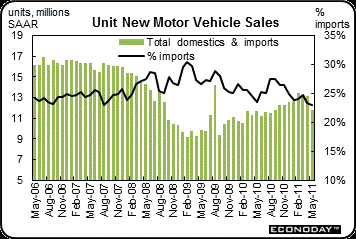
The North American component includes Japanese brands assembled in the U.S. and parts shortages limited supply of many models significantly. Lack of available Japanese brands pushed up related prices. This may have convinced many car buyers to wait for the desired model to become available and/or for a lower price, according to analysts.
What is the help that Bernanke's Fed needs? It can't do all the heavy lifting, if more fiscal stimulus isn't forthcoming. A good place to start is forgiving some of the $trillions in delinquent real estate debt incurred during the Great Recession. Real estate is hurting so much because it is estimated 25 percent of home loans are under water -- i.e., have more loan than equity in their property. So the quickest way to bring down their debt load -- which is holding back consumers spending -- is to forgive some amount of the underwater mortgage principal, with some kind of loan modification.
The first quarter 2011 Federal Reserve so-called Flow of Funds report shows just how much is already "forgiven," in some sense. Much of homeowners' equity has been lost with so many foreclosures and short sales, of course. But homeowners are also paying down debt in record amounts.
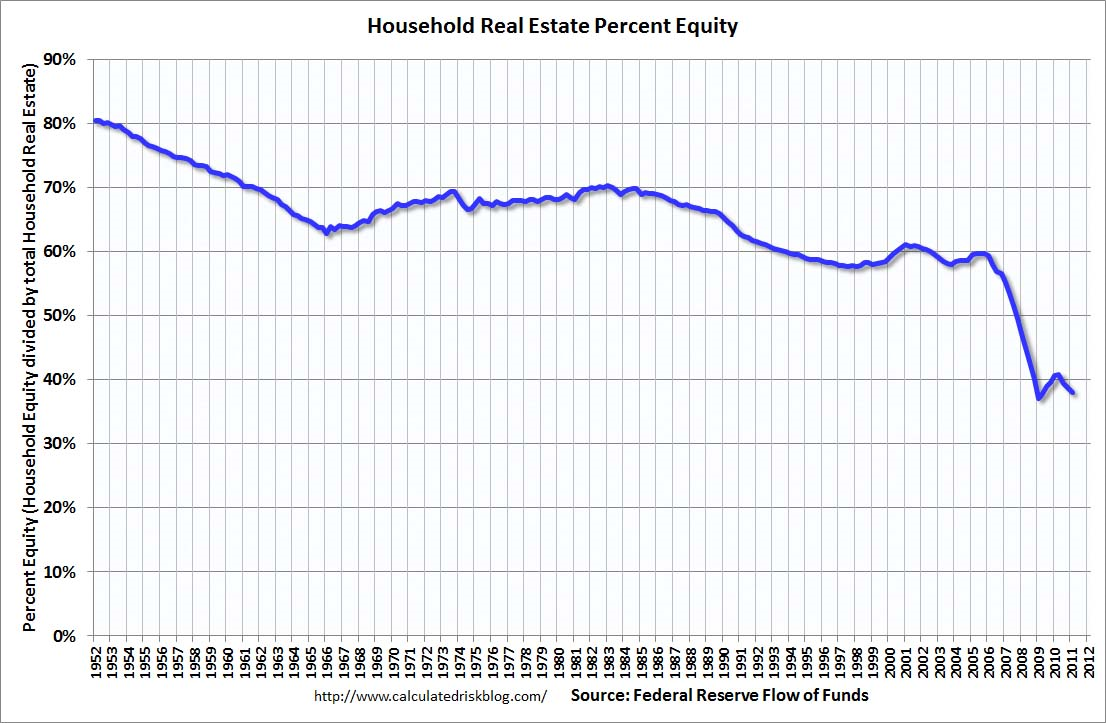
The Fed estimated that the value of household real estate fell $339 billion in Q1 to $16.1 trillion in Q1 2011, from just under $16.5 trillion in Q4 2010. The value of household real estate has fallen $6.6 trillion from the peak -- and is still falling in 2011.
In Q1 2011, household percent equity (of household real estate) declined to 38.1 percent as the value of real estate assets fell by $339 billion. A note by Calculated Risk says something less than one-third of households have no mortgage debt. So the approximately 50+ million households with mortgages have far less than 38.1 percent equity - and 10.9 million households have negative equity.
But banks are reluctant to modify loans unless urged by the White House, banking regulators, and/or Congress, even though it is also in their interest to take the delinquent mortgages off their books. And there has been no requirement that mortgage holders/servicers do so, even with the HAMP loan modification program.
Creditors -- or rentiers in Europe -- were also calling the tune at the beginning the Great Depression in the Hoover Administration. Roosevelt understood this, and instituted inflationary measures by increasing government spending, with regulations that controlled the banking speculation that caused the credit bubble -- i.e., highly leveraged bank loans with no regard to risk. It took some inflation to get the economy growing again. In other words, it was the debtors turn to recover, which ultimately brought us out of the Great Depression.
The Roosevelt Administration actually refinanced more than 1 million homes under the Home Owners' Loan Corporation from 1933-35, with bonds sold to the banks. It also bought many homes lost to foreclosure and rented them back, until they could be sold into the private market. Can we imagine what could be done today with that same political will? One million homeowners then would translate to at least 5 million today, when it is estimated there are no more than 8 million homes in various stages of delinquency. That is, if there is the political will to clean up the real estate mess.
Follow Harlan Green on Twitter: www.twitter.com/HarlanGreen
Richard (RJ) Eskow: Jamie Didn't Know: The Tragic Legacy of JPMorgan Chase's CEO
Obama, Dems: This is Your Economy; Deal With It
Siemens says quarterly business grew, economy slowing
Study shows GPS interference poses major threat to US economy
True. Prices have been held in check, partially caused by the Fed paying banks to hoard cash and partially due to the fact that consumer demand is subdued. However, the likelihood of inflation is a real concern. You seem to think this fear of inflation is creditor driven, mostly by big banks. True that banks do not like inflation, but they do have ways to hedge against it, people that live on fixed income or have little discretionary income are the ones that are hurt most. And when we want to roll over our national debt as it matures, the interest on those loans also goes up.
Your idea on forgiving the trillions of dollars n delinquent real estate debt is also divorced from reality. Doing so just destroys wealth. The ONLY thing to do is to ensure that creditors have all the support needed to exercise their property rights to underlying collateral, since property rights are the foundation of free markets, and their legal rights to go after delinquent borrowers to be made whole. The government is wrong to take a side of delinquent borrowers againt creditors; doing so just undermines the willingness of creditors to lend in the US ig they know that their legal righst are not guaranteed.
You are right about the Roosevelt Administration becoming involved in the housing markets. The moral and financial hazard that such interventions inject into the markets ultimately can prove to be disastrous, as we have found out.
Kai
IT would be nice if life was like it is in Textbooks. The reality one of the major reasons that Banks can not "exercise their property rights" is that it is unclear who really owns a large part of the homes that the owners can no longer pay for. Banks securitized mortgages and the were real sloppy about tracing the almost untraceable paths of ownership as the securities traded.
Also it is governments duty to protect "delinquent borrowers" where there are abuses, as there was in a large percentage of sub-prime lending.
Economics is not a science. Textbooks talk about models that are section of a theoretical real world, not the real world.
Moral Hazard? The risk that a party to a transaction has not entered into the contract in good faith rest has nothing to do with government. It was the banks that engaged in a moral hazard by making high risk loans, knowingly, and then betting against those high risk loans to try to remove themselves from the risk they willing accepted.
I agree. Some, but not a good portion, of the foreclosures have paper problems. And I agree that proper paperwork must be submitted. But once it is, get them out. There are far less cases of dubious paperwork than you think, more importantly even so, the original underwriter retains ownership, not the borrower. So start the proceedings from there. Whatever the outcome, the borrower should not be entitled to the house. They defaulted.
Yeah they have a duty to protect them if there is fraud? Very little I have seen so far in the millions of mortgages that have been foreclosed upon has been fraudulent. What fraud are you talking about by the way?
You are right, economics started out as a moral philosophy, and evolved into its own discipline. But the underpinning of economics is praxeology, the study of human action. So?
Your definition of good faith is incorrect. The terms were presented in good faith, meaning the bank had every intention to lend the money and the borrower intended, in good faith, to pay back the money and the terms for both were set, including the ARM rates. Sorry. There is nothing to assail those contracts. What they do with the contracts afterwards is immaterial to good faith.
Regardless, there are very few cases out of all the cases of foreclosure that have a valid beef. Very few out of the 10’s of millions. Sorry.
Kai
and food prices and clothing prices and prices of used cars and prices of building materials and the price of most things I and most regular Americans buy. How about the cost of a couple of college classes or a prescription? Try to buy a six-pack or a carton of cigarettes lately? It seems that almost anything you try to buy costs much more than it did a couple of years ago.
The amount I pay in taxes is increasing at an even faster rate. I paid more income tax for 2010 than I did for 2009 and my 2010 income was lower. The last time I went to buy toilet paper, the sales tax was 9.3%!!! Talk about flushing my tax dollars down the drain.
Meanwhile, articles like this one try to convince us that there is no inflation and that taxes are the lowest they've been historically. Do they really think people are "stupid"? In science, statistics are supposed to help explain observations, not replace them. No set of statistics can overrule the observation that $50.00 leaves our shopping carts 1/2 as full as it did a couple of years ago and that more money comes out of our paychecks and is added to our register receipts to pay taxes.
Howard Galt
A Conscious Conservative
www.conservativeconscious.blogspot.com
We have to move to alternative energy that has a domestic origin. Now we are held hostage to external forces who do not have our interests in heart.
You are absolutely wrong about taxes. Your paycheck does not buy more because wages have not kept up with price inflation. In real terms our wages have had a steady decline while corporate wages have risen.
If you are looking for a villain, it is not the government. In a democracy, the people are the government, and regardless of what talking heads may tell you, we are still very much a democracy. So when people tell you that Government is the problem they are telling you that you are the problem. They are trying to disable the middle class - the group that cast the most votes - as quick as they can, and then has puppets to tell then that Government is the problem.
Believe it at your own risk.
the trickle! THE TRICKLE!
The creditors were bailed out by Bush. They have billions of profits and don't need to squeeze blood from stones. They don't need to destroy the national economy. They're just doing it for fun.
Read Krugman. The austerity scare is just the next phase in the European and American anti-government factions' attempt to remove safety nets and let the poorest perish. Don't sugarcoat it, please.
The only reason the corporate welfare junkies got their is because the citizen welfare junkies were already on the other tit. The only people left without a tit are the beleaguered middle class: those below the top 2% and above the bottom 50%, paying for everything they get plus everything those above them and below them get.
Krugman is a pseudo-scientist (like all economists) banging the Big Government drum (like 80% of economists) for some reason I can't speculate on. Social safety nets don't make economies prosperous. When economies become prosperous, they can afford social safety nets. But once they take their eye off the prosperity ball and begin focusing on the social safety net ball, they quickly descend to a point where the cost of the social safety net, in human and financial terms, begins devouring the future potential for prosperity. This becomes a death spiral that can only be broken through the most painful maneuvers. Eg; Great Britain, today, 2011. Or Greece, or Ireland, or Portugal, France is teetering ... on and on.
I am a big Paul Krugman fan. I agree that economics is a science in which some data is always missing, and I don't expect everyone to agree with Krugman's outlook, but if you look back at what he's written in the last 15 years, he has made good sense. Here is a link to an article he wrote on his Princeton blog before he became a NYT columnist. http://web.mit.edu/krugman/www/socsec.html
So, again, thanks for your thoughts.
Ever wondered why the bank will usually not give you more credit when you have little or no income and cannot pay your debts? So why should states and governments not learn to live within their means?
People aren't getting rich through hard work anymore, they are getting rich with the fame lotto... look at the former Governor of Alaska... not working for her money, just milking it for her money, and the money is flowing in..... how sad.
Why should one work? Work is for suckers, you game the system like Sara Palin and just get on a bus and let people give you money for no reason....
and the little daughter. A 20 year old single mom looser who can't write with a book deal, and no real talent on a talent show? I feel like a chump for punching a time clock.
there is much more wrong with america then just taxes.
wealth and power corrupts and lots of weath and power combined really corrupts. history tells us that and we only have to observe america's decline to see it happening every day in america.
there are two significant variables driving this nation to self destruction: religion and capitalism. one preaches guilt and fear and exceptionalism and capitalism teaches a survival of the fittest profits over people mentality. double dynamite that is exploding daily in america.
All I can think of is Howard Beale calling us all maniacs for what we are doing to ourselves as we laugh at him like he is the one that is nuts.
As someone who lived through the Carter years of malaise with robust inflation, I would argue you don't have to be rich not to want that again.
So how does such a lame "economic" claim arouse so much support on HP? Because they said the magic words - "This is another example of the rich stealing from the poor". Class warfare! The stock and trade of the HP and its dinizens!
Now everyone supports the idea. Yea, low inflation, another tool of those rich fat cats to take from us. They control everything! Unless you drink the cool aid it almost sounds laughable!