More

Featuring fresh takes and real-time analysis from HuffPost's signature lineup of contributors
Harlan Green

GET UPDATES FROM Harlan Green
 

Who Else But the Fed Will Rescue Real Estate?

Posted: 01/13/2012 1:37 pm

How can we thank Fed Chairman Ben Bernanke for keeping our economy afloat with gridlocked Congress and a timid White House? Not only has the Fed kept interest rates low enough to prevent actual deflation, as happened to Japan over the past 20 years that shrunk their economy. But the Fed is now proposing commercial banks under its purview take a more proactive position; not only by modifying more 'underwater' loans on their books, but actually renting out those it has taken back in foreclosure to tenants; including their former owners.

This is while President Obama and Congress keep picking fights with each other over recess appointments, or the budget deficit, when job creation is what 80 percent of Americans give as the highest priority, according to a recent Rasmussen poll.

The Fed is currently circulating a White Paper entitled "The U.S. Housing Market Current Conditions and Policy Considerations" that asks both government supervisors -- specifically those of GSEs like Fannie Mae, Freddie Mac, FHA and VA -- and private mortgage holders to both loosen their overly restrictive underwriting standards, allow more loan modifications, as well rent out the REO properties they hold, until they are able to be sold!

This is medicine that was applied once before -- during the Great Depression -- by the Roosevelt Administration, under the Home Owners' Loan Corporation. It sold bonds to bring down interest rates for something like one million homeowners, or rented them back to those who had lost their homes, until they could again be sold.

The data currently show that less than half of all lenders are currently offering mortgages to borrowers with FICO scores of 620 with a 10 percent down payment. Yet these loans are within the GSEs purchase parameters, according to the White Paper, which means little risk to the loan originators.

Particularly first-time homebuyers aged 29 to 34 years old are affected, with only 9 percent taking out a mortgage from 2009 to 2011, while 17 percent took out mortgages from mid-1999 to mid-2001.

Why the urgency now?

"Perhaps one-fourth of the 2 million vacant homes for sale in the second of 2011 were REO properties... and the continued flow of new REO properties -- perhaps as high as 1 million properties per year in 2012 and 2013 -- will continue to weigh on house prices for some time,"
said the Fed.

And we know housing prices continue their decline in most areas, according to the S&P Case-Shiller Home Price Index and other indicators. The Case-Shiller 20-city composite is down a seasonally adjusted 0.6 percent in October following a revised 0.7 percent decline in September and a 0.4 percent decline in August.

2012-01-13-caseshiller.png
Graph: Econoday

Individual cities show a decline in Atlanta where monthly rates of adjusted decline have been 4.1 percent, 4.8 percent and 2.9 percent the last three reports. Other weak spots include Minneapolis, Los Angeles, and Chicago as well as Las Vegas and Miami.

So this is a good time for lenders to rent their REO properties, as rents have been rising while national multifamily vacancy rates have plunged. Depending on whether you use U.S. Census Bureau or REIS, Inc. data, the vacancy rate is hovering around 9.8 percent or 5.2 percent, when rates were as high as 11.8 percent during the recession.
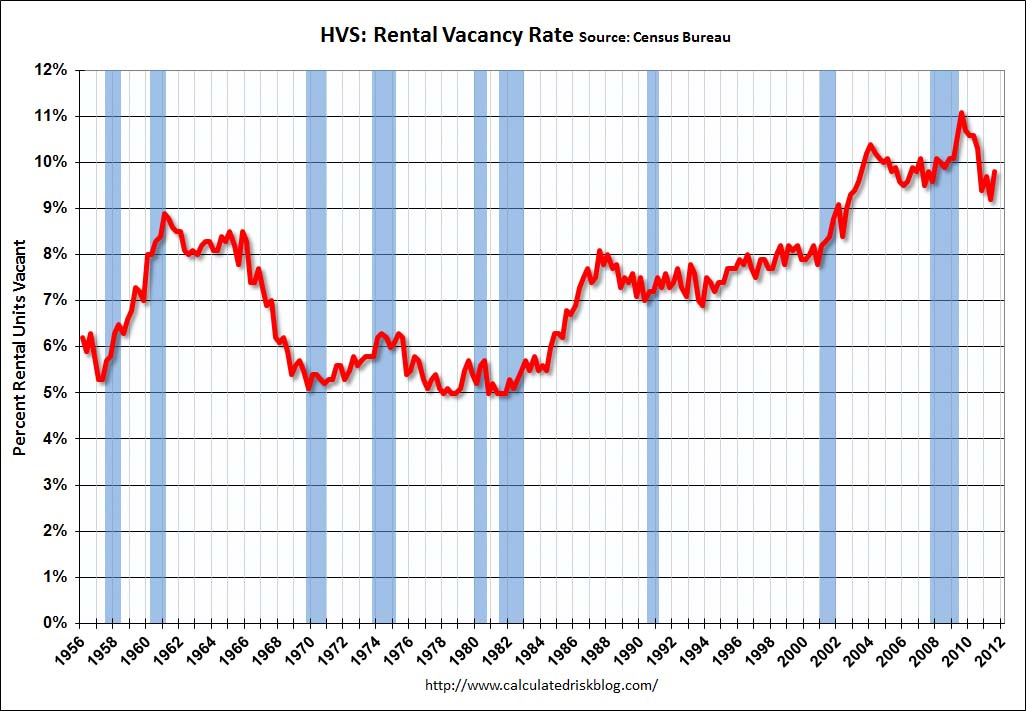
2012-01-13-vacancy.png
Graph: Calculated Risk
"...the challenge for policymakers is to find ways to help reconcile the existing size and mix of the housing stock and the current environment for housing finance," said the White Paper. "Fundamentally, such measures involve adapting the existing housing stock to the prevailing tight mortgage lending conditions--for example, devising policies that could help facilitate the conversion of foreclosed properties to rental properties -- or supporting a housing finance regime that is less restrictive than today's, while steering clear of the lax standards that emerged during the last decade."

So there is hope for real estate when the Fed decides it is time to assist housing, after Chairman Bernanke and others in various speeches have highlighted the drag that a devastated real estate market has on overall economic growth. That is to say, it is time for the banks holding all those vacant homes to get them off their books and back into the real economy. And who else can put their feet to the fire?

Harlan Green © 2012


Follow Harlan Green on Twitter: www.twitter.com/HarlanGreen


  • Comments
  • 9
  • Pending Comments
  • 0
  • View FAQ
Comments are closed for this entry
View All
Favorites
Recency  | 
Popularity
10:20 AM on 01/16/2012
I support a large role for government in many things, including the public option for healthcare. Unfortunately, in regard to the real estate market, I cannot for the life of me see how it can be "rescued" by anyone. The real estate bubble produced an EXCESS INVENTORY of between 2 and 3 million residences in the US. The only "rescue" is for home builders to build fewer units, until this excess inventory is depleted. I believe this has already been happening, whic is good, but the process still has further to go.

I wish there were another way, but when you have a million or so excess residences, there will be problems in the real estate market.
07:39 AM on 01/16/2012
Rental rate statistics showing higher occupancy are baloney, just as were the home sales statistics provided by NAHB for years preceeding and during the the housing bubble. Why? to create another bubble for the benefit of the soon to be 1% who own all the rental properties. To convince YOU, the always willing to panic "exceptional" American you must NOW, this minute, rent before prices go up (again). try this...instead of acting like a sheeple in front of a bullying used car salesman, walk into ththe "clubhouse/office" of any apartment/townhome complex rental property near you, take the tour, nod appreciatively at everything the blond says and when you return to the soft lighting of the "associates" office to draw up the deal, offer them 70% of the asking price and no deposit , refuse a credit check or verification of income and pull out your checkbook. Smiley will have to "check with her manager" but will take your deal and be glad of it because it saves her job for another month.
05:23 PM on 01/15/2012
I wonder if the banks are paying property taxes on all these empty homes?
photo
HUFFPOST SUPER USER
frank day
Republican = FAIL
05:59 AM on 01/16/2012
yes
photo
4eva
.-.. --- ...- . --..-- / -. --- - / .... .- - .
03:41 PM on 01/15/2012
The Fed is not going to be 'solving' anything.

And lenders are not going to be renting these properties.
The plan is to bulk sell these properties to large (politically connected) investment groups to rent out.

Individual investors need not apply.
09:21 AM on 01/15/2012
The price of houses went up. Mortgages were created (ARM's and the like), tailored, manipulated so that someone making $20,000 a year could afford a home worth at the time $250,000. If the banks had held the line the price of homes would have stopped rising. Instead they fed the boom. Why? To get all those poor people's signatures saying they would pay X dollars a month for the next 30 years on incredibly overvalued assets. A banker's dream if I ever did see one. Now people like you suggest banks should help. BANKS DID THIS TO US ON PURPOSE!!!! WHAT DO I HAVE TO DO SING IT FOR YOU!!!!!!
This user has chosen to opt out of the Badges program
02:39 AM on 01/14/2012
Would the Fed also unwind the MERS Mess ?...

http://www.huffingtonpost.com/l-randall-wray/why-mortgagebacked-securi_b_802600.html
L. Randall Wray: Why Mortgage-Backed Securities Aren't (Backed by Securities): How MERS Toasted the Banks

"In a series of pieces I have argued that MERS, a creation of the mortgage banking industry, has effectively destroyed the institution of private property in America. Ironically, MERS was created to facilitate quick and easy and cheap securitization of mortgages -- what are called mortgage-backed securities. In fact, what it did was to eliminate any backing of the securities by mortgages. Of the total securitized asset universe, something like $7 trillion are (supposedly) backed by residential mortgages. However, MERS helped to delink the securities from the mortgages. At best, they are unsecured debt -- there is no property backing the securities. What this means is that foreclosure is not permitted. As I have said before, it is likely that most or even all foreclosures occurring in the US are illegal seizures of property -- home thefts. We are talking about 100,000 completed home thefts per month, with another 250,000 new foreclosures started to steal homes every month. Projections are that 13 million homes will have been "foreclosed" (read: stolen) by 2012.

Worse, from the perspective of the banks, they've got to take back all the fraudulent MBSs, most of which are toxic..."
photo
HUFFPOST BLOGGER
HarlanGreen
12:09 PM on 01/14/2012
Yes, without MERS banks could not have securitized all those mortgages, perhaps slowing growth of housing bubble...who knows? We hope State AGs will get adequate settlements from banks for all the abuses, but it's more important that the Fed is now involved in getting banks to unwind the toxic MBSs they hold! Editor
This user has chosen to opt out of the Badges program
12:19 PM on 01/14/2012
Thanks for the reply

Delaware AG Biden is suing MERS Corp for deceptive practices.

Many state deceptive trade practices laws allow for treble damages.

Could the banks that own MERS Corp afford that ?