Why does the final debt ceiling agreement look like 1938, when Republicans took over Congress after President Roosevelt ok'ed spending cuts while raising some taxes? Because Congress may have made the same mistake -- a repeat of the Great Depression by cutting spending when the U.S. economy hasn't recovered from the Great Recession.
Democrats lost 71 House seats and 8 Senate seats in the 1938 election, after Roosevelt had been persuaded by his advisors cut back on New Deal programs, which precipitated the 1937-38 second depression and gave Republicans ammunition to say the New Deal hadn't worked. Production and profits and wages had regained their 1929 levels by the spring of 1937. Unemployment remained high, but was considerably lower than the 25 percent rate seen in 1933.
So in June 1937, some of Roosevelt's advisors urged spending cuts to balance the budget. WPA rolls were drastically cut and PWA projects were slowed to a standstill, according to Wikipedia. The American economy took a sharp downturn in mid-1937, lasting for 13 months through most of 1938. Industrial production declined almost 30 per cent and production of durable goods fell even faster.
Does this look terribly familiar? In other words, we might be doomed to repeat the historical mistake of listening to creditors to whom so much of the federal debt is owed by cutting spending without actually reducing debt, when we should be stimulating growth both to reduce the ratio of debt to GDP and help debtors repay their debts.
The new agreement doesn't allow any revenue increases in the first stage of some $2.1-2.4 trillion in mandated spending cuts over the next 10 years. This of course means the debt isn't being paid down. All of the Bush tax cuts had added $3.7 billion to the $14 trillion in debt, with tax loopholes extended for energy and agribusiness, two wars and two recessions making up most of the rest. The spending cuts weren't paid for then, and aren't being paid for now, in other words.
But, had we continued the stimulus spending of 2009-10 that included the $787 Billion in ARRA stimulus, spent more of the $11 billion set aside for the HAMP mortgage modification program, and extended the homebuyer tax credits that expired last June, we might have started both a real estate recovery and longer term economic growth.
Instead, we are close to a 'double-dip' after just leaving the Great Recession. The first part of the Great Depression actually ended in 1934, which lulled everyone into believing that cutting spending in 1937 would do little harm. But it just made the Depression worse, until spending from government debt that topped 122 percent of GDP during World War II ended the Great Depression!
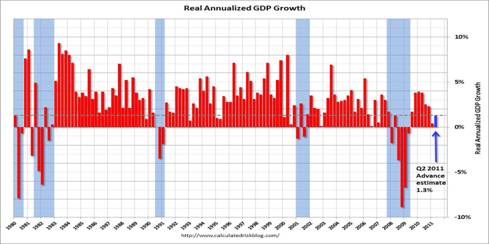
So history is very clear on what it takes to stimulate jobs and economic growth -- more spending on policies that produce growth. That is the only way to bring down the debt level. But one can't borrow for the wrong things, such as tax cuts. As one pundit put it, business doesn't care where the dollars come from -- a public or private worker. Calculated Risk has kept tabs on the possibility of a double-dip recession and second quarter numbers show the economy has almost ground to a halt. GDP growth revisions show Q1 2011 rose just 0.4 percent and Q2 1.3 percent in the 'advance estimate'.
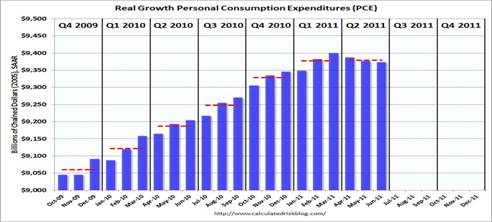
Personal Consumption Expenditures, which account for almost 70 percent of activity, have been falling for just the past 3 months for a number of reasons, including a spike in energy and food prices, and falling vehicle sales due to the Japanese Tsunami. It is why GDP growth has slowed so drastically. There are 4 indicators used by the National Bureau of Economic Research Business Dating Committee to determine a recession -- employment, personal income less transfer payments, real GDP growth, and industrial production. Of the 4, industrial production and GDP growth have recovered the most.
There is some hope with the July Institute of Supply Management non-manufacturing survey that showed overall service sector activity had risen 2.7 percent in 13 of its 18 industries, including transportation and Warehousing, Mining, and Real Estate (surprisingly), and which account for more than 70 percent of all economic activity. So we have not yet entered a double-dip. But without a viable job creation program, that may still happen.
So history as well as basic economics tells us those who want to shrink government by slashing spending without programs that also grow the economy are wrong. What would it take to convince them otherwise? Another Great Depression, or a Great War?
Follow Harlan Green on Twitter: www.twitter.com/HarlanGreen
From what I've seen, creditors were not demanding any cuts. The US government was borrowing at rate equal to the Eisenhower era. This means that more and more people wanted to be our creditors. The creditors were not to blame. Until the insane Debt Deal, they had no fear of not being repaid.
A few of us had been screaming for months that recessions are ended by two words: SPEND MORE!
Washington was seized by a Shared Psychotic Delusion that spending LESS would end the recession. Many still suffer from that delusion.
The lesson of 1937 was this: Never, ever, no matter what cut spending during a recession.
How in the world did Obama comes to believes in Say's Law? It is the equivalent of the Flat Earth Society. Say's Law holds that all money should flow to the top as they are the Job Creators. That is why one does not raise taxes on the tippy top. This belief can only be held by an insane person or an economic ignoramus. Say's Law is the basis of Obama's economic philosophy. DUMP OBAMA
Now I understand that many people say in a down economy the government should keep spending to promote growth and recover us from this recession. Here’s the thing though, we did massive spending in 2008, 2009, and 2010 and the economy has not improved and unemployment has even risen. Right now the US is spending over 100% of GDP in deficit spending each year with no end in sight. What this author does not talk about or show in his numbers is that even with the heavy spending that was going on during the Depression, the US was never spending in excess of its actual GDP per year just to pay its bills.
So my question is this, If the US decided to add 10 Trillion new dollars to the debt bringing it to 25 Trillion that we would owe. And the US spent this 10 Trillion dollars on stimulus on the economy. Do you really believe that it would turn things around? Do you believe it would turn things around enough that the US would be able to pay back its new 25 Trillion debt?
Since the crash in August 2008, Bush and Obama have made certain that Main Street has been cash starved while flooding Wall Street with trillions of dollars. Geithner and Obama believe in Say's Law which requires the government to give money to the ultra-wealthy as they are the "Job Creators." Say's Law is economic idiocy.
The Keynesian solution was:
(1) Insured all residential mortgages. That would have made every toxic mortgage worth 100 cents on the dollar and the banks would not have needed one cent from the US government.
(2) reinstate Glass-Steagall. No system can operate when fraud is legalized. The repeal of Glass-Steagall destroyed the Invisible Hand of the market.
The Invisible Hand is the Price System. Capitalism functions only if accurate prices for everything are transmitted accuratel. Without Glass-Steagall, Wall Street could defraud people as to the value of mortgage backed securities which in turn deceived the entire world as to the value of American homes and mislead everyone in the housing market. It misdirected billions of investment dollars to the housing industry, leaving others without cash. By destroying the Invisible Hand for the home mortgage market, Wall Street sold junk for top dollar and that always leads to economic disaster.
The US government did virtually no deficit spending, and when Obama's Debt Deal tied the government's hand to spend more, the world freaked out ---- with good reason.
I'd also like to include this one,
http://www.theatlantic.com/business/archive/2011/08/the-4-scariest-economic-graphs-ive-seen-this-year/242997/
as those graphs are alarming indeed.
The author is misundertanding the intentions of the radical right.
The debt crisis was an excuse to take a chunk out of government. The consequeces of shrinking government are irrelavant because to them the government should not have been this big in the first place.
Of course this line of reasoning is deeply flawed.
http://www.msnbc.msn.com/id/3096434/vp/40575006#40575006
Why didn't Pres. Obama and the administration bring this up every time they got in front of a TV camera or talked to a reporter? Instead he just let the Tea Party and GOP control the debt ceiling debate and acquiesced to their demands.
===
Wrong? No, the people who want to shrink the government are not wrong. The mistake is to believe that they too want a prosperous, harmonious America but merely have the wrong ideas to achieve it. The truth is that they want oligarchy. What's going on is exactly what they want. It's not enough for them, but it's in the right direction.
Second, can you reference where the graphs are coming from?
>> What would it take to convince them otherwise? Another Great Depression, or a Great War?
Finally, this is the big question? How long are we going to languish in this stagnative and rotting out. As more people lose their skills, their relevence, the houses, their health ... someone is thinking about this and realizing it ... what is the effect, and does it serve that 1% in some way?
Crime is going up, some of these people are getting sick, their children are developing poorly, they will have medical problems far into the future, many could be getting education or training.
We know this, they know this, so why is this going on. This whole thing we are seeing is being rationalized with the thinnest of excuses, questions, and alternate ideas get no media coverage, what else is this but a form of totalitarianism.
I read the "Shock Doctrine" and was not very impressed with it, but there is no denying that pushing these kinds of downward expectations and traumatic changes on the country is made easier by having the whole country in disarray.
It should be one of the tenets of our government to keep our nation away from such moments, since that paralyzes and makes dysfunctional democracy, and the representation of the people our government is based on.