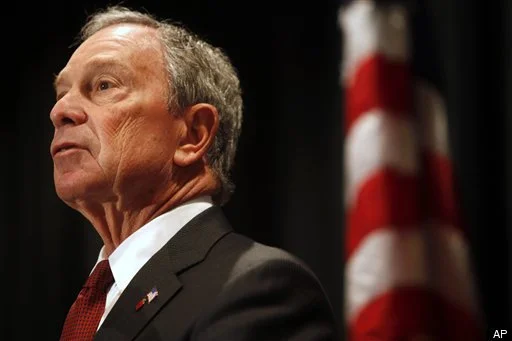
One might think, in this era of environmental consciousness and suspicion of special interests, that a prominent national politician would avoid comparison to Big Oil, Big Coal, and Big Auto. Not Mayor Bloomberg. Visiting Washington on Monday, he expressed mounting frustration that New York's congressional representatives have allowed Wall Street to be pummeled by populist outrage without defending the state and city's interests. The Mayor wants New York's representatives to be more like those from Texas, West Virginia, and Michigan who, in the face of the overwhelming evidence of the harmful effects of their cash cows, fight tooth-and-nail to protect them.
The New York Post has joined in, of course, accusing Senator Schumer, in particular, of "playing politics" with financial reform. Instead of ensuring that "draconian regulation and confiscatory taxation" are stripped from the bill the Senate will soon consider, the Post - citing financial insiders - says that Schumer is "ingratiat[ing] himself with fellow Democrats" in anticipation of a battle for leadership of the Senate. Forget reforming the industry that nurtured a housing crisis, set off a financial panic, and helped trigger a recession. Schumer should avoid the appearance of playing politics.
Harold Ford, New York Senator Gillibrand's erstwhile potential primary challenger, had tried to fill this void for Wall Street. As Jonathan Chait put it, "Casting about for a champion, Wall Street's eyes turned to Ford." But, despite the eagerness of Wall Street types to have a voice pushing Gillibrand to accommodate the desires of the financial services industry, the strategy was far from a winning one and Ford dropped out of the race before he ever got in.
That said, Bloomberg's argument for a more robust defense of Wall Street is not necessarily a bad one. New York City depends heavily on the financial services industry for jobs and tax revenue: prior to the recession, it accounted for about 17 percent of private-sector jobs and 9 percent of the City's taxes. The unexpected improvement of Wall Street profits in 2009, due mostly to the largesse of Treasury and the Federal Reserve, helped save New York from an even gloomier fiscal outlook.
However, Bloomberg and others worried about Wall Street imply that the financial reform bill in Congress would destroy the City's financial services sector and, by extension, its economy. Certainly, if Congress were considering a permanent 50 percent tax on bonuses, many "fat cat" bankers would flee Manhattan. But the financial reform bill is not a punitive one. Rather, it is overwhelmingly designed to create more stability in the financial system, whether by creating a Consumer Financial Protection Agency, creating a resolution authority for too big to fail firms, or enhancing regulation of derivatives. Resolution authority will even be good for some smaller firms that are put at risk when large failing institutions create turmoil in financial markets.
New York City's Independent Budget Office has warned of the uncertainty created by financial reform. But it has also recognized a crucial point:
Depending on the outcome of [reform negotiations], New York could wind up with a less profitable but potentially less volatile industry at the core of its economy.
The danger in Bloomberg's comments is that they not only favor a status quo that has made New York an increasingly unaffordable "luxury city" but that they make the financial industry he claims the City relies on vulnerable to a repeat of the crisis that has put New York, and cities across the country, in dire financial shape.
Regardless of reform, New York is expected to keep losing financial services jobs at least until midway through 2012, the sector expected to perform the worst in the City's economy. In contrast, in his assessment of post-crash America, Richard Florida reminds us that:
New York is much, much more than a financial center. It has been the nation's largest city for roughly two centuries, and today sits in America's largest metropolitan area, as the hub of the country's largest mega-region. It is home to a diverse and innovative economy built around a broad range of creative industries, from media to design to arts and entertainment.
The gobs of money generated by Wall Street make it a crucial part of the City. But the diversity of New York's economy means that a stable, well-regulated banking sector can suffice. New York doesn't need a housing bubble and a bloated financial sector to prosper.