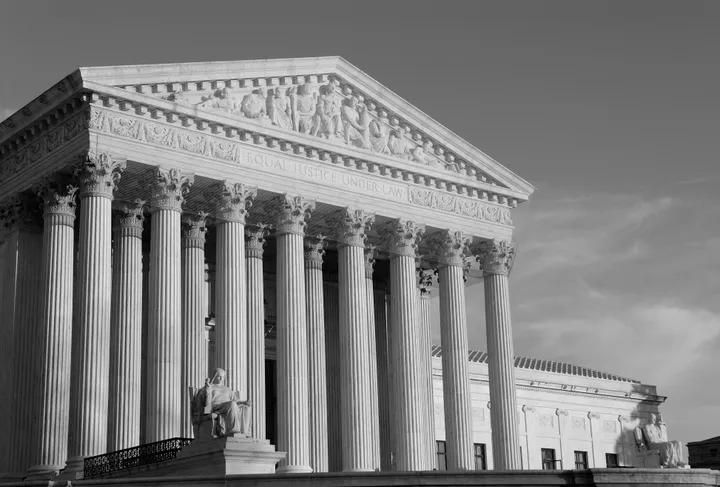
Last November, the U.S. Supreme Court announced it would hear one of many lawsuits by conservative officials challenging the new federal health care reform law championed by President Obama. At the time, you will recall, very few observers thought there was a serious chance that the high court would invalidate the legislation.
I was among them -- until three weeks later, when the Supreme Court announced it would hear the federal government's challenge to Arizona's immigration law, which bars illegal immigrants from trying to get a job and gives state cops the power to arrest people suspected of being illegal immigrants. The Obama Administration argues the Arizona law interferes with federal authority to control the nation's borders.
When I heard that the Court took the immigration case, I was pretty sure I saw a trade-off in the works.
Here's how I reckoned it: Extreme conservatives loathe universal health care (and the president) and want to stop it now, before it takes effect and becomes one of those successful federal programs, like Social Security, that becomes wildly popular and hence impossible to privatize or repeal. Liberals, by contrast, aren't crazy about the sorely compromised product that President Obama signed, but they believe that everybody should receive the health care they need, and that the government ought to at least mandate fair rules in the marketplace. Overturning the new law would set liberals ablaze, and give President Obama a powerful campaign issue -- activist judges -- in the fall.
On immigration, many liberals are uncomfortable with the harsh and arguably unconstitutional provisions of Arizona's law. And they remember how the "state's rights" movement was once a thinly veiled euphemism for maintaining state laws that discriminated against African Americans. But conservatives strongly support the right of Arizona to take extraordinary measures to stop illegal immigration. Overturning the Arizona statute would anger the conservative base.
See where I'm going here?
By taking both cases within a few weeks of each other, the Republican majority on the Supreme Court gave itself the kind of political cushion it didn't have when it handed the presidency to George W. Bush in Bush v. Gore. The high court can grant conservatives the massive victory they seek by invalidating federal health care reform, and then disappoint them by ruling in favor of the federal government in the Arizona case.
"See! Impartial!" the pundits will trumpet; "this proves that Supreme Court 'judges are like umpires,'" as now Chief Justice John Roberts put it during his confirmation hearings on Capitol Hill in 2005. "Umpires don't make the rules; they apply them. The role of an umpire and a judge is critical. They make sure everybody plays by the rules," he said at the time, and it sounded reassuring.
"Split the difference" maneuvering is a common feature in American politics. I've seen it in action ever since I first worked on Capitol Hill in the '70s. The lawmaker votes against a bill -- disappointing some -- only to vote for a different bill a few days later, pleasing them. All is forgiven, or maybe not; either way, it's portrayed as proof of "independence": "If both sides are mad at me," the politicians' old saw goes, "I must be doing something right."
That may fool some of the people some of the time, but such tactical machinations are of course completely improper in the judicial branch, where justice is supposed to be blind and decisions made based on the merits of the case, not whether "the base" will be thrilled or disappointed, or both.
As a lifelong student of the law, I hope I'm wrong about the U.S. Supreme Court. Those who devote their lives to justice, as most lawyers one way or another must, can only rue the public's distrust of the judicial process.
That's growing, and no wonder. Some conservatives indiscriminately berate "judicial activists" on the bench. Meanwhile, corporations spend increasingly vast sums of money belittling judges, juries and lawyers in the quest to pass legislation repealing the average American's right to hold wrongdoers accountable in a court, which they call "tort reform."
And in a little noticed part of its infamous Citizens United decision, the Supreme Court granted corporations the First Amendment right to campaign for or against judges as if they were politicians. Super PACs are now targeting justices whose rulings aren't pro-business enough -- as if "pro-business" is a constitutional imperative unto itself.
I checked the Constitution -- it's not in there.
Unfortunately, what's transpired since last winter gives me little reason to believe that the current Supreme Court will put respect for precedent over politics. During three days of hearings last month, the notion that the Supreme Court would invalidate the federal health care law went from being a right wing fantasy to a possible, even likely, outcome based on the questions and comments of the Republican justices.
In fact, after the hearing on the immigration law last week, it looked to many like the Supreme Court was prepared to rule in favor of Arizona.
The Conventional Wisdom now has the Court dumping heath care reform and upholding the immigration controls, making it a clean sweep for the anti-federal government conservatives. After all, members of the Supreme Court cannot be held accountable for their actions, short of impeachment. So why would they care whether they look like they're "balanced"?
So much for my theory.
On the other hand, a political version of one of the laws of quantum physics may be at work on the Court at this very moment. The Heisenberg Principle posits that the mere observation of atomic particles changes their course. Since its astounding determination that the Constitution protects corporate money, the Supreme Court has come under a nearly unprecedented degree of criticism. Perhaps the public scrutiny is beginning to have an effect.
At least two members of the Court itself have said they want to reconsider it. Justice Anthony Kennedy, the "swing vote" on the bench, may end up unwilling to join in a wholesale re-engineering of constitutional law. Some experts suggest that Chief "Umpire" John Roberts might be sensitive to how history will view his stewardship of the institution.
So I still wouldn't be surprised to see a "split the difference" strategy play out in June, when the Supreme Court is expected to issue its decisions on both cases, just five months from the election.