iPhone app iPad app Android phone app Android tablet app More

Featuring fresh takes and real-time analysis from HuffPost's signature lineup of contributors
Homayra Ziad

GET UPDATES FROM Homayra Ziad
 

Living Out the Sacred Word

Posted: 04/13/2012 12:20 pm

And if all the trees on earth were pens, and all the seas, with seven more seas besides (were ink), the words of God would not be exhausted. God is Almighty, All-Wise. --Quran 31:27

In each day a (new) splendor. And which of the favors of your Lord will you deny? --Quran 55:29-30

The Word of God is always revealing itself. Born from umm al-kitab (Mother of the Book), the Quran points upward to the Preserved Tablet of divine speech that knows no beginning and no end, and outwards to the living tradition that flows from it.

We who receive the word are favored with a heart that carries the revelation to life again and again. "The heavens and the earth cannot contain Me," says a hadith qudsi (divine saying), "but I am embraced by the heart of My faithful, loving servant." And so God's word becomes dynamic and always radically novel.

Fourteen hundred years ago, the Quranic message unfolded in conversation with the intentional community of Madinat al-Nabi, the City of the Prophet. This audacious group, the foremothers and forefathers, laughed and fought and loved with passion, in a decades-long play of give-and-take with God reflected in the language of the text as we have it today. The highs and lows of sincere human endeavor brought the sacred into the world. The Prophet Muhammad (upon him, peace) was described by his wife, the scholar Ayesha, as a "walking Quran." What does this mean? At the most basic level, his actions conformed to the ethical commands of the Quran. At a more profound level, his every action was a re-enactment of revelation.

I may pull the Quran down from the topmost shelf, and sit in silent recitation, but if the Quran cannot be read in the movement of my limbs, the angle of my chin, the way I walk, sit and hold someone's hand, it is as if it had never been written at all.

To be a living, breathing sacred word -- this idea is worth reflection. The Urdu poet and Friend of God Khwajah Mir Dard tells us that "humanity is divine eloquence." He reflects on the theological idea that all life emerged as beautiful words from the mouth of divine power, through the life-giving force of Kun (Be!). Surely he was inspired by the first revelation of the Quran that, in weaving literary images into the language of creation, blurs the boundaries between human beings and the word.

Read! In the name of your Lord who created.
Created the human from a blood clot.
Read! Your Lord is All-Giving, who taught by the pen.
Taught the human being what he did not know.

--Quran 96:1-5

We are, at our source, a self-disclosure of the Word.

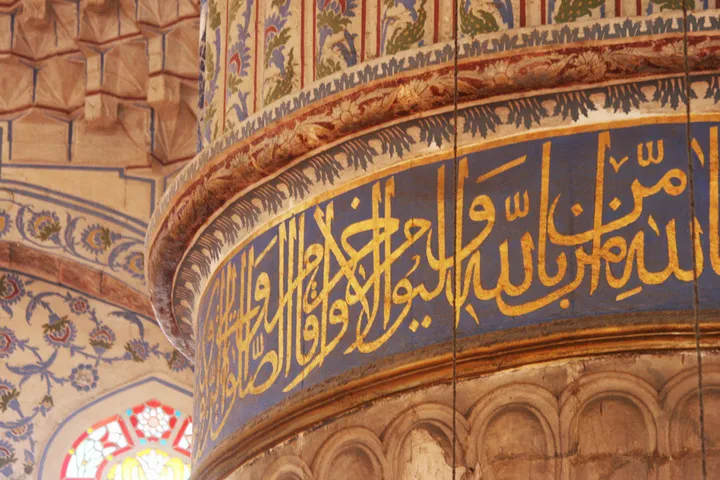
It is the painstaking work of the calligrapher -- an act of worship as much as an art form -- that ignites the creative power of words. I have watched my dear friend Elinor Aishah Holland, as she gently moves her reed across the burnished paper. What if we imagine ourselves as Arabic letters set down by a loving hand? Some of us stand haughty like an alif, some stooped and humble like a dal, some all tied up in knots like a ha. Alone we are of course marvelous, a singular creation. But it is only when letters are connected that they can write out a word. So it is with us. It is only in fellowship that we can write the Word.

Still, connection is not so easy after all. In Arabic, almost every letter must change its shape in multiple ways in order to connect to its neighbor. As Aishah tells me, each letter must find the true proportion that allows it to be both in harmony with the letters around it and in harmony with what is being conveyed. And so it is with us: regardless of where we stand in the play of human fellowship, we have to change to accommodate the flawed and glorious selfhood of our neighbor. We bend a little out of shape, only to realize with a start that this is not a loss after all, but a new beginning, a movement across the borders of ourselves.

Can we come together to activate the sacred Word? The words we create in fellowship are more powerful than any one of us can hope to utter alone. These are the words of the ever-new revelation. These are the words that will change our world.

 
FOLLOW RELIGION
And if all the trees on earth were pens, and all the seas, with seven more seas besides (were ink), the words of God would not be exhausted. God is Almighty, All-Wise. --Quran 31:27 In each day a (ne...
 
 
  • Comments
  • 13
  • Pending Comments
  • 0
  • View FAQ
Comments are closed for this entry
View All
Favorites
Recency  | 
Popularity
04:33 AM on 04/21/2012
this is beautiful!
This user has chosen to opt out of the Badges program
10:12 PM on 04/18/2012
All the "holy" books are heresay.

Religion is a MAN-MADE power tool fueled by fear and need and greed. Sometimes it serves the best interest of humanity. All too often it does NOT.

If an all-powerful god were as peaceful and/or beautiful as you seem to want to believe, then the history of and current condition of much of humanity would not be as ugly.
HUFFPOST SUPER USER
F-BVFF
10:27 AM on 04/16/2012
One problem though, the Quran was written by one person on his own who then convinced others to follow him. There's serious doubt that this makes makes a person a prophet, especially since there was no prophecy in existence at that time, it was outside the land of Israel, the author had emotional issues, he claimed to change the Torah he was supposedly invoking, so by his own definition of prophecy, he's contradicted himself.
photo
HUFFPOST SUPER USER
see-ellen2001
12:59 PM on 04/15/2012
Creates such a poetic image in my mind.
photo
Jelle NL
Unity in Diversity
05:26 AM on 04/15/2012
It’s beautifull metaphor to see human beings as different letters, that only make sense TOGETHER. In the Arabic script - as you pointed out - this "together" also means that we have to change our form to connect with each other. It seems the Writer wants us to adjust and compromise for Heaven’s sake.
HUFFPOST SUPER USER
Oppose obama
02:27 PM on 04/14/2012
I'm sure the Taliban and the despots in Saudi arabia live
By those words
photo
nonChristian
Not even Jesus can save me
09:03 PM on 04/14/2012
Not to mention around 10+ other countries like it.
09:38 PM on 04/19/2012
As one who reads and studies Quran I suggest that the Taliban don't live by the teachings and oppose schooling to keep the people from reading the Quran themselves. The Mullahs distort the teachings. Did you know that the Quran mentons "man" and "woman" an equal number of times? Do you know that Muhammed's wife was the bread-winner for the family - a successful business woman? Neither the Taliban or the Saudi Wahabi would today tolerate that today.

But don't judge, Jesus reportedly said the to the Ten Commandments hed would add just one - That would should love one another.... I see a lot of similarities between unloving, intollerant Christians and the Taliban and Wahabis.
06:58 AM on 04/14/2012
This is so beautiful and true. Thank you for how you convey it.
photo
HUFFPOST SUPER USER
Cindbird
Using my head for something other than a hat rack.
09:14 PM on 04/13/2012
Beautiful, and haunting. Thank you for this reminder that we are only truly alive when we are in concert with life.
04:00 PM on 04/13/2012
Thank you for this beautiful piece. Can you tell us the name of the poem by Khwajah Mir Dard that contains the remarkable line "humanity is divine eloquence"?
05:00 PM on 04/14/2012
Thank you to all of you for your kind comments. This phrase does not come from Dard's poetry, but rather from his philosophical/theological prose work `Ilm al-Kitab (in a larger discussion on the relnship between humanity and the divine word) - it's a beautiful text.
01:59 PM on 04/13/2012
Thank you so much for this deep and artistic understanding of the word of God. I will share this article with my students as we discuss the nature of the Quran.