Mitt Romney thinks little of making a $10,000 bet because that amount means very little to someone worth hundreds of millions of dollars, just as a $10 bet means little to a typical American household. In both cases, it is merely a very small fraction of the bettor's net worth.
Likewise, when we look at the national debt of different countries, we should focus on the relative amounts of debt rather than the absolute amounts. Relative to what, you might ask? Well, that's a fair question. Often we look at the national debt divided by the GDP or some other measure of the nation's economic power. This isn't a perfect normalization (as the GDP itself is a flawed metric), but let's use it for now.
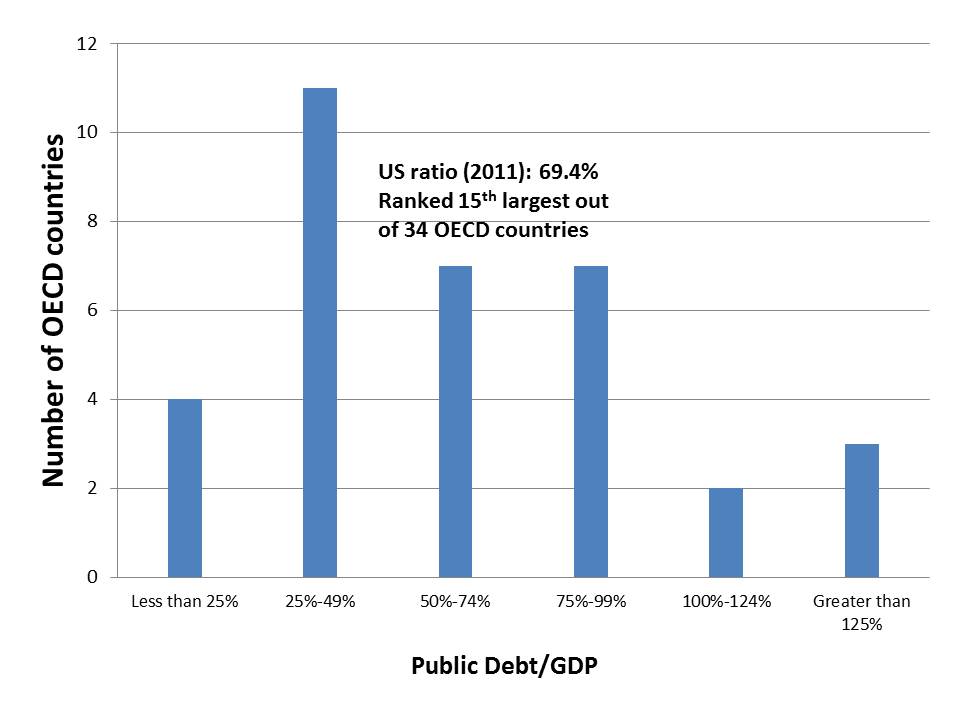
When we look at this measure of debt burden, defined as the ratio of public debt to GDP for Organisation for Economic Co-operation and Development (OECD) countries, we can see that as 2011 the OECD countries with the highest debt burden were the following (in order from most to least):
(1) Japan 230.8% (Most Indebted)
(2) Greece 165.4%
(3) Iceland 130.1%
(4) Italy 120.1%
(5) Ireland 109.2%
(6) Belgium 99.7%
(7) Portugal 88.0%
(8) France 85.5%
(9) Canada 83.5%
(10) Germany 81.5%
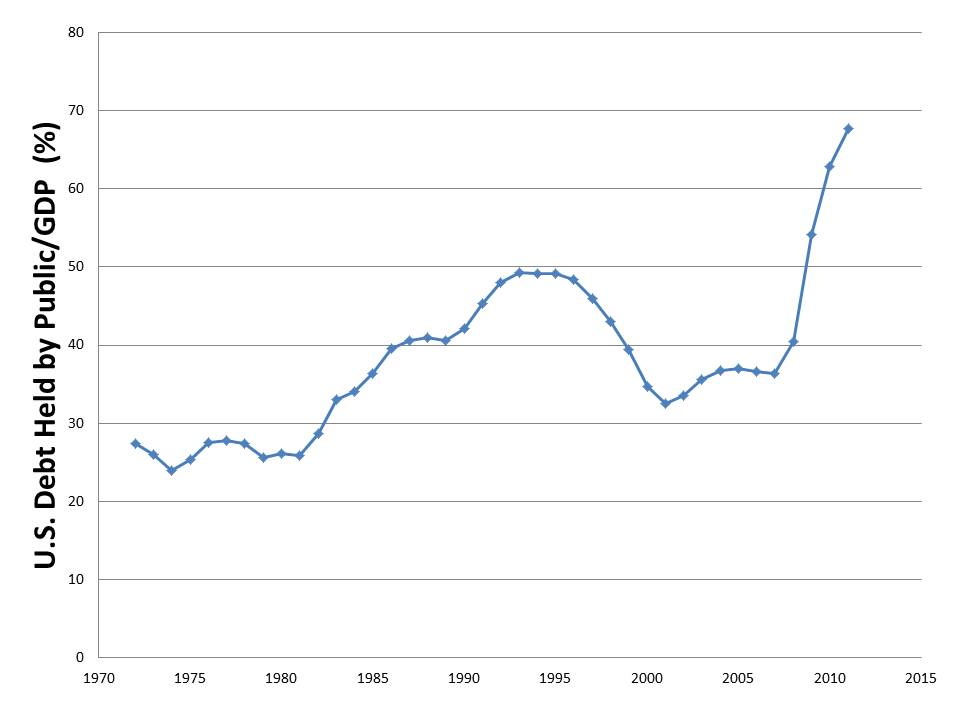
The federal government outlays ranged from 18.2% to 19.1% of the GDP in 1998-2001 but have been between 24.1% and 25.2% of the GDP from 2009-2011, so the government is spending more than it did during the surplus years, in both relative and absolute terms. Federal government expenditures are divided into two parts, discretionary (decided on an annual basis) and mandatory (decided by eligibility rules with some possible changes, like Social Security, Medicare, and Medicaid). I'll discuss the increases in both the mandatory and discretionary spending in separate articles but suffice to say that both have increased dramatically, for different reasons. The discretionary spending ballooned due to the wars and non-defense spending increases while the mandatory spending jumped mostly due to the economic crisis and the actions that have been taken to try mitigating the effects.
As we stare at this exploding debt burden, we are faced with serious economic and policy questions. How do we increase federal revenue in ways that don't hurt the fragile economy? How do we control federal spending without stomping on the sprouts of economic growth?
For those who are busy preaching that the government spending needs to be slashed immediately, ask yourselves how austerity measures have negatively impacted the European countries. Do you really need another data point in the long history of how austerity measures have hurt economic growth or as you hoping that "this time it is different"? For those who are busy preaching that federal debts don't matter (arguing that the federal government "owns the printing press") ask yourselves what happens to long-term economic prospects when any government becomes overburdened with debt.
In general, economists that begin analysis with their personal philosophy first and then hunt for data to support those ideas can be called many things, but they certainly cannot be called objective scientists. Politicians and voters who make decisions without taking the time to study the facts are poor stewards of the nation's future and risk damaging the country's long-term growth.
The answer to our debt burden is simple: collect more revenue and make targeted spending cuts. It's not a complicated idea, but getting politicians, economists, and voters to agree seems to be today's Gordian knot. Until someone slices through the political and economic rhetoric, many of us will keep staring at that graph of the exploding US debt and seeing a train rushing down the tracks to crush America's future.
Follow Howard Steven Friedman on Facebook
Notes:
- The Organisation for Economic Co-operation and Development (OECD) is an international organisation comprised of 34 countries, representing many of the wealthier countries in the world. Its members include North American countries (Canada, Mexico and the U.S.), much of Western Europe, as well as New Zealand, Australia, Chile, Israel, Japan and South Korea. Data from the OECD is readily available online and makes for a great data source for cross-country comparisons.
- Estimates of the OECD country debt burden were taken from the CIA World Factbook
- Estimates of the United States federal government's debt burden over time was taken from the Congressional Budget Office
Follow Howard Steven Friedman on Twitter: www.twitter.com/howardsfriedman
Maybe that was how the US won WWII!
And non-wealth producing nations like the USA might destroy their own economies with (deficit) government spending which will impoverish all of their citizens by selling and/or mortgaging existing NATIONAL WEALTH and spending the proceeds for federal government activities!
Instead of Russian and Communist Chinese Armies conquering the USA, Russian and Communist Chinese individuals and/or businesses are using the US Dollars that we paid them for making the consumer products that we imported from them and consumed to purchase title to (corporations that own) privately owned businesses, factories, casinos, hotels, farms, land, ports, refineries, forests, ports, breweries, distilleries, and other privately owned NATIONAL WEALTH and other assets located in the USA that were created by previous US generations prior to de-industrialization overseas instead of redeeming the US Dollars and the freshly printed paper US Treasury Bonds that they earned by making and selling things to US consumers.
These purchases are made instead of redeeming these freshly printed paper US Treasury Bonds (and electronic US Dollar credits) with gold from Ft. Knox.
When people from the recently industrialized nations own most all of the assets in the USA, these foreigners will be the only source of jobs for US citizens.
http://pshakkottai.wordpress.com/2012/02/27/national-debt-and-national-wealth-compared/
http://pshakkottai.wordpress.com/2012/02/26/misunderstood-deficits/
http://pshakkottai.wordpress.com/2012/01/14/debtgdp-yr-and-govt-spendingtax/
"Because Congress is victim to debt-reduction madness, and we are victim to Congress. It’s as though children were voting the best way to do brain surgery. And everyone is surprised we, the patients, are dying.
“Down and down we go
We’re in a deadly spin
Hating this spin we’re in
Our helpless panic grows
Down and down and down we go.”
(Alice Cooper: “Deeper”)" from http://rodgermmitchell.wordpress.com/2011/09/21/debt-reduction-madness-how-congress-continues-to-diminish-america/
Maybe Mr. Gaither and Dr. Bernanke could hire some of the NASCAR mechanics to modify their printing presses to print US dollars and US Treasury bonds as fast as they need to print their "fiat" money so that they will always have enough money to pay for all of the quickly increasing US government expenses.
http://www.financialparty.ca/theParty.htm
The second paragraph is unnecessary. Money is created by keystrokes on computers.
Printed money is about 5% and banks create the rest by lending. Of course the banks get a huge amount of interest that supports the bank owners. That money also circulates through the US economy which is good. The NASCAR mechanics should do something else.
http://www.savingsbonds.gov/NP/BPDLogin?application=np
http://rodgermmitchell.wordpress.com/2010/10/30/how-to-end-federal-debt-and-create-prosperity/
FICA is very regressive and taxes people who are least able to pay and the money is not needed. USA is not like a household and does not need to tax for spending!
The USA will evolve into a third world nation of mostly unemployed starving beggars similar to Somalia after the US government deficit spending destroys the purchasing power of the US dollar.
US citizens should elect politicians that will work towards RE-INDUSTRIALIZATION of the USA because that will create a bigger economic pie, CREATE MORE (non-government funded) JOBS for US citizens that will create more NATIONAL WEALTH in the USA that a portion could be CONFISCATED by the governments at various levels as taxation to pay for our ever increasing government expenses such as more infrastructure, more teachers, more firefighters, and maybe to also PAY OFF SOME OR ALL OF THE US NATIONAL DEBT that we are expecting our children to repay to the bondholders.
http://pshakkottai.wordpress.com/2012/02/27/national-debt-and-national-wealth-compared/
The Trade Deficit is the basic structural economic foundation problem that will destroy the US economic miracle because title to US located assets are also leaving the USA to pay for the things that we import and consume in addition to paying for our increasing US government expenses.
Brazil, Russia, India, China, (BRIC) nations, plus Pakistan, South Korea, and the other industrialized manufacturing countries of the world have a positive net foreign trade balance because those nations are NET CREATORS of NATIONAL WEALTH (and the associated manufacturing jobs) for their own nations.
The de-industrialized USA (plus France and the other European PIIGS nations) with a negative net trade balance are NET CONSUMERS (DESTROYERS) of their own existing NATIONAL WEALTH (and the associated manufacturing jobs) in the USA, who live “high on the hog” by continuously borrowing wealth from the industrialized countries.
Now that the economy is starting to warm up we should take the long view. Set a target for unemployment (5%) at which point we raise taxes (especially top brackets ala the Buffet rule) and significantly reduce spending. In the latter category it's obvious that defense spending is the easiest area to cut--down to France's level. Rather than cutting the entitlements, which are costly but boost the economy, means-adust them and extend Medicare to all citizens. Medicare's efficiency would save hundreds of billions of dollars.
The budget for 2020 should be: revenues = expenditures + amortization fo the federal debt + amortization of anticipated future costs of entitlements. Wipe out the debt and trust fund liabilities. Pay for programs with progressive income taxes. Nuff said.
As a country we excel at cutting from the wrong-end when we are looking to save money.
As far as revenues, people making money means more spending, more demand, and more taxes. The more people making money the better. A man making $10,000,000 a year may pay a comparative amount of taxes to ten men making $1,000,000 a year or five-hundred men making $20,000 a year, but that man doesn't provide as much demand for goods and services, the consumption of the same inflicting myriad taxes along the way.
When the middle-class loses wages and benefits, demand goes down and tax revenue with it. Our government has seen this situation and concluded that they need to cut services for the lower and middle class, since they're not paying the bill anymore, while stepping up for the "job creators" who still pay them money to go a-campaigning.
The question is, where will these partners in crime (the government and big business) be when the middle-class totally vanishes?
Except for the occasional politician, nobody anyplace outside of an Economics Department, has troubled themselves ever to imagine that economics is a science, though it is generally agreed that whatever economics is, empirically, it is undoubtedly 'dismal'.
It's also good that the official Debt to GDP isn't 69%. It is 100%, according to the Treasury (Intragovernmental holdings are debt)
http://www.savingsbonds.gov/NP/BPDLogin?application=np
This article is extremely dishonest, to say the least.
Fact Check: Who was president the last time the budget was balanced?
– The U.S. government suffered budget deficits every year from 1970 through 1997.
– Democrat Bill Clinton was president in 1998, when the government finally recorded a surplus.
– There also were budget surpluses in 1999, 2000 and in 2001. 2001 was the last year the Clinton administration proposed the budget.
– Republican George W. Bush succeeded Clinton in 2001. The United States had a budget deficit in 2002, and it has recorded budget deficits every year since.
http://politicalticker.blogs.cnn.com/2010/02/03/cnn-fact-check-the-last-president-to-balance-the-budget/
Posted on February 3, 2008
Updated on February 11, 2008
Q: During the Clinton administration was the federal budget balanced?
Was the federal deficit erased?
A: Yes to both questions, whether you count Social Security or not.
http://www.factcheck.org/2008/02/the-budget-and-deficit-under-clinton/