iPhone app iPad app Android phone app Android tablet app More

Featuring fresh takes and real-time analysis from HuffPost's signature lineup of contributors
Howard Steven Friedman

Howard Steven Friedman

Posted: October 12, 2010 01:56 PM

As the Nobel Prizes are being handed out this year for Physics, Chemistry and Physiology/Medicine, many people are asking the question, "Where are the Chinese Nobel Prize winners in science?" Before digging more into this question, it's worth stating that using Nobel Prizes in science to measure national science skills is akin to using Olympic gold medals to measure national athleticism -- it cites extreme individual/small group performance and ignores the general population's performance. More generally, winning a Nobel Prize in science reflects a combination of strategy, intelligence, luck, perseverance, training opportunity, research opportunity, funding availability, as well as politics, both academic and national.

The early years of the Nobel Prize were dominated by European scientists -- for the first six years all science winners were European reflecting both the quality of the science in Europe as well as the committee's initial European bias. For the first 25 years of the awarded, Germany dominated the Nobel Prizes in science followed by England and France. For the last few decades, the US has dominated followed by Germany and the UK. So where are the Chinese Nobel Prize winning scientists?
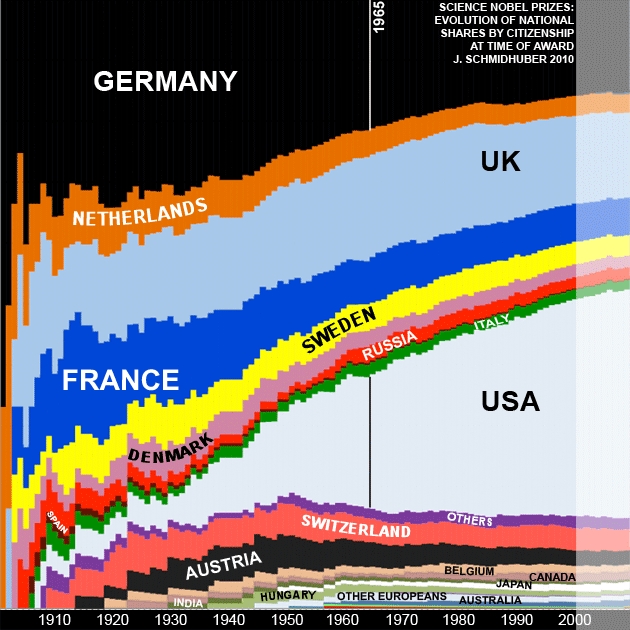
2010-10-12-NobelPrizedistributionovertime.JPG

Graph courtesy of Jürgen Schmidhuber (2010): Evolution of National Nobel Prize Shares in the 20th Century http://www.idsia.ch/~juergen/nobelshare.html

No one born in the mainland China has won the Chemistry or Physiology/Medicine until this year, and all four of the mainland China-born winners of the Physics prize (Charles K. Kao, Daniel C. Tsui, Chen Ning Yang and Tsung-Dao Lee) received their graduate training and did their prize-winning research outside of China (three in the US, one in the UK). The one Taiwan-born Chemistry Prize winner, Yuan Tseh Lee, did his graduate work in the US and has remained here for his prize-winning research. The US has historically benefited from top foreign talent being drawn to our strong academic programs, with many of these foreign-born scientists staying after they graduate. Continuous investment in our undergraduate schools, graduate schools and research institutions will help keep this pattern vibrant, though an increasing number of foreign-born scientists perceive that the career opportunities outside the US are starting to outshine those inside the US.

So when will we see a Nobel Prize winner in science who was trained in China and did their prize-winning research in China? Not for a long time. Although the Chinese government has been investing in its science technology as well as luring established scientists of Chinese descent back to the mainland, it will take years to build a strong infrastructure for cutting-edge research. Additionally, Chinese academia will need to modify their teaching styles to emphasize more creative problem solving, rather than the traditional approach that values wrought memorization. Delays will also be due to the typically decades-long lag between when research occurs and when an award is granted (though this year's Physics prize was an exception). This lag, which allows for validation of the scientific merit and importance, means that great scientific discoveries that occur now will most likely not be awarded until 10, 20 or even 40 years in the future. Lastly, the glaring political influences that have marred some of the recent Peace Prize awards and the early Eurocentricity of many of the awards will need to be avoided so that greatness is recognized fairly, regardless of national origin.


Follow Howard Steven Friedman on Twitter: www.twitter.com/howardsfriedman


  • Comments
  • 45
  • Pending Comments
  • 0
  • View FAQ
Comments are closed for this entry
View All
Favorites
Recency  | 
Popularity
12:05 AM on 10/17/2010
They just haven't stolen enough basic research from the West yet to come up with their own discoveries. Give them time, they'll get there.
06:16 PM on 10/14/2010
"No one born in the PRC has won the Chemistry or Physiology/Medicine yet."

This statement reflects negligence of the author. One of the Chemistry Nobel prize winners (Ei-ichi Negishi) this year was born in Changchun, China. He is an ethnic Japanese. Will Chinese in China get Nobel prize in the near future? Probably not. But I am sure that somebody from China will get a Nobel prize in science in 30 years. From time to time, I have been noticing some good work from China. I have trained many Chinese post-doctoral fellows and graduate students in the last 15 years. They are generally quite bright and motivated. In terms of work ethics and creativity, I probably rate them higher than many American trainees. Some of them returned to China to conduct independent research. Quite a few are very productive. In recent years, some of the well established scientists from the US including several of my colleagues, were also lured back to China. The facility and other instrument hardwares for research in China are just as good if not better than those we used here. If China keep throwing money at science, I will not be surprised that they will catch up on us in 2-3 decades.
05:17 PM on 10/16/2010
Re: "This statement reflects negligence of the author."

Naturally. The author is interested in making a political point and to once more bang the 'They do rote learning, we do creativity' drum.

Regardless of disguise, it's still a shot in the culture wars.
11:48 PM on 10/16/2010
@joshreiss Appreciate the attention to detail - the article was written a week before the 2010 award announcements and only posted Oct 12th. Since PRC was formed in 1949, technically Ei-ichi Negishi was born in Manchukuo (Japanese controlled territory) not PRC. In order to avoid anyone getting tripped up over these details, I corrected the sentence to now say "No one born in the mainland China has won the Chemistry or Physiology/Medicine until this year". Agree that we will likely see more Chinese winning science awards over time as top scientists are drawn back to China by generous grants and excellent equipment Per your suggestion, within 30 years (or even 20 years) seems like a good bet given the lag between top research being performed and awards being given out.

@mamababa Based on your comment, I suspect you didn't actually read my article.

The key points included:
- It took decades for Americans to dominate the science Nobel Prizes
- Winning a Nobel Prize in science reflects a combination of strategy, intelligence, luck, perseverance, training opportunity, research opportunity, funding availability, as well as politics, both academic and national.
- It takes years for any country to build a strong infrastructure for innovative research and China is doing that now
- The education system needs to encourage creative thinking in order to do ground-breaking science.
- Time (usually decades) has to pass in order for great science to get recognized
- Political influences have to be minimized so great science is
This user has chosen to opt out of the Badges program
photo
WYHKTai-Tai
Wyoming, Hong Kong, Tai-Tai
05:15 AM on 10/17/2010
Thank You for your reply, even though it is not showing here, or even in your comments page.

I've been here for 11 years, I think the kool-aid has probably worn off. One of the great benefits of life as an expat is that one can finally see the forest for the trees; in both countries.

I don't know why your such a fan of rote-memorization learning, (Also the basis for British and European academics, BTW), but IMHO, it has a place in education, but process-oriented, working through strategies also has a place. The system here in HK solely emphasizes rote memorization. The culture also DOES emphasize conformity. There are good things about that, but creativity is not one of them. Sorry if you don't like that fact.

One of the other great benefits of leaving the US is that one can have open dialogue about cultural differences & similarities, that are not value-added or attacks. Over here, we're not in any "Culture War" (I have to admit, I formed these opinions largely with the influence of local & Mainland friends). The reality is that some things one country does better, other things another country does better. EVERY system, (here we're talking about cultural systems) have strengths and weaknesses.

I suggest you do a bit of traveling yourself. The old saying is true, It IS the best education.
photo
HUFFPOST SUPER USER
DAE
02:46 PM on 10/14/2010
If you read scientific journals you will see that many articles in Biology, Physics, Chemistry and Astronomy bear a predominance of Chinese names in Pinyin romanization indicating that they are from the PRC. There are literally thousands upon thousands of Chinese studying, researching and teaching abroad and the vast majority maintain strong ties to their homeland. China is and will be a leader in engineering and science for decades to come. I'm afraid the U.S. will soon lag far behind if the like of Palin et al. gain any moreinfluence
12:07 AM on 10/17/2010
So if they are studying abroad, then their discoveries are not really the product of China, but rather, the product of the country they are studying in.

When people start moving to China to study, then they can start squawking about not getting Nobel prizes.
04:08 AM on 10/14/2010
Not directly related to the article per se, but to be honest, there's quite a lot of concepts which are pretty hard to "take the first step" without some emphasis on memory regarding teaching. If that makes sense. With the quality of US education, often it depends on the school and specific area. The quality to be honest is not evenly distributed, and I've seen enough examples personally where people can't group all American schools together or focus on the successful ones as representing it all. However, I think another asset besides encouraging creativity (which depends on the school) are the many opportunities for students to explore, fail and get back up again. I think many countries, not just China, would like to have that type of environment. Scientific research in general involves a lot of people. I think for every individual awarded, there's at least 3 or 4 others possibly a dozen people out there that should get as much as the Nobel recipient for that specific accomplishment. The word innovation doesn't necessarily applied in science, but I understand why people like to use that as a form of description. There's a lot more I can say but I'm afraid it's too irrelevant to this article.
02:03 PM on 10/13/2010
Microsoft clearly teaches the world that it is not necessary (or often time not the best strategy) to be the first mover.

Actually putting it to work, to commercialize, is where the rubber meets the road, as the saying goes. Nobel prices are pats on the backs. The real test is how profitable those technologies can be put to use. R&D in China continues to cost 1/4th to 1/5th that in the West. The trend remains.
03:26 PM on 10/13/2010
Being a fast follower can be a great business strategy if done well and often is better than being on the leading/bleeding edge (hence a lot of companies including Microsoft follow that plan) but science and technology would not move forward if every researchers goal was to follow their competitor's innovations. Some Nobel Prizes are given for technology innovations but the majority are for basic scientific research, where the application isn't readily apparent but all of humanity benefits. Long term, some basic science discoveries have far more applications than many technology leaps (i.e, discovery of electromagnetic radiation, quantum mechanics development) but many don't never have a clear use.
05:31 PM on 10/13/2010
True. But the point is, at China's current stage of development, basic research is less urgent than usable or profitable research - work that can be converted into job creation and industry.

$4,000 per capita is very low compared to that in the developed nations.
10:02 AM on 10/13/2010
A potentially provocative title for a reasonably sound article. I have to confess I came here to see if this would be another "we are better than them" article.

It makes good points. There's a widely used Japanese axiom which is often applied to all of East Asia: the nail that sticks out gets hammered down.

But if one looks at scientific and technological advancements in the world in relation to world politics, government's with military and global political ambitions find ways to foster scientific and technological advancements. Germany was the most advanced country in Europe for much of the first half of the 20th century leading up to WWII. Britain was not far behind. America is now the leading, most powerful, and arguably a global empire today. Those closest to America, such as France, Germany, Britain, have found ways to satisfy the American demands for innovation through discoveries. And the most funds for discoveries come from government funds, in particular military funds.

One could argue that China has made innovations, but in specializing that that it acquires from foreign countries to satisfy China's demands- not cutting edge, but to distinctly satisfy China's needs .
This user has chosen to opt out of the Badges program
photo
03:16 AM on 10/13/2010
"Chinese academia will need to modify their teaching styles to emphasize more creative problem solving, rather than the traditional approach that values wrought memorization."

This is mostly the case. I have a close friend who is a research scientist at a university, and spends a lot of time working with candidates. Many from China, capable, but often afraid to 'think outside the box' or take initiative, and its a major problem for many. This may have some roots in the confucius culture.
That being said, the chinese philosophy is also rather pragmatic when something becomes a glaring issue (success is the most important thing), so over time I think it will modify.
08:23 AM on 10/13/2010
You make a great point about the pragmatism of the style of instruction. As someone who teaches, I understand why instructors would prefer a style that emphasizes memorization. It is easier to plan lessons and at assess performance. If I were trying to plan a school curriculm for thousands or millions of students, it would be orders of magnitude easier to have material that a student needs to "know" rather than skills the student needs to acquire.

I do my best to have my classes be active dialogs with everyone contributing but it isn't easy and it doesn't always work. Usually I will have most of my students actively thinking about the material and discussing the implications while there will always be a non-trivial amount of students who are "waiting for the test questions" and are immune to my efforts. I hope as I do more teaching and become better at my craft, that the percent of students who are "waiting for the test questions" will decline.
This user has chosen to opt out of the Badges program
photo
WYHKTai-Tai
Wyoming, Hong Kong, Tai-Tai
12:05 AM on 10/13/2010
IMHO, It is not only the Chinese academia that will have to modify their teaching styles. The rote learning you spoke of is deeply deeply entrenched in the culture at every level of child-rearing. This is one area tha I as a mom raising 2 western kids in Hong Kong can tell you with some authority. From birth, Chinese moms I know would put their kids on a schedule, from EVERY age and every level they are taught not to color outside of the lines. There is no free play time for kids of any age. The differences in our western expat-brats and theirs is seen every time we go out in public, local kids will be completely obedient, still and non-active, while ours are always touching things they shouldn't walking off, and talking when they shouldn't....
I guess it makes child-rearing easier, but the real downside to this is that their childrens' abililty to 'think outside the box', their curiosity and creativity are pretty well extinguished. Exploration and creativity are like muscles, if not used, they atrophy.

Biggest complaint from Western senior managers is that they can't find local Jr. managers that can problem solve or be left to their own devices on anything.

I can't see Beijing even trying to change that as a conformist society is also soooo much easier to control.

IMHO, a very major factor, maybe the largest in this issue as well as China's prospect as 'world-leadership-future'.
photo
HUFFPOST SUPER USER
GPTP
12:22 AM on 10/13/2010
Thank you for your analysis. We will take note.
01:59 PM on 10/13/2010
I doubt if "world-leadership-future" is in the forefront of the Chicom leaders' checklist. China has a GDP of $4,000 or so per capita. Still catchup time. The ruling elites clearly (and wisely) decided that the best bang for the buck comes from the last leg - in applications and system integration.

There is no Nobel for that.

And yet look at the enablement coming out of these achievements that are continuing - entire industries spring up, employing tens of millions and lifting many from poverty. All exportable tech.

- Fastest supercomputers (technology is known by several of the top countries) to be briefly inaugerated this year (but very soon to be overtaken by IBM again). Price performance at least 10% higher than the next competitor, with the goal of reaching at least a 40% disparity to No. 2 in another decade. Generic architecture assures flexibility with CPU choice.

- Largest network of the highest speed rails, with the most complete vertical integration (from soup to nuts) of any nation.

- Nuclear power plant construction cost latest at $1,227/kwe, with the mythical $1/we projected in 5 years.

- Other more mundane things such as slashing silicon solar PV panel costs from $7 to $1.50/wp in a short 5 years. Wind turbines, of course.

Nobel does not have a "lifting the largest number of people out of poverty" prize either. But does or should China care?
This user has chosen to opt out of the Badges program
photo
WYHKTai-Tai
Wyoming, Hong Kong, Tai-Tai
07:46 PM on 10/13/2010
Very true. Very good points. There is always a plus and a minus to any system. Modifications/improvements and efficiency definitely seem to be the forte.

I think China would be quite happy, bursting their buttons with pride for one of their scientist or engineers to recieve such a prestigious award, but no, they're not focusing on that at the moment.
The American education system, well it used to be anyway, before the 'teaching-to-the-test' meme took over, was for process oriented, individual thinking and creative problem solving. That also has it's pluses and minuses.

IMHO, a middle ground, in this and a lot of other aspects of our 2 cultures would be the best of both worlds.

Thanks for your reply.
11:28 PM on 10/12/2010
All great points. I would add that many anti-china folks would see giving a Nobel to someone in prc as some kind of tacit approval of the Chinese government. The politically correct Norwegians would not risk that perception.
04:35 AM on 10/13/2010
The Swedish Nobel committee is responsible for all the other Nobel Prizes. The Norwegian Nobel committee is only responsible for the Nobel Peace Prize.
08:17 AM on 10/13/2010
I think that the Science Committees are reasonably politically independent these days - if a truly prize-worthy piece of research came from PRC then I think they would likely award it. During the peak of the cold war, they were still awarding prizes to scientists on both sides of the Iron Curtain. Where I think the politics have been overwhelming were in the early years of the science awards and most recently in the peace prizes (correctly pointed out that those are from the Norwegians, not the Swedes). Many feel that the prizes given to Gore and Obama were little more than a way for the committee to take a swipe at the Bush era.
12:16 AM on 10/17/2010
And I wouldn't blame them. The Chinese government is a brutal dictatorship (by the Communist Party).

Just think of how great they could be if they didn't have to worry about being carted off to a re-education camp for voicing their opinions.
06:26 PM on 10/12/2010
Yeah. It is true.

Happy now?
12:32 PM on 10/13/2010
Based on your comment, I suspect you read the headline and didn't actually read the article.

The key points included:
- It took decades for Americans to dominate the science Nobel Prizes
- Winning a Nobel Prize in science reflects a combination of strategy, intelligence, luck, perseverance, training opportunity, research opportunity, funding availability, as well as politics, both academic and national.
- It will take years for any country to build a strong infrastructure for innovative research.
- The education system needs to encourage creative thinking in order to do ground-breaking science
- Time has to pass in order for great science to get recognized
- Political influences have to be minimized so great science is rewarded, regardless of nationality