Before diving into any detailed analysis of government data, I usually hear the voice of one of my professors telling his favorite statistics joke. It went something like this, "Statisticians are brilliant people. They can analyze raw data, develop complex models, draw causal inferences and make bold projections of the future. They do this fearlessly, without concern for the minor issue that the data itself came from the fellow down the hall who wrote down whatever he felt like so he could get paid." Analyzing government data isn't quite as bad as that joke, but statisticians do need to be concerned about the danger of "garbage in garbage-out" in any work that do.
So how do these concerns about data quality relate to identifying the world's deadliest wealthy countries? It starts with the fact that the data for crime is notoriously fraught with quality issues. Criminologists use the phrase the "dark figure of crime" to describe the amount of crime that goes unreported or undetected. This "dark figure of crime" represents the gap between the true crime rate and the rate found in official reports.
Knowing that the "dark figure of crime" is so large, I decided to focus on homicide rates in this article. Why homicide? For starters, it is a critically important measure of crime since it is perhaps the most extreme of possible crimes, the taking of a life. More importantly, it is considered to be one of the more reliable crime statistics.
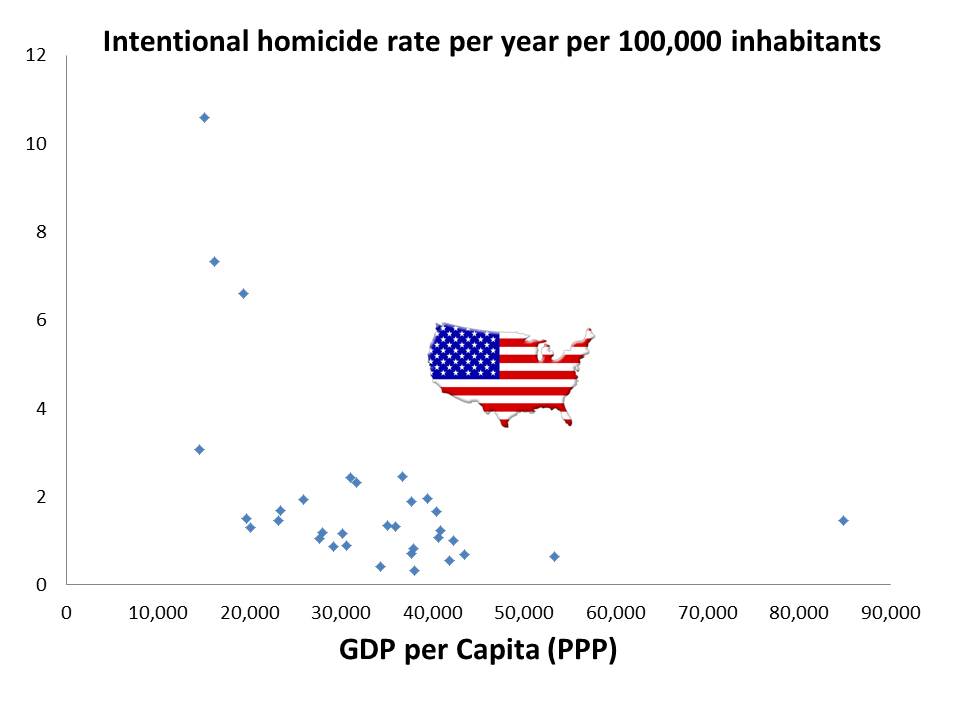
So which wealthy countries have the highest homicide rates? Of the 34 countries in the Organisation for Economic Co-operation and Development (OECD), the countries with the five highest homicide rates are, in order: Mexico (highest), Chile, Estonia, the United States and Turkey (fifth highest). Anyone looking at that list would likely call out the fact that these countries, while all being in the OECD, are not equally wealthy. In fact, the United States has a GDP per capita that is more than twice that of any of the other top four most deadly OECD countries. A simple scatterplot, where each data point represents a different country and the US is displayed prominently, gives a clearer picture of how America stands. The graph below shows that for the OECD countries, the US has one of the highest rates of GDP per capita (a rough, but commonly used metric of wealth). You will also quickly see that the US is a major outlier in the general observation that wealthier countries tend to have lower homicide rates.
In summary, America's homicide rates, incarceration rates and gun ownership rates are all much higher than other wealthy countries. While the data associated with crime is imperfect, these facts all point to the idea that America is more violent than many other wealthy countries.
These thoughts about crime were summarized by friend from Australian who remarked, "I don't know why you Americans are so violent, but don't blame it on the Brits since Australia, New Zealand and Canada sure don't have your issues."
Follow Howard Steven Friedman on Facebook
Follow Howard Steven Friedman on Twitter: www.twitter.com/howardsfriedman
The profeesor missed this fact?
Here is my exact quote from above "There are a multitude of explanations, from economic disparities, to inequalities in education and careers opportunities, to America's history of violence and racial issues. One important factor driving America's homicide rate is gun ownership since firearms are used in the majority of American homicides."
Plus, to prove a point all the facts must be connected , not just one. Or at least a large part of it. But I pointed out it is not. That is like saying a black man killed someone, therefor all blackmen are killers. That can't stand for a scientific truth or am I wrong?
The First step is to take advantage of high profile incidents.
The Second step is to marginalize legal gun use and historic precedent.
The Third step is to make some guns seem more dangerous than others, even if they are not.
The Fourth step is to register every sale.
The Fifth step is a robust “Shall Issue” permitting process.
The Final step is to encourage and incentivize the forfeiture of arms.
The recent drop in U.S. homicide rates is similarly mysterious, although police departments everywhere immediately take credit for it. Many tout recent developments in forensic science, despite the fact that police rates of solving homicides are much lower than they were before recent scientific developments.
Malcolm
One can either, as is the case with most other "democratic" countries limit people's freedoms by imposing a constitution or rule of law in which the citizen must look to see if the government has granted him permission to do something or continue with our government of enumerated powers in which a person has the right to do anything unless and until the act has been duly proscribed by law.
As Lincoln said, our nation was "conceived in liberty".
The unspoken import of the article suggests a disaffection with the basic premise of this country.
But who is "we"? The US certainly does have emigration restrictions. I know an MIT professor whose family can't get green cards here, which is completely absurd. Many other countries are unfriendly to US citizens also. At very least, you are required to provide reasonably detailed explanations as to the purpose and plans of your trip upon exiting through customs into many countries around the world. And while it is pretty easy to get into Mexico or Canada, it is not so easy to find safe housing once you are there unless you have a job lined up. That's assuming you have enough money to cross enough of this country to get out of it, which (frankly) probably is a reasonable barrier to most of the people who are most affected by the results of the incredible economic disparity we have in this country. Of course, I think more and more young people are going to realize that opportunity is looking elsewhere first, and in the next few generations the "white flight" phenomenon will not mean suburbia, but Australia, Canada, New Zealand and India.
I wonder why that is....
I also wonder why he does not talk about suicide rates?
For example, in the US, death is seen as an absolute and for some, with only two paths: heaven or hell. Suicide is heavily associated with mental health issues (depression, for instance).
In some other countries, death isn't seen as an absolute. If this life isn't satisfactory, then it's better to end it now to enter the afterlife and after a period of time, you're born into a new life.
Some other countries, it's similar but the focus is more on self. If you take your life, you'll be given "demerits" that will affect your next life (not exactly like karma but similar). So people who feel extremely guilty over some things they did will choose to punish themselves (or leave it to the afterlife to determine their punishment as it sees fit) by taking their lives. Suicide may be associated with mental health issues, but I think for some it's about seeking redemption through (extreme) spiritual means.
And of course, there are people who choose suicide as an act of self-sacrifice for whatever or whomever they think is worth dying for. Or as a political act to protest. In this case, suicide is associated with values, beliefs or politics.
With all this in mind, some countries' suicide rates will probably always be higher than other countries. It's, unsurprisingly, notoriously difficult for many to conduct good international statistical and comparative studies on suicide.
Another thought didn't Germany before the rise of Nazism have very tough gun control laws?
Seems our founding fathers had Nazi Germany in mind when they crafted the 2nd Amendment. Now look next door to Germany in Switzerland. Almost compulsorily gun ownership requirements.
I just wonder how successful the Nazis would have been in rounding up their Jewish minority if each household had an automatic weapon?
I was reading that if our gun homicide rate was to continue for 200 years it would not equal the numbers of Jews killed by the Nazis.
No - after careful consideration I believe despite some misgivings that the founding fathers were correct concerning the 2nd Amendment.
No - I don't own a gun but I will be sure to get one to defend my neighbors right to own one!
That's why we had the Bill of Rights.
Without these protections of a Bill of Rights it's not a question of if but when "tyranny of the majority" takes place.
-------------------------------
That should be easy to prove or disprove - using many cities, not just one or two.
WONDER IF THERE IS ANY DATA?