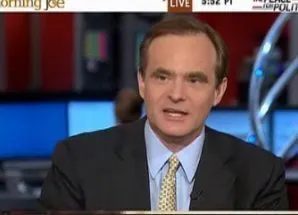
The nation's largest banks still pose a dire threat to the economy, according to MIT professor Simon Johnson, who appeared on MSNBC's "Morning Joe" on Tuesday.
Johnson, the co-author of the forthcoming "13 Bankers: The Wall Street Takeover And The Next Financial Meltdown," former IMF chief economist and HuffPost contributing editor, said that, even more than a year after the financial crisis, the banking sector is undiminished.
Here's Johnson:
"We don't need these particular banks and we definitely don't need these bankers. Remember they managed their way into an enormous crisis that cost us trillions of dollars. And yet we kept every one of them in their jobs, we kept their board of directors, and they got to keep heir bonuses, their pensions, their empires. In fact, they're bigger now than they were before and they're more powerful now than they were before the crisis."
When the discussion touched on Sen. Chris Dodd's (D-Conn.) latest financial reform bill, one MSNBC anchor jokingly asked, "We're going to have reform, right? And it's all going to be OK? There will not be another meltdown right?
"No, unfortunately," Johnson said. "I wish that were true."
The next crisis will come sooner rather than later, Johnson said, unless the nation's largest banks are broken up and some sort of Glass-Steagall-type approach is taken to separate commercial banks from investment banks.
"The absolutely necessary step is to make the banks smaller, Johnson said. "Too big to fail is exactly the right term, "
WATCH:
Visit msnbc.com for breaking news, world news, and news about the economy
So there it is! Too big to fail to manipulate every aspect of our lives.
Americans have been had over and over. And, as time goes on, the corporations will work to wring more profits out of every situation, but the people won't have the money to spend.
Glass-Steagall needed to be reinstituted at the top of this string of failures, but is still no where in sight. Go back to first sentence.
:-)
End the FED
Independent Banking without the Central Cartel of the Banksters.
We either do it now or we will be owned by these greedy thieves.
North Dakota broke new ground nearly a century ago, but the true potential of publicly-owned banks remains to be explored. Nearly all of our money today is created by banks when they extend loans. (See the Chicago Federal Reserve’s “Modern Money Mechanics”, which begins, “The actual process of money creation takes place primarily in banks.”) We the people have given away our sovereign money-creating power to private, for-profit lending institutions, which have used it to siphon wealth from the productive economy.
Money today is just a ticket, a receipt for work performed and goods delivered. We can fund the work we need done by creating our own credit. The real promise of publicly-owned banks is not that they can bail out subprime borrowers but that they can jumpstart the economy by creating real wealth. They can provide the liquidity to put labor and materials together, allowing the economy to build and grow. Our private, profit-driven banking sector has been bleeding wealth from the rest of the economy. Public-interest banks can transfuse the economy with the credit it needs to flourish and be productive once again.
For more updates on the movement for publicly-owned banks, see http://www.public-banking.com.
To sign a petition for a citizen-owned bank in California, go to http://www.change.org/actions/view/help_the_terminator_save_california.
http://www.webofdebt.com/articles/growing_movement.php
Regardless, another crash is likely coming. Assets have not been marked to market, so balance sheets are not worth the electronic paper they're written on. With derivatives liabilities not clearly probable or reasonably estimable, the newest bubble will quickly and catastrophically burst.
Obama is insideously crafty. He backs Volker knowing that what will end up crossing his desk will get so watered down that it protects nothing. When the crash happens, he can then say that he proposed more stringent regulation, but had to work with Congress. It's all BS!
OK, that last WAS cynical.
Obama never intended to side with Volker and break up the "too big to fail". Obama picked Summers to cozy up to and left Volker out in the rain.
Some politicians are not good communicators and therefore not particularly believable. So it is easy to dislike a leader that can't convey an honest statement without eyes darting all over the place. Few politicians are really slick and can talk a person out of their pants. Bill Clinton comes to mind. You know, slick Willy.
The president we have now is a master deflector. It is always the fault of the other guy when something turns sour.
It's coming.....wait for it
People are silently changing the way they do business. Selling locally, bartering, buying locally. Move your money out of the big banks if you can. It's all coming down a few bricks at a time. Ah, change is in the air...
I whole heartedly concur with the above statement.