
iPhone app iPad app Android phone app Android tablet app More

Featuring fresh takes and real-time analysis from HuffPost's signature lineup of contributors
Ian Fletcher

GET UPDATES FROM Ian Fletcher
 

The American Manufacturing Crisis and Why it Matters

Posted: 05/26/11 08:32 AM ET

Despite the denial chorus of the same politicians, financiers, and economists who told us prior to 2008 that our financial sector was fine, the American public is increasingly aware of the truth: American manufacturing is in a state of deep crisis. (And ,as I argued in a previous article, the recent small uptick in this sector doesn't change that fact.)

Let's start with manufacturing employment. Below is a chart giving the grim story of job losses in this sector. (Source.)

2011-05-26-mfg_employ.gif

This degree of manufacturing job loss is not inevitable or normal. The U.S. actually enjoyed relatively stable employment levels in manufacturing as recently as the year 2000. Then, thanks to our burgeoning trade deficit, things fell off a cliff.

Neither is there anything inevitable about our poor export performance--which is, by definition, half the cause of that deficit. Over the decade after 2000, America's share of world exports dropped from 17 to 11 percent. But the share of the European Union, home of trade-savvy export superstars like Germany, held steady at 17 percent, despite the relentlessly expanding share of China and the rest of the industrializing Third World. (Source.)

Our trade deficit is going to be balanced, the hard way or the easy way, eventually. And it will be essentially impossible for the U.S. to balance its trade without healthy manufacturing exports. Unless, of course, we are willing to radically curtail our imports, which means either:

a) A reduced living standard, or:

b) We start producing the formerly imported goods for ourselves. This, of course, itself requires a strong manufacturing sector, so we're back where we started.

So there's no way to avoid manufacturing.

People sometimes imagine that the U.S. can balance its trade by exporting more services or agricultural goods. Unfortunately, the numbers just don't add up.

For example, in 2010, we ran a deficit in goods of $646 billion, while our surplus in services was only $149 billion. (Source.) Even worse, thanks to the offshoring of services, our surplus in services is shrinking, not expanding.

As for agriculture, forget it. Our surplus in agriculture is less than a tenth the size of our overall deficit.

It is crucial to understand that manufacturing is not the "past" of our economy. It is, in fact, a big part of our future (albeit an endangered part).

For example, it is no secret that the U.S. will need to transition, over the next few decades, to green energy technologies--whatever form they ultimately take. And these technologies, be they solar cells, windmills, electric cars, fusion reactors or dilithium crystals, are emphatically not virtual. One cannot download them.

They are good old -fashioned things. And there's nothing low-tech about an electric car.

Unfortunately, the U.S. is losing its position in green-energy manufacturing, as shown by the fact that we now run a multi-billion dollar deficit in these goods.

One fact that belies the idea that manufacturing belongs to the past is that manufacturing is the origin of 70 percent of U.S. research and development. (According to one recent study, 22 percent of manufacturing firms engage in some kind of innovation, compared to only 8 percent of other companies.) So despite the myth that innovation is a post-industrial activity, losing our manufacturing means losing a lot of our future opportunities to innovate.

Can service industries fill the gap? No. Among other things, even healthy service companies frequently depend upon manufacturing. For example, many companies sell design, customization, operation, optimization, training and maintenance for the products they make. But the skills needed to provide these services often only accrue to those who are intimately involved with building the product in the first place.

Manufacturing tends to draw these other activities along with it. In the words of economist Gregory Tassey of the National Institute for Standards and Technologies--which is, by the way, just about the only serious national civilian industrial-policy agency left in this country:

When technological advances take place in the foreign industry, manufacturing is frequently located in that country to be near the source of the R&D. The issue of co-location of R&D and manufacturing is especially important because it means the value-added from both R&D and manufacturing will accrue to the innovating economy, at least when the technology is in its formative stages. Thus, an economy that initially controls both R&D and manufacturing can lose the value-added first from manufacturing and then R&D in the current technology life cycle--and then first R&D followed by manufacturing in the subsequent technology life cycle.

It is no accident that 90 percent of electronics research and development now takes place in Asia, hardly boding well for America's future in an industry we dominated as recently as the early 1970s.

This won't just hurt blue-collar workers. Despite the unfortunate image of manufacturers employing lunch-bucket labor, in reality, 51 percent of their current workforce consists of skilled production workers, 46 percent of scientists and engineers, and only 7 percent is unskilled production workers. (Source.) So losing manufacturing industry means losing not just assembly-line jobs, but many white-collar jobs, too.

It's not just electronics that's decaying. Other high-tech industries are, with a few exceptions, in no better shape, as shown in the chart below. (Source.)
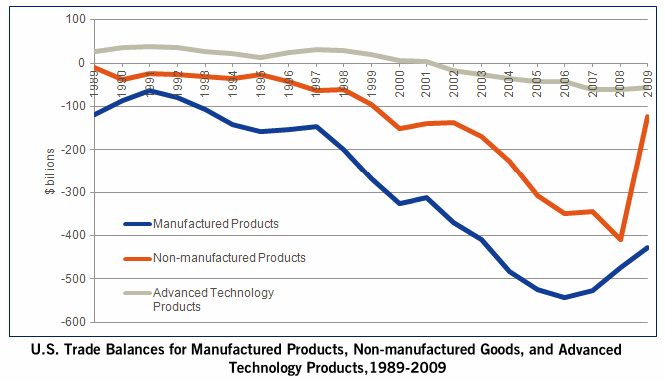
2011-05-26-mfg_trade.gif

What categories of manufactured goods does the U.S. still have a strong position, signaled by a trade surplus, in? Only aircraft, aircraft parts, weapons, and specialized machine tools (mainly machine tools for making the former). These areas are the last redoubt of American industry largely because they have been the beneficiaries of just about the only institution in the U.S. which still does serious industrial policy and blocks inappropriate trading relationships: the U.S. military.

This may be a clue to what America needs: an appropriate dose of protectionism, plus some serious government-led industrial policy to stoke the fires of industry bright again.


Follow Ian Fletcher on Twitter: www.twitter.com/IanFletcher


  • Comments
  • 133
  • Pending Comments
  • 0
  • View FAQ
Comments are closed for this entry
View All
Favorites
Recency  | 
Popularity
Page: 1 2 3 4  Next ›  Last »  (4 total)
photo
HUFFPOST SUPER USER
Fred Scarran
11:56 AM on 05/27/2011
"Unfortunately, the U.S. is losing its position in green-energy manufacturing, as shown by the fact that we now run a multi-billion dollar deficit in these goods."

_____________

Your green'ism is an invitation for the some to say, "Well let's just subsidize this green stuff (crap)" instead of saying, "Flat Tariff on China."
09:01 AM on 05/27/2011
aircraft and weapons -----now that is a sad state of affairs -----especially when the weapons part is not a wealth creator
07:46 AM on 05/27/2011
No energy policy in over 30 years, the majority party in the house of representatives does not believe in global warming, the most costly and inefficient health care system in the western world, too big to fail banking system now worst than ever, almost half the country believes Jesus will return in their lifetime and are obsessed more about abortion than job creation, a bloated military empire that will continue to grow even after the debt debate is over and programs for the poor and the middle class have been slashed, an effective corporate tax rate of 13 percent, practically no investment in alternative energy and infrastructure going forward, a president that hires the biggest outsourcing CEO in America as his new advisor on job creation. I think we are going in the wrong direction.
photo
HUFFPOST SUPER USER
Fred Scarran
11:58 AM on 05/27/2011
I rest my case. Your Green comments only attracts the radical leftist fruitloops who add nothing constructive.
annyp
A Canuck, eh!
03:49 AM on 05/27/2011
I am a Canadian and I try to buy Canadian and USA made products. Yes, they are a bit more expensive but also a better quality. I boycott as much as I can products from China
09:25 PM on 05/26/2011
Take a look around.
Look at ordinary working Americans.
For too many of us, our standard of living is already going downhill.
HUFFPOST SUPER USER
rtx47
09:56 PM on 05/26/2011
With 50% divorce rate, it takes twice the income to support the same "family"- TWO homes, mortgages, insurances, jobs, etc; not to mention stress and strain on children and adults.

For a time this increased 'demand' of more resources creates an artificial boom till it crashes.
HUFFPOST SUPER USER
rtx47
08:05 PM on 05/26/2011
Even with America's manufacturing base replaced by robots on the assembly line and other jobs shipped overseas; we would not be in such a bad unemployment shape if the service and other sectors like finance, education, health-care etc, (which we should be good at), worked well.

But:
We ourselves criminally manipulated the banking system.
We ourselves manipulated Wall Street with Hedge Funds, Insider trading and lax enforcement.
We speculated on the market; creating bubbles, for last 2 decades.
We ourselves manipulated home-building and related industries causing the boom and bust.

And:
We ourselves are mismanaging our school and college education system.
We are mismanaging health-care delivery, which could be an international industry.
We are mismanaging energy management which could be an international industry.
We are mismanaging environmental pollution which could be an international industry.
We ourselves are mismanaging our and the world's monetary debt.
We ourselves are mismanaging world peace.

For some time we have been deluded by our slogans of exceptionalism; which is no longer be bought by ourselves or the rest of the world.
07:36 PM on 05/26/2011
Ian, As much as I agree with you on the importance of US production of goods, I would argue that we will have to accept a reduced standard of living in either case. If we produce the goods here the costs are higher and the result is that 100,000 people will pay more for their goods so that 1,000 US workers can get wages. 99,000 people are worse off and have a lower standard of living.

I don't think that you would argue that there are certain goods that can be produced in lower labor cost markets which would result in lower priced goods than can be made in the US at our manufacturing labor costs. That is the basic premise behind specialization and trade. For us to "reimport" that production, must by definition, cost the US in standard of living as the buyers provide the producers a wage higher than they need to.

Also, all those dollars that are recycled by the surplus nations into US Treasury obligations are a store of future inflation, which will decrease our standard of living.

Fundimentally, we are living at a level we cannot afford in the long run, regardless of where the goods are manufactured.
08:52 AM on 05/27/2011
Mr Maus
You explain the advantage of free trade very well. However the fact is that free trade players are not playing fair by hoarding US dollars in Treasuries instead of buying US products. Milton Friedman preached that free trade would mean that the dollars accumulated by unbalanced trade would return to the US when the holders of dollars bought US products and services. Instead they bought Treasuries so they could accumulate interest instead of US products and services to keep the trade balances in their favor
.
So if free trad de is not fair, the partners do not use the dollars to buy US products and services, the free trade system is a detriiment to the economy of the unbalanced trade partner instead of an asset.

Let all the foreign holders start buying US products and services. or build plants in the USA with their dollars ..and the unemployment proplems in the USA will end.

If inflation results in the US, it also affects the foreign holders of the hoarded dollars.. So they should all get together and start slowly investing the dollars back in the US and "PLAY FAIR" or they will lose out too same as the US has lost out by allowing free trade to decimate manufacturing jobs and technology in the US at the expense of US workers..
12:10 PM on 05/27/2011
One cannot "hoard" dollars, they do not end up in mattresses in China. By purchasing US Treasury securities they are reducing our inflation rate for the time being (if you assume that government spending would be unchanged). Once they choose not to buy treasuries they will have the choice to buy US manufactured goods and services or dollar denominated assets. If they choose the later, it will cause inflation, if they choose the former then you will se production of goods and services increase.

The other choice would be to sell dollars and repatriate the currency back into their local currency, which would increase the cost of all the goods coming into the US from that local (again inflation).

The end result of almost all scenarios is that we are enjoying a standard of living that is too high.
HUFFPOST SUPER USER
Tim Hogan
husband, father of two, Catholic, trial lawyer
06:40 PM on 05/26/2011
The US must study consumer protection, environmental and safety related non-tariff trade barriers to export of US products. US autos could not be sold in Japan due to more strict pollution control standards and lack of break away side view mirrors. US car makers adapted and upgraded vehicles resulting in better pollution controls and safety for US auto fleets at home as well as abroad.

A comprehensive study of similar non-tariff trade barriers combined with US loan guarantees to manufacturers would comply with US international trade agreements and make our goods more exportable, more safe and green. Part of the guarantee programs would have that innovations supported by the government must be shared among rival manufacturers at a reasonable cost of licensing such innovation.

The creation of a single payer health system in the US would make exports cheaper. Estimates show healthcare costs add some $1,500.00 to the cost of an auto in the US. Americans can all have healthcare. The cost of manufactured goods for sale goes down large percentages, making our US goods cheaper here and abroad. Similar savings could be realized across the manufacturing sector. The US is the only major industrial nation which doesn't have such a healthcare system and unnecessarily imposes these costs upon its manufacturing sector.

Innovation in supports for research and development and cutting the underlying cost of goods could make US manufacturing more competitive. We only need the political will to do what will work.
photo
HUFFPOST SUPER USER
Fred Scarran
12:02 PM on 05/27/2011
Your generic talking points would accomplish nothing, are you running for Congress or something? OMG I think these people actually believe in the talking points politicians make. This is sad.
05:31 PM on 05/26/2011
By the way, Detroit survived for so long before the crisis in large part because light trucks (read SUVs) are subject to a 25% tariff, while the tariff on cars is 2.5%.
05:18 PM on 05/26/2011
Great article Ian. I particularly like the point about our few remaining examples of successful high tech manufacturing industries being tightly controlled by military industrial policy. This is something I've pointed to numerous times in my comments. There's no excuse for not producing many of the high tech products we currently import; buyers will pay for these products regardless of a 5-20% increase in price because the real value is in the intellectual property, which can not easily be duplicated unless you hand it over to your competitors like many unrestricted industries have done recently.

A strong industrial policy should be the core of rebuilding America. A healthy manufacturing industry would generate greater tax revenue and increase employment thereby reducing social costs cutting deficit spending in a much more beneficial way than slash and burn cutbacks. While health/social/tax/military reform are desperately needed to put us on a more sustainable future course we need a policy directed not only at cutting spending but also at generating new sources of revenue.
photo
Dredd
Our government is a wartocracy.
04:38 PM on 05/26/2011
Make more butter! Make more butter!

http://blogdredd.blogspot.com/2011/05/reds-want-butter-too.html
04:37 PM on 05/26/2011
Ian,

The only hope for your message to ever be heard is for you to run for office of the President in 2012.
You know the nitty grity details and have the ability to debate the problems of unbalanced trade to blow away any compromised politician on this subject.

Writing books helps, but US manufacturing workers need more than written words.

Announce your entry in the Presdential Race and watch how fast you will obtain both volunteer support, campaign donations, and media attention.

We all will help. Just put your pen away on this blog and use it to fill out the Presidential application forms. Get on the radio and TV commentary shows and watch how fast you get support.

Just do it.Trump brought up this issue and gained immediate support in the election poles. He could never win though because he has too much baggage.

The worse thing that could happen to you is you will sell more books and the best thing will be to get this hushed up Congresstional issue out in front of US voters. We are all sick and tired of being told the economy is doing great when millions of US workers are still unemployed and underemployed working two part time jobs to put food on their table and roofs over their heads.

There will never be a better time than now for you to run for election.
05:26 PM on 05/26/2011
Do it Ian. Run for president in 2012. Seventeen years after NATFA
09:10 AM on 05/27/2011
Lets think up a campaign slogan for Ian like:

"Free traded by my politician, now unemployed, broke, and forclosed."

or

"Nothing is free when you lose your job because of unfair free trade."
04:12 PM on 05/26/2011
Trade deficit is a red herring that doesn't mean anything. Does Lichtenstein worry about it?
photo
HUFFPOST SUPER USER
becky bradshaw
"In a time of universal deceit, telling the truth
05:20 PM on 05/26/2011
Each dollar lost in trade deficit results in about 84 cents of national debt (http://www.economyincrisis.org/content/trade-deficit’s-reverse-tariff-increased-us-national-debt-–-84-correlation-0). The U.S. had a trade deficit last year of about $1.5 trillion, which resulted in a national debt of about $1.2 trillion.

A review of the many crisis facing the country, including unemployment, government budget deficits, etc. have at their source, the trade deficit. It does matter.
07:25 PM on 05/26/2011
Which comes back to the point (kind of) made in the article. The only solution is to reduce our purchasing power (reduce our standard of living. Regardless of the solution (manufacture here at a higher cost or put a tariff on the imports) we still buy less than we bought before.

As for the national debt issue, it is irrelevent as long as the seller of goods is obligated to buy Treasury obligations with their surplus to negate the natural exchange rate impact of the surplus/deficit issue. As long as they do not let the surplus enter the US dollar market inflation is contained and we get to live a better life. It only becomes an issue when they want to use the dollars for something other than currency manipulation. Then we all get inflation, which hurts the person with a surplus.
05:31 PM on 05/26/2011
Free trade is a red herring.
There is no such thing as free trade. Trade can be (1) positive (2) negative (3) neutral. If trade becomes 'free' for one of the parties it becomes charity. You may have noticed that charity is not what the free traders have in mind.
04:03 PM on 05/26/2011
We have more clout than we acknowledge. We can "inform" our corporate "partners" that we want high quality manufactured in the USA goods at reasonable prices. In order to accomplish this we have to be willing to forsake the "bargain price" and encourage the manufacture and distribution of quality goods right here. Shoes, socks, clothing, hard goods, etc.
Linda from Deerfield
Paying attention
03:49 PM on 05/26/2011
It seems so obvious to those of us who come here to thank Mr. Fletcher for making these points so well, but apparently it is not obvious to many. Not only was the loss of manufacturing not inevitable, it was planned. I remember very well Reagan's announcement of the coming service economy, although his voice seemed to reveal a bit of surprise. Where is there someone brave enough to tell us why that was done to us, and whether it accomplished the intended result? Was the intention to bring us to our knees?

In spite of the factory worker approaching extinction nearly as complete as the farmer's, there still is tremendous disdain spouted by many for such people, even though it was hardly the mindless and lazy drudge often depicted that made us the most productive and often admired manufacturers of the world. The other disciplines described by Mr. Fletcher worked in concert with the producers and often achieved remarkable results. In fact, I rather think a lot of careers were made on the backs of those on the factory floor. No, I was never one of the latter, but I respected them.