
iPhone app iPad app Android phone app Android tablet app More

Featuring fresh takes and real-time analysis from HuffPost's signature lineup of contributors
Ian Fletcher

Ian Fletcher

GET UPDATES FROM Ian Fletcher
 

Why Innovation Requires (Shocker!) Big Government

Posted: 05/31/11 08:43 AM ET

Most people realize that the Federal budget deficit and the trade deficit are serious problems. Unfortunately, as I have argued previously, few people grasp the importance of another big deficit in our economy, without which it will be extremely hard to fix the first two: our innovation deficit.

Simply put: despite appearances to the contrary, our economy is not innovative enough. And it's costing us, big-time.

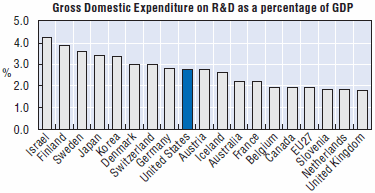
Despite our smug self-image as a global innovation leader, the U.S. actually only ranks in the middle of the pack for resources committed to innovation. See the chart below. (Source.)
2011-05-31-RnDbyGDP.gif

Of course, spending money on problems isn't everything. But it is also true that you generally get what you pay for. So unless our R&D is somehow more efficient dollar-for-dollar than that of other nations, we're not setting the pace here.

Our other big problem, of course, is that even when we do succeed in out-innovating other nations, we often can't hang onto the industries we create. In fact, we have a long record of originating technologies and then "losing our birthright" of commercial dominance in them. To give just a few examples:

• high-fidelity sound systems
• color television
• digital watches
• videocassette recorders
• semiconductor memories
• semiconductor production equipment
(like steppers, the machines that "print" computer chips onto silicon)
• flat panel displays
• robots
• lithium-ion batteries
• advanced ceramics
(turbine blades, not coffee mugs)

The weakness of our innovation performance is masked for the time being by the fact that innovations often have long lead times between the stages of the so-called "technology life cycle." That is, decades can pass between the beginning and the end of the following process:

1. The key underlying science is discovered or key technology invented.

2. The first (exotic and expensive) commercial applications appear.

3. The technology gradually achieves adoption in all uses where it is appropriate.

4. The know-how to build the technology diffuses so much that it becomes a low-cost commodity product that any reasonably competent nation can make.

As a result, a nation that was once on the forefront of innovation can still be harvesting technological positions it previously planted years later. We're coasting.

This coasting effect is enhanced by the presence of so-called "standards lock-in" protecting the oligopolies of companies like Microsoft and Intel. Microsoft's products are, as anyone who uses them knows, in many ways abysmal: its desktop operating system delivers a user experience that is no faster or more reliable than the one sold a dozen years ago. People keep using it because of their need to interface with the installed base of other Microsoft users. Intel is less of a technological laggard, but it still commands a fat market share, and premium prices, based on the difficulty of computer manufacturers adapting to the use of alternative chips.

Other lesser-known companies and industries enjoy similar effects. But these effects are a wasting asset which will not last forever. They are vulnerable to both gradual encroachment and to sudden technology shocks that render their existing products obsolete overnight.

Another factor masking America's innovation decline is the short-term gains from offshoring, which can make declining tech companies seem to boom as they ramp up profits by inexorably selling off their crown jewels. When a company offshores the least-productive, and least profitable, parts of its supply chain, both its productivity and profitability must, by definition, go up, in the short run. In the long run, however, this can lead to an insidious logic according to which, in the words of aerospace engineer Dr. L. J. Hart-Smith, who wrote a prescient critique of how Boeing was slowly outsourcing itself to death, the company decides "to outsource everything except a little Boeing decal to slap on the nose of the finished airplane."

So how can we restore America's innovation engine?

As I argued in a previous article, the key bottleneck in America's innovation system isn't, as many Republicans seem to think, that the government hamstrings would-be innovators with excess regulation or taxes their profits to death. Outside a few industries with big risks to the environment (nuclear energy) or public health (pharmaceuticals), the regulatory burden is, in fact, relatively light. Neither does our government impose confiscatory taxation on successful innovators.

Instead, the key bottleneck in our innovation supply chain is what we can call useful unpatentable ideas. (The more sophisticated term is "infratechnologies.") These are technological innovations which cannot themselves be commercialized. But innovations that can be commercialized and sold for profit cannot take place without them. As a result, the private sector tends to neglect them.

To take one example: nanotechnology is probably the first major technology since the steam engine in which the U.S. is not the dominant player, research in this area being divided roughly equally between the U.S., Europe, and the Far East. And commercial nanotech companies depend, according to Greg Tassey of the National Institute of Standards and Technologies, upon the following infratechnologies:

• Techniques for measuring the shapes, dimensions, and electrical characteristics of the
various molecules making up nanoscale devices.

• Techniques for manipulating and measuring the spin of individual electrons.

• Scientific and engineering data for characterizing the fundamental physical behavior
and long-term reliability of new nanoelectronic materials.

Note that the words "techniques" and "data" figure prominently in the above descriptions. As noted, these are not (usually!) things that can be directly commercialized or patented. Nor are they academic pure science that the National Science Foundation will fund.

Reigning neoclassical economics assumes (often without realizing it) that new technologies grow automatically from advances in pure science. It also assumes that these new technologies automatically commercialize themselves. But if, as noted, there are important gaps in the "innovation supply chain," this isn't true. Pure laissez faire doesn't work well in technology any better than it does in other areas of economics.

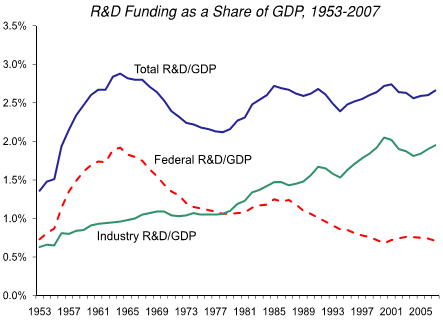
Back in the golden age of the American economy , the Federal government used to fill these gaps much better than it does today. In 1965, it funded 65 percent of all American R&D. But it has been walking away from this task for decades, as the chart below makes clear. (Source.)
2011-05-31-FedRDSpend.gif

One big problem for the U.S., as opposed to other countries, is that our publicly-funded R&D is dominated by mission-oriented agencies--NASA, the Defense Department, the National Institutes of Health, etc. These are fine institutions, but none of them is organized around the economic objective of increasing our GDP. They are all organized around non-economic missions: explore space, defend the nation, cure illness.

Other nations tend to focus R&D funding on what will improve their economies. For example, Taiwan's Industrial Technology Research Institute has one mission: technology development and commercialization. (One consequence is that private industry contributes about a third of its budget; leveraging money this way is key.) It is no accident that while our Defense Department produces 0.1 patent (an imperfect measure for infratechnology research, but it's what's available) per million dollars, ITRI generates twenty times that. (Source.)

Proposals have been made to remedy America's shortfall in this field. In 2008, the liberal Brookings Institution and the industry-funded Information Technology and Innovation Foundation proposed a National Innovation Foundation along the lines of the existing National Science Foundation.

Beyond this, what else could we do? Here are some suggestions:

• Raise the average level of research and development (R&D) in manufacturing to six percent. This would be roughly a fifty percent increase from today. It wouldn't push the entire manufacturing sector into the ultra-high R&D category characteristic of true high technology, but it's a good benchmark of what level we need for the sector to be innovative across the broad range of categories we need.

• Shift American R&D more towards long-term "breakthrough" research, as opposed to short-term research oriented to next week's product launch.

• Because long-term research is, by its nature, more speculative, encourage a "portfolio" approach in which many projects are pursued, only a few of which will reach fruition in any given time-frame, as opposed to a "bet the house" approach on one or two things.

• Increase the efficiency of America's R&D spending by supporting a number of policies to this end, like regional technology clusters, supported in part by state governments. Some states are already doing this part on their own.


Follow Ian Fletcher on Twitter: www.twitter.com/IanFletcher


  • Comments
  • 72
  • Pending Comments
  • 0
  • View FAQ
Comments are closed for this entry
View All
Favorites
Recency  | 
Popularity
Page: 1 2  Next ›  Last »  (2 total)
10:48 PM on 06/08/2011
Solar power on the ground has a cost of 10-20 cents per kWh and an energy payback time of 2-4 years.

With a relatively small amount of innovation and investment (about a month of oil imports) it seems to be possible (from the physics and economics) to make solar energy from space for 2 cents per kWh with an energy payback time of under two months.

If you want a longer version, there is an article on The Oil Drum I wrote about this. It was put up last Friday, there are now over 400 comments.
photo
HUFFPOST SUPER USER
Fred Scarran
07:40 AM on 06/09/2011
The international-corporate-banker globalists are trying to divert you're attention with all this innovation talk; they are trying to divert you all away from thinking about Tariffs.

"If only we spent more on government scientists, innovation, then all will be well" they say.

Don't fall for this innovation-diversion propaganda, think Tariffs. Think happy thoughts.
photo
HUFFPOST SUPER USER
Fred Scarran
07:23 PM on 06/05/2011
All of you pro R and D people are basing your ideas off of a futuristic pre-conceptions that there are flying cars and holo-decks waiting to be discovered if only there were more R and D. It won't work, and cut down on the science fiction if it's effecting your judgement so much.
05:59 AM on 06/06/2011
There should be a balance between technology creation. copying and engineering, commercializtion, and monetary supports through all phases. Right now the bean counters are in short term gains for commercialization. However, there is one thing intengeable and missing other than money: Scientiest/technologists may be poor in most the developing countries but are respected and valued as indicated by the popular culture. Here you may want to be a teenager idol, a wall streeter, a billionare, a senator? The culture of craftman is dying.
photo
HUFFPOST SUPER USER
Fred Scarran
02:49 PM on 06/06/2011
Culture is irrelevant. The type of government is irrelevant. The amount of taxes is irrelevant. How much the government spends is irrelevant.

When it comes to scientific advancement, it comes sporadically and randomly, one brilliant man comes up with an idea out of the blue that nobody could conceived of, and everyone else naturally falls in line. Science is a Dictatorship, not a Democracy.
07:35 AM on 06/05/2011
Ian: You have some good points. But there is one thing missing. I thnk that is mental. That the other countries seem to have over the US. They don't mind to be students or copier of the US. But US never thought of reverse engineering the advances in other countries. You seem to touch upon Taiwan's program. But the advances in others including infratechnology, processes can be adopted and then adapted, while you recognize you are behind, and that has never happen before.
photo
HUFFPOST SUPER USER
Fred Scarran
03:32 PM on 06/02/2011
Another analogy of modern day "scientific innovation".

This one's poking fun at giant particle super colliders.

The year is 1880 and James Clerk Maxwell, instead of studying science he played golf his entire life so we didn't get all of his wonderful equations on classical electromagnetic theory. The "innovators" in this alternate reality government know the future is in magnets and electrostatic charges; imagine a cruiser powered by MAGNETS and lighted by those little lightening bolts you see with electrostatic charges being released! So the federal government builds the world's largest lodestone, at 1% of the federal budget. This giant natural magnet is 1,000 feet across and 1,000 feet high, government scientists in white robes with cursive engraved bars of copper or glass being rubbed with all kinds of materials to create a static charge in the presence of this giant lodestone, make themselves busy day and night trying to understand the natural world. It's all very steampunk, but in the end pretty much a waste of money.

Is this necessary? No.

Does this lead to "innovation" faster? Maybe a little, probably not, prolly.
photo
HUFFPOST BLOGGER
Ian Fletcher
Economist, Coalition for a Prosperous America
12:09 AM on 06/04/2011
Sorry, but your story has no relation to the actual history of science. Very few major government-funded scientific projects have turned out to be a waste of time. And most people are blind to the origins of the science that makes things like cell phones and the Internet possible.
photo
HUFFPOST SUPER USER
Fred Scarran
12:25 AM on 06/06/2011
The last great leap in power plant technological improvement was going from steam power to internal combustion power, and the Greens oppose that. Why should anyone give them any power or money? They are retros.
12:32 AM on 06/02/2011
Fletcher, you poor thing,

You seem to have a very stunted vision of innovation! Don't you know that government expenditures on R
oilfield
large employer per obamacare
11:34 PM on 06/01/2011
if the govt wants to fund innovation they can do so by guaranteeing sba loans at a higher percentage...there is no capital available for an idea other than from vcs. banks loan on collateral and existing sales numbers.
need 500k already have the sales to prove you can pay it back and have 20% collateral...you may get the money.
HUFFPOST SUPER USER
mansterEZ
searching for secular humanist fact-based truth
02:15 PM on 06/01/2011
As a supply chain procurement specialist myself, I could not agree more with what Ian has to say. The global economy has unleashed Capitalism to run amok creating a new feudalism where corporate oligarchs take advantage of countries wanting to join in the new world interdependency willing to sacrifice their environment and the less-fortunate of their population in the process.
HUFFPOST SUPER USER
logicanada
Blogger, radio co-host, writer, editor, voice-over
12:17 PM on 06/01/2011
Here's a promising cancer cure discovered at the U of A that can't get funding because it is a common substance and not patentable. . . hence no profit. This could save billions in medicare commitments.

http://scienceblog.cancerresearchuk.org/2010/05/12/potential-cancer-drug-dca-tested-in-early-trials/
photo
HUFFPOST SUPER USER
Fred Scarran
03:40 PM on 06/02/2011
How do you know that it's a promising cancer cure? I had one class in high school on biology, that doesn't make me an expert on biological matters.
photo
cyclone70
When one facepalm isn't enough
11:58 AM on 06/01/2011
I'll try this again

According to Industry Week, 70% of all Research and Development investment comes from the mfg sector. Most innovation comes from the continuous improvement and re-application of exisiting technologies. The interaction between the shop floor and the engineering department is crucial to this process as designs are imporved and processes made more efficient

Innovation and manufacturing go hand in hand. neither can exist in any meaningful way without the other. When your ability to produce is offshored, so too is the need for engineering, as these disciplines typical need to be close to where the production is occuring to be effective.

Also, in order to more widely share the benefits of a new technology, one must not only create it, but also produce it. it is in the production where the greatest potential for employment is. just as mr Fltecher has pointed out, far too many innovations done in US labs ends up getting made offshore - globalization short circuits the whole process
photo
HUFFPOST SUPER USER
Fred Scarran
02:50 PM on 06/01/2011
That's right, all we need are some strong Tariffs, not throw trillions more down the drain on leftist Green boondoggles.
photo
HUFFPOST BLOGGER
Ian Fletcher
Economist, Coalition for a Prosperous America
12:13 AM on 06/04/2011
Bingo! I wrote about the interdependence between innovation and production in my book.
HUFFPOST SUPER USER
kdallas999
Entrepreneur, patriot and liberal
10:51 AM on 06/01/2011
Thanks for the article! As an owner of a tech company, I'm glad to see someone pointing out the useful unpatentable ideas concept.

Private industry is happy to fund patentable products. They are the basis of VC. But the patented product is only a part of how innovation spurs economic development. Once the patented product is out there, it should be spurring supporting products and uses.

The government needs to step in and support unpatentable ideas. I love the concept of supporting portfolios of ideas. Government funding (these days) is so fixated on lowest cost specific outcome, it leaves little room for unplanned R
10:44 AM on 06/01/2011
I recently surfed through the Department of Energy's website. It seemed to me they are doing a superb job of bringing new alt energies to the market. So 2 thumbs up to DOE. That might be the only department in federal government that works well
photo
cyclone70
When one facepalm isn't enough
09:29 AM on 06/01/2011
manufactur­ing is responsibi­le for over 70% of the R
photo
cyclone70
When one facepalm isn't enough
09:43 AM on 06/01/2011
why does it keep cutting off the rest of my comment?
photo
cyclone70
When one facepalm isn't enough
09:24 AM on 06/01/2011
manufacturing is responsibile for over 70% of the R
This user has chosen to opt out of the Badges program
photo
Olderandwiser55
getting older and wiser....
12:36 AM on 06/01/2011
Excellent premise. I lived in Chile for several years and although it is often touted as economically free" and was where Friedman and his Chicago boys privatized and proclaimed a miracle-it's not. A lovely country but no innovation-the internet is both slow, undependable and expensive. Most products are expensive in comparison to the US if available at all. Very little manufacturing-most industry is mining companies which suck the natural resources away without any responsibility. Of course water is privately owned-mostly by large mining corporations. Terrible customer service.-I believe because the working poor know losing their minimum wage job doesn't matter. all management positions are taken by those of the upper class. Getting ahead is extremely difficult unless you are born into money. About four families control everything. privatized education-public schools are abysmal-only the very poor send their kids there. Books are expensive. Monopolies form....the 'free market" experiment has been done-under a 17 year dictator. Jose Pinera assisted him (working in his "administration") and now is at the Cato Institute privatizing everything possible.
photo
HUFFPOST SUPER USER
jabailo
(Participant) Texeme.Construct()
05:33 PM on 05/31/2011
Government can pour a lot of money into something and create products that are eventually world changing. Eventually Government research alone ends up with lots of innovation on the top shelves of some retiree's office.

To get them to market seems to require private industry.

However, eventually private industry will exhaust the basic research and end up spending most if its time figuring out what kind of daisy patterns to put on the iPhone.