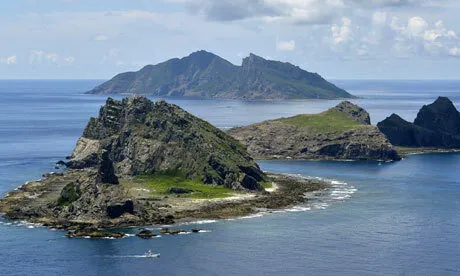
We sometimes encounter arguments in the U.S. media that nationalism is growing in Japan. The logic is that mounting frustration amongst people, stemming from continuing stagnation, is leading them to take tougher attitudes towards neighboring countries. It is interesting, but vastly exaggerated.
Here, I will not go into history to explain why it is clear that Japan has sovereignty over the islands which are now getting attention. What I would like to stress is the fact that the recent problems with our neighbors have not been started by Japan.
The three islands of the Senkaku belonged to a Japanese individual. The Japanese government had rented the land on the islands from the said individual for years to maintain and manage the islands in a calm and stable manner. Therefore, it has not allowed Japanese nationals to land except for emergencies. It has allowed no construction. In the last few years, however, it is true that concern grew as an increasing number of Chinese patrol vessels from relevant authorities and fishing vessels entered the waters adjacent to the islands, as well as our territorial waters. The reason for the Japanese government's recent purchase of the islands from the individual was to preempt the purchase by others, so as to maintain the status quo and continue to maintain and manage the islands in a calm and stable manner. Furthermore, it is to be emphasized that the purchase is a civil transaction and the change of ownership of the land legally has nothing to do with sovereignty itself.
As for relations with the Republic of Korea, the recent situations were initiated by the very first visit of its leader to the disputed islands this summer. No previous leader has done that.
Japan will continue to deal with these issues in a calm manner. We have no intention of heightening tension. There is no merit in doing so for anyone. We think what is required is to firmly register our position, restrain from making it into an emotional issue, and peacefully cope with the issues while respecting international law.
The U.S. government has repeatedly confirmed that the Senkaku islands are covered by Japan-U.S. security arrangements. Such reassurances constitute an important deterrence. For the last several decades, according to polls, around 70 percent of Japanese have always answered that the present form of defense should be maintained, where Japanese security would depend on the Self Defense Forces as well as on the US extended deterrence.
It is a truism that you cannot change your neighbors. We have to live next door to each other for the generations to come. Our economies are already closely intertwined. We are, we should and we will continue to be good friends with each other. I have recently spoken to hundreds of Japanese language school students about the importance of being good friends with youngsters of Chinese and Korean descent. The days of using force or coercion, whether military or economic, to solve disputes over land should be left in the last century. Let us not forget that we are already deep into the 21stcentury. No, Japan is not turning to the right. We will continue to go on straight.
I think OP need to seriously take both China and Japan's arguments into consideration.
There are a lot of facts, such as Treaty of Shimonoseki, Potsdam Declaration, Cairo Declaration, and so on, OP don't know (or at lease, did not mention in the article.)
I don't know wether Japan is turing to the right, but at least Japanese and its media shouldn't pretend some historical facts and legitimacy of Chinese argument does not exist at all.
It's time for Japanese to face the history and fact. Only then, harmonic relation can only be attained with China and many Asian countries.
By Fred Hiatt
“Well, you might say, how a nation treats its internal history is less relevant to its qualifications for the Security Council than whether it teaches its children honestly about its wars with other nations. A dubious proposition, but no matter; as the Times found in its review of textbooks, Chinese children do not learn of their nation’s invasion of Tibet (1950) or aggression against Vietnam (1979). And they are taught that Japan was defeated in World War II by Chinese Communist guerrillas; Pearl Harbor, Iwo Jima and Midway don’t figure in.
“Facing up to history squarely” isn’t easy for any country. Americans don’t agree on how to remember the Confederacy. Russia can’t yet admit to Soviet depredations in the Baltic republics. And, yes, Japan too often sees itself purely as a victim of World War II.
But in countries that permit open debate, historical interpretations can be constantly challenged, revised, maybe brought closer to the truth. In dictatorships that use history as one more tool to maintain power, there’s no such hope.
China’s Communists used to find it useful to vilify Russia in their history texts. These days, for reasons of China’s aspirations to lead Asia, Japan makes a more convenient villain. Next year might be America’s turn. The reasons may be complex, but none of them has much to do with facing history squarely.”
http://www.washingtonpost.com/wp-dyn/articles/A61708-2005Apr17.html
Pearl harbor, nanking, comfort woman, just to name a few thing neighboring country can't forgive.
Koizumi for example made a great show in appeasing these people, and during a time of economic uncertainty, the right always benefits, so I want to make sure that the country stays true to the progress of a reasonable, civillian lead government that has made it a worldwide economic power. We in America have to control our crazy people, and we do a poor job of it, but Japanese people tend to be more homogenous and more groupthinky (see the problems with establishing jury trials for a great example), and so are much more likely to embrace these kinds of negative changes quickly
Just something to keep in mind
"After Yin was identified 17 years ago as one of the Japanese army sex slaves known as 'Comfort Women', she went to Japan twice, testifying as a victim, but both court verdicts refused to accept her claims
Japanese women and women of other occupied territories (such as Taiwan, the Philippines, Indonesia, Burma and the Pacific islands) were also used as comfort women, according to a report by San Francisco State University.
After the war, many of the women were brutally slaughtered and their story was first told in 1991."
http://www.dailymail.co.uk/news/article-2216808/Chinas-oldest-World-War-II-sex-slave--forced-comfort-woman-Japanese-soldiers--dies-91.html?ito=feeds-newsxml
Get this straight: there is NOTHING wrong iwth visiting the Yasukuni shrine. You should be ashamed for even suggesting that. There are, after all, a lot of NON war criminals buried there, too. It is shameful to insinuate that a visitor is honoring the war criminals when there are so many other war dead there.
As for the matter of the Yasukuni shrine, I don't think you understand the reason for resentment on the part of Japan's neighbors. I fully understand that it is an important spiritual place for the Japanese to honor those who had given their lives for Japan. Koreans, Chinese, and other Asians are NOT asking the Japanese to stop honoring the non-war criminals. All they ask is that the war criminals(as sentenced by international court post-WWII) be removed from the holy place. I don't think anyone can raise an issue with any Japanese visiting the Yasukuni, as long as the war criminals are removed from there. Why do the Japanese continue to desecrate their own holy place by keeping the war criminals enshrined?
The 1969 map, produced by the People's Republic of China map authority and labeled “confidential,” lists the islands as “Senkaku,” the Japanese name, and contains a dividing line south of the islands indicating that they fall within Japanese territory.
http://www.washingtontimes.com/news/2010/sep/15/inside-the-ring-145889960/
http://youtu.be/sK0dPy8L4OU
Rusk note of August 10, 1951
by Dean Rusk
As regards the island of Dokdo, otherwise known as Takeshima or Liancourt Rocks, this normally uninhabited rock formation was according to our information never treated as part of Korea and, since about 1905, has been under the jurisdiction of the Oki Islands Branch Office of Shimane Prefecture of Japan. The island does not appear ever before to have been claimed by Korea.
(United States National Archives and Records Administration(NARA) RG59, Lot54 D423 JAPANESE PEACE TREATY FILES OF JOHN FOSTER DULLES, Box 8, Korea.)
http://en.wikisource.org/wiki/Rusk_note_of_1951
Admit it: China was not interested in the Senkaku Islands nor Korea in Dokdo until very recently, when mineral resources were discovered there. Until then, both were quite content with the way the islands were divvied up in the wake of World War II.
Let's know forget that Japan invaded and conquered the Ryukyu/Okinawa islands.
Both have the reason to justify their insistence.
I think it is nearly impossible to solve this dispute between two countries.
Simply because both will never change their insistence, will never compromise.
So, most Japanese think this case should be brought into International Court of Justice.
If the International Court make judgement that the island belongs China,
then we Japanese respect the judgement, and obey it.
If the result is the opposite, Chinese obey the judgement?
The most stupid attitude is to resort to violent means.
http://www.youtube.com/watch?annotation_id=annotation_574935&feature=iv&src_vid=05x4iciT_z8&v=gnlr_OBN2uw
Although, Japanese Government denies, since Japan accepts the forcible jurisdiction of International Court of Justice, if China proposes the jurisdiction of ICJ about the Sovereignty of the Senkaku Islands, Japan has to accept. As we declared, we have abondoned to use the military force to solve the international dispute by our Constitution, the ICJ's court decision would be very meaningful as a mean of peaceful solution to achieve the justice.
China can appeal their saying to ICJ anytime but they have never come and will never come - as they know their assertion of Sovereignty is baseless under the international law - so as Korean's assertion
to Takeshima Islands.
As a Permanent member of the Security Counsil, China should follow the principle of "Rule by Law" which UN asserts. (So as Korea.)