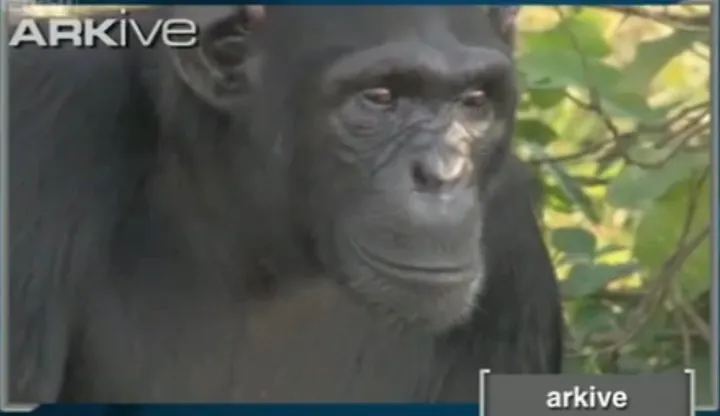
All movements for social change take forever -- especially if you are the one in shackles, up the chimney, or having your bottom pinched at work. Finally, the chimpanzees' moment is approaching. Maryland Rep. Roscoe Bartlett -- a former Navy physiologist who once experimented on primates -- has introduced bipartisan legislation to end invasive research on great apes in the U.S.
Get ready for celebratory pant hoots from the general direction of Dr. Jane Goodall.
I am 62. So are some of the chimpanzees who were captured as youngsters from their families in Africa -- the mothers and aunts are shot if they try to defend their children, and they all do -- to be used in experiments here in the U.S. While I have been traveling the world, working on what I care about, enjoying personal relationships, hiking, and, most recently, watching Rise of the Planet of the Apes, many of my chimpanzee peers were restricted to sitting every day and lying every night on a concrete slab in a barren cage with steel bars and no windows. These chimpanzees, hundreds of them, have been alone all those decades: no mate, no child, no friend to comfort them, to help them get through the pain of whatever experiment they are being subjected to. Being possessed of the ability to anticipate, they could only dread the next ordeal -- a lung biopsy, perhaps, an injection, an infection -- who knows? They don't.
Half my life ago, almost exactly, I attended a symposium on alternatives to animal experiments held in Washington, D.C. It was one of two within a matter of months and the first of their kind in the United States. This one was put on by the National Institutes of Health (NIH); the other one was held at Georgetown University by the new animal rights group PETA. At the NIH one, Dr. Alfred Prince, well known for his blood-work experiments on chimpanzees, was labeled a turncoat by career experimenters. That's because he introduced a "Chimpanzee Bill of Rights." It was basic, but it put forward the idea that chimpanzees should not be treated as disposable objects but rather as feeling, social beings who had thoughts and interests and who should not be killed in experiments or allowed to go insane from long-term confinement. Some experiments would be off limits. If Dr. Prince could say that, after all he'd done to chimpanzees, including infecting them with hepatitis, mutiny was afoot!
At the time, this won the support of a few daring souls, including Dr. Roger Fouts. Fouts was conducting non-invasive research in Washington state and had in his care Washoe, a chimpanzee who knew hundreds of American Sign Language signs. Washoe was becoming famous for making up her own words, like "dirty toilet" for something she didn't like or "water apple" for watermelon. Fouts reminded scientists that at one time only humans were thought capable of using language but that this false belief was blown out of the water pretty definitively. He pointed out that the argument for linguistic superiority had quickly been replaced by the statement that only humans could use tools. That theory was quickly proved laughable. Chimpanzees use sticks to "fish" for termites, otters use shells to crack open other shells, and the list of instances of innovative tool-making among other animals just keeps growing. Fouts speculated to an audience at the Smithsonian Institution that perhaps the next desperate barrier to be erected that would stop us from having to accept our link to the rest of the animal kingdom -- and certainly to our closest relatives in it -- would be that only humans put their tools in special belts worn around their waists.
After Dr. Prince spoke, there was much mumbling and foot-shuffling in the auditorium. Then, a red-faced scientist stood up and screamed -- not spoke but screamed -- that any talk of affording chimpanzees rights was nonsense. He was beside himself with rage as he accused anyone who cared about animals as using "solely emotional arguments." I stood up to say that there's nothing wrong (in fact there's often everything right) with being moved by the plight of others -- for those who can't empathize include sociopaths -- but I really didn't need to open my mouth. The irony of his fiercely emotional outburst said it all. I drove home thinking, "It's started." But look how long the journey has taken!
Having been in prison myself, I can assure you that, after only two lousy weeks, even having been surrounded by other prisoners, able to watch TV, take a phone call now and then, go to Bible study (I'm an atheist, but it passed the time), and walk a little in a communal area, my first beer and first bowl of vegetable lo mien never tasted so good. At Save the Chimps, a sanctuary in Florida where former lab chimpanzees are now living in groups on islands in the sun, the saying "Freedom never tasted so sweet" is almost palpable. These refugees from Alamogordo's hellhole lab cells at White Plains, New Mexico, lived exactly as I have described above. Now they race about in the grass or, in some cases because they are so mentally disabled by their past experiences, sit and watch the birds and the sky, their backs to the world, unable yet to communicate with others. At chimpanzee sanctuaries elsewhere, you can see the rescued apes taste snow for the first time, gaze at mountains, cherish their blankets, hug toys to their chests as if they were their lost children, and make chimpanzee friends.
Animal liberation was once a wonderful dream, but now, starting with the chimpanzees, it is beginning to happen. There will be no retribution trials, but there should be. And not just for chimpanzees. After all, SeaWorld, which has condemned free ocean-going orcas to lonely lives performing tricks in a small, cement pool, and circus profiteers, who have removed elephant babies from their mothers, tied them down, and beaten them in order to break their spirits and make them perform, should be forced to tell the public every detail of their wretched trades. History will do it for them, regardless.
Let's wish the other animals the best in winning their future freedom, too, and celebrate the eventual end of our role as their masters.