
This week marks the one year anniversary of the beginning of the end of Iceland's economic prosperity.
After World War II, Iceland may have been the poorest country in Western Europe. Centuries of abuse -- physical and economic -- by our colonial overlords (Norway, then Denmark) had weakened our financial institutions and stunted our economic potential. After receiving our full independence in 1944, we gradually clawed our way up the food chain, going from a remote backwater to the world's richest nation on a per capita basis in just six decades.
Unfortunately, our new house was built on foundations of sand, and when the economic fallout from the Lehman Brothers collapse began to hit the markets, Iceland's lack of solid grounding became evident. On September 29, 2008, the Icelandic government announced that it would nationalize Glitnir -- one of the three large banks upon which Iceland built its prosperity -- thus starting a chain of events that would lead to the collapse of all three banks, the Icelandic stock market, and the Icelandic króna within two weeks, and of the ruling center-right government within six months.
The International Monetary Fund (IMF) was called in, and has proceeded to impose austerity measures and to apply pressure on the Icelandic government to guarantee the banks' losses abroad. The new center-left government bungled the initial negotiations with the United Kingdom and the Netherlands regarding its responsibility for the banks' losses, but has now submitted a more realistic plan for repayment. Nevertheless, it has had to cut essential services, such as health care, and has not provided a clear plan for returning the country to solid footing.
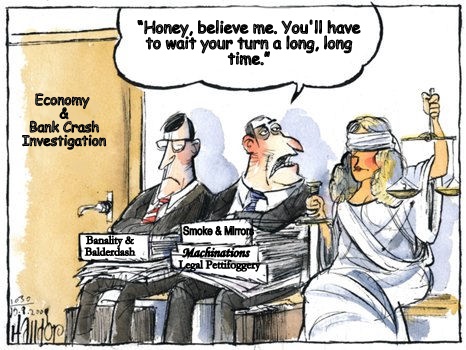 "The Goddess of Justice" Halldór Baldursson, mbl.is
Investigations of widely-rumored fraud have not yet yielded any arrests, but an important legislative fact-finding investigation is due out in November. Páll Hreinsson, the Supreme Court judge chairing this investigation, has warned that "No committee has ever had to bring to its nation such bad news." It is also expected that the special prosecutor appointed to investigate possible fraud in the banking industry will start issuing indictments soon.
Nevertheless, Icelanders do not appear to have learned any lessons from this debacle. There is a great reluctance on the part of most Icelanders to accept any responsibility for our current situation. Those who participated in the madness truly believed that they had found the secret for printing money and blame our depression on the global economic downturn, and are waiting for the market to bottom so that they can buy up resources for a song and start over again, more powerful than ever.
Those who did not participate in the bubble truly believe that they should be exempted from any hardship. They are like the radical Jewish sect in Monty Python's Life of Brian sitting around asking what the Romans had ever done for them -- other than aqueducts, sanitation, roads, irrigation, education, wine, security, etc., etc., etc. They may have voted for the minority parties, worked outside of the banks, and resisted the urge to go on shopping sprees abroad, but they accepted the legitimacy of the status quo by failing to take affirmative steps to change it fundamentally.
This failure to learn is exemplified in three recent developments -- the new government's decision not to revise the current fishing quota system, the imminent loss of public control over Iceland's geothermal energy resources, and the reemergence of Davíð Oddsson as a player in the public debate over Iceland's future.
The event that many see as starting the economic corruption that permeated the business environment in the 2000s was the 1990 decision to grant fishing quotas to selected fishing vessel owners at no cost, even though the Icelandic constitution declared the fisheries to be a public resource. This decision made the lucky owners fabulously wealthy, and they showed their gratitude by sharing their wealth with Iceland's political parties, though of course not with the Icelandic people themselves.
When its status as the perpetual minority party seemed secure, the Left-Green Party declared that one of its principle aims was to restore the quotas to the Icelandic people and to auction off the fishing rights to ensure that the people to whom the fish belonged would receive a fair economic benefit.
However, now that the Left-Green Party has entered into a ruling coalition with the Social Democrats, that election promise has dissolved in the purple power koolaid that produces 180° position reversals, cowardice, and episodes of integrity breakdown, all on nauseating display on Icelandic state television last week as Fisheries Minister Jón Bjarnason told an interviewer that it wasn't up to him (the Minister, the boss), but a bureaucratic committee, to fulfill what he and his party had promised voters. Of course he had no way of knowing what the committee would end up deciding, the matter was completely out of his hands!
Iceland can only be said to have two natural resources of any importance -- fish and energy. The method by which Iceland distributed fishing quotas remains deeply flawed, but it is the politicization of energy that presents the greatest danger to Iceland's future. Whatever its flaws, at least the fishing quota system has ensured that Iceland's fisheries have been relatively well managed. The exploitation of energy in Iceland, however, it anything but well managed.The recent flurry of activity surrounding the sale of HS Orka, the largest privately owned energy company in Iceland, shows that the old way of doing business has not changed much, if at all. A Canadian company, Magma Energy Corp., announced in July that it had signed an agreement to acquire a minority interest in HS Orka from Geysir Green Energy (GGE), a private geothermal development company with a majority stake in HS Orka.
GGE acquired its shares in HS Orka when the Independence Party-led Icelandic government decided to privatize the company in 2007. Not surprisingly, GGE -- which was headed by the same investors who already owned most of what was worth owning -- had greased the skids for this deal by "donating" ISK 30 million to the Independence Party a couple months earlier.
To no one's surprise, GGE is now in deep debt as a result of failed geothermal projects in Germany and elsewhere, and has been held on life support by the Icelandic banks, which are themselves essentially insolvent. A bank desperate for cash selling off a bankrupt debtor's assets to recoup a portion of the outstanding debt is, of course, nothing unusual.
However, to gain effective control over HS Orka, Magma has also struck a deal with Reykjavik Energy (RE) and two other municipal shareholders under which it gained an additional 32.32% share of HS Orka, while putting down only about 30% of the purchase price, with the remainder secured by a bond repayable in a single installment in seven years with interest at 1.52% per annum. The bond is secured by the shares acquired by Magma in this transaction. The deal will give Magma exclusive rights to exploit one of Iceland's most productive geothermal fields for the next 130 years.
This is precisely the type of deal that characterized Iceland's banks before the collapse, and it's sad to see that the municipal politicians have learned absolutely nothing from the failure of the neoconservative ideology. What's even more heartbreaking is the realization that this sale is also exactly the type of deal described by John Perkins, in his haunting book, Confessions of an Economic Hit Man, for stripping countries of control over their natural resources and placing them in the service of a few very large foreign corporations.
Iceland decided long ago to "diversify" its economy by enticing Alcoa and other aluminum manufacturers to set up shop in Iceland to take advantage of dirt cheap energy prices. The resultant hydroelectric projects have destroyed pristine wilderness, with little or no profit to Iceland's people, as has been documented by Andri Snaer Magnusson.
The HS Orka sale is an attempt by the aluminum interests to ensure that the government does not interfere with their plans for continued expansion, despite a lack of public support, and that it does not renegotiate the current contracts to charge a fair rate for the exploitation of Iceland's geothermal and hydroelectric resources.
The individual seen by most Icelanders as the architect of the bubble economy is Davíð Oddsson, the former long-time Prime Minister, leader of the Independence Party, disciple of Milton Friedman, and chairman of Iceland's Central Bank at this time last year. As Prime Minister, he led the charge for the privatization of public resources, including the banks and the energy companies. As Central Bank chair, he is credited with the United Kingdom's decision to invoke its terrorism laws to freeze the assets of Icelandic banks in the UK, after he stated during a radio interview the day before that "we do not intend to pay the debts of the banks that have been a little heedless."
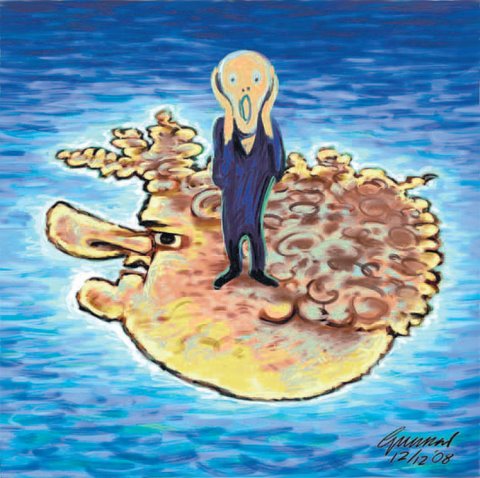 "The Davíð's Scream" by Gunnar/Fréttablaðið
After the Independent Party-led government fell last winter, he was forced out of the Central Bank, and had, it appeared, decided to slink into a hole, one hoped, to mull over his multitude of mistakes and to seek atonement for the great suffering he had caused.
But like the proverbial bad penny, Davíð turned up last week as the new editor-in-chief of Morgunblaðið, Iceland's premier newspaper, whose ISK 3 billon debts were nationalized before a member of the fishing quota royalty then took ownership of the paper. Iceland's newspapers have never exactly been independent beacons of free thinking, but Morgunblaðið under the pre-Davíð editor (Ólafur Stephensen) had been praised by many people (of diverse political opinions) for fine reporting. Now, the Morgunblaðið staff has been purged of dozens of long-time staffers, and it is generally anticipated that an alternate Faux News-type universe will be fabricated to justify past misdeeds and to pave the road for a return to power by the power brokers behind Iceland's collapse.
Does this imply that Iceland is doomed to an economic and societal purgatory for the foreseeable future? I hope not, but I'm not optimistic. There are some indications that the worst criminals will be punished, and that some stolen assets will be recovered. The reality, though, is that most of the money lost in the past year is gone forever (or, more precisely, never really existed), and that most of the participants in the orgy will escape with a slap on the wrist, at most.
What we must avoid, however, is repeating the mistakes of the recent past. We can no longer accept a society in which a few selfish individuals control the fate of the entire nation, the obeisant public acquiesces without comment to gratuitous transfers of public resources to private interests, and the concept of personal responsibility is seen as a quaint concept applicable only to others.
This has been a very rough year for Iceland, and it's not likely to get better anytime soon. The public's anger continues to grow, and it would not be surprising if this winter sees a repeat of last winter's uprising. One would hope that we retained a few lessons from this painful debacle, but unfortunately and inexplicably, Icelanders seem hell-bent on self-destruction - again.
According to recent polls, a third of voters support the Independence Party, the architects and enforcers of the corrupt policies that devastated the country. Icelanders' story continues to be that of Bjartur of Summerhouse, the protagonist of Nobel prize author Halldór Laxness' Independent People, "the story of a man who sowed his enemy's field all his life, day and night."