
The Iceland of my youth was not a rich country. When I was growing up, our diet mostly consisted of fish, lamb, potatoes, and the few crops that could be grown near the Arctic Circle. "Exotic" foods like fresh apples and oranges were reserved for Christmas - "The deli-síjus apples have arrived..." announced the ad-reader on the state-owned radio each December. I was 14 when I first tasted iceberg lettuce. I thought I had died and woken up in consumption heaven when, as a 17 year old exchange student, I first experienced an American supermarket.
Because there was so little foreign currency available, we had rather few consumer goods. I have almost no photographs of myself as a baby, because my parents didn't own a camera - in the 60s a luxury item for our working class family of seven. People rarely left the island. Summers away from school were spent working, and I was 12 when I began working in a fish factory, cleaning cod for export (which I found a welcome change from the babysitting I had done every summer since the age of nine).
Due to the country's dependence both on unreliable fish catches and foreign demand for fish products, Iceland's economy remained very unstable well into the 1990s. Iceland became one of the founding members of the European Economic Area (EEA) in 1994, which allowed its economy to diversify. Aluminum refineries were built, even though there is no aluminum on the island, to take advantage of the country's cheap electricity. Economic growth averaged about 4% per year from 1994 until last year.
At the end of 2007, the United Nations' Human Development Index ranked Iceland as the most developed country in the world. Unemployment was essentially non-existent, and foreign workers were brought in to handle the tasks that Icelanders felt were now beneath them, such as fishing. Young people no longer ate fish. Only two of 200 business administration graduates chose to go into the fishing business in 2007.
2008 brought a 90% decline of the Icelandic stock exchange, a 50% decline in the Icelandic krona, and the complete collapse of all of Iceland's banks. Unemployment is expected to be in the double digits shortly. Foreign workers have fled or been forced out of the country, and thousands of residences stand vacant or uncompleted. Automobile sales have essentially stopped.
So what now? When will we hit bottom?
If it was business as usual in the rest of the world, Iceland would probably be able to stabilize itself, with assistance from the International Monetary Fund (IMF), negotiate some sort of debt forgiveness settlement with its largest foreign creditors, and adapt itself to a more realistic budget. We would have to cut back from the glory years, but we would still live a good life.
Unfortunately, of course, the rest of world is not doing so well. Experts, such as Paul Volcker and George Soros, recently stated that they can't see the bottom, that things may be worse than the Great Depression.
The Great Depression passed mostly unnoticed in Iceland because most people were so poor that it was a stretch to fall any further. My parents tell me stories that almost defy belief. The novel Independent People by our cultural icon, Nobel prize-winning author Halldór Laxness, describes early 20th century Iceland amid farmers and fishermen - much like my grandfather, a West fjords seaman - who would rarely leave their valleys and fjords, except for a trip to the nearest village to shop for necessities, a country whose farmers might be so destitute that they "died without ever having transacted a business deal involving more than a few dollars at a time."
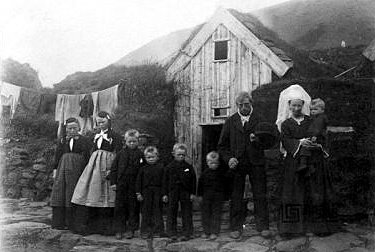 In 1882, an Icelandic family in front of their home, getting ready to leave for church services. Photo credit: Ponzi, F., Brennholt Publishing.
It seems almost unimaginable that we could ever sink that low again. Almost. It is hard to see how we will be able to maintain a middle-class standard of living if there is a severe global downturn. We didn't build an infrastructure during the fat years that will permit us to support ourselves during the lean years; everything has been partied away.
Rather than working to repair the flaws in the system, however, we seem to be going out of our way to alienate the countries in the best position to help us. The banks took in hundreds of millions of Euros from investors in Britain and in the Netherlands that they can no longer repay. Norwegian authorities claim that one of the banks embezzled €47 million. Last week, the "Green" Party Minister of Fisheries reaffirmed that Iceland will defy the International Whaling Commission and pleas by the ambassadors of United States, Sweden, the United Kingdom, Germany, the Netherlands, France and Finland and commence massive whaling.
Although a spontaneous uprising of the people forced the government to resign, I see no signs that the new bosses will respond to the nation's demands for change. Why hasn't "the group of thirty" that bankrupted the country been arrested and questioned as formal suspects, their assets frozen? The special prosecutor should have a smorgasbord of charges - theft, fraud, tax evasion, conversion, to name a few (he doesn't have to start with the treason immediately, although it belong on this list). The Icelandic authorities diligently throw people „suspected" of selling drugs or stealing a car in jail and confiscate coke and stolen goods, but these individuals who have stolen hundreds of millions of dollars cannot be touched! Who is protecting them and why?
It's back to business as usual. The Icelandic political parties and the media have fallen back into their same old pattern of finger-pointing and ad hominem attacks, and but for a miracle, I suspect the elections will put the same professional politicians who got us into the mess back in charge - that would be a new bottom for us.
Or perhaps not, to quote a cultural giant of our times, Homer Simpson: "Not a chance! I can sink way lower."
I've never been so afraid for my country, for my family.