As a leader within the alternative and democratic education community, I am frequently asked the question, "What is democratic education?" When I was a teenager, and at that time a recent graduate of a democratic school, I used to give a fairly dogmatic and uninviting response which included a bullet point list of requirements to be "democratic." Surprisingly, this was not an effective method to talk about what I was most passionate about. This style of communication disappeared as I grew up and my experience as an organizer and educator evolved. I learned to approach individuals humbly, listen genuinely, internalize and digest, respond gently and with care, share what is true for me, and not feel as though I needed to provide answers and solutions. I learned what I try to teach the young people in my life today -- how to meaningfully and authentically communicate and be in community with others while honoring one's own unique self and needs. When asked, "What is democratic education?" today, I am excited to share my current answer as well as shed light on what other voices in the wider education community have to say which are gleaned from hours of interviews I recently conducted.
What is democratic education?
The Institute for Democratic Education in America (IDEA) defines democratic education as "learning that equips every human being to participate fully in a healthy democracy." This definition excites me. It is brilliant in its simplicity, yet still profound. Before unfolding what the word "learning" means in that definition, I want to address democracy and public education since it affects most of the young people in the United States. In all public schools, democracy is taught, so wouldn't that make them all democratic by IDEA's definition? It's important to note that while democracy is taught, students are not given an opportunity to authentically practice democracy. This means having the opportunity to make real decisions in a community with concrete outcomes -- not voting in student council on recommendations that are then given to an adult authority figure to say "yes" or "no" to. As learning activist Shilpa Jain pointed out to me, "If we don't experience democracy in our schools, how could we ever expect to end up with democracy in the 'real' world?"
We must balance our intellectual and historical understanding of democracy with opportunities for practice and spaces to learn about the nuances that take place when you must collectively come to a decision that affects your entire community. After attending a democratic school and teaching high school and preschool in a democratic environment, I've come to settle on a personal definition of what democratic education is, which unfolds the word "learner" in IDEA's definition. I see democratic education as learning that is meaningful, relevant, joyous, engaging, and empowering. I've come to realize democratic education is more than any one learning environment, such as a school, and more than one feature, such as voting, but an approach to life and learning and an approach to interacting with all members of your community in a way that respects, honors, and listens authentically to each voice within it. For me, this is the practice of real democracy, which can manifest in many different ways based on you, your community, and your learning environment
What must education be to become democratic? Voices from around the country
Melia Dicker: Communications Director, Institute for Democratic Education in America
"...It must be accessible for everyone. It means every human being has access to quality education and has their basic needs met. This means addressing social issues such as poverty and others that affect people's ability to learn. For education to be democratic, every person must be valued, listened to, and participate actively in their learning and in the decision making processes."
Sonia Nieto: Professor Emerita of Language, Literacy, and Culture, University of Massachusetts, Amherst
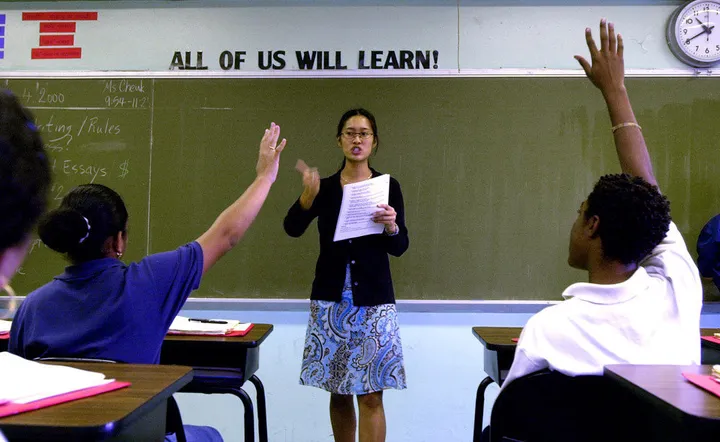
"...In terms of students, it means having more of a voice in what happens in classrooms and schools and being able to practice democracy and not just read about it. And not only through student councils, but through taking action and being able to learn the tools of democracy like writing a letter, starting a petition and learning how to start a boycott."
Bill Ayers: Co-author of Teaching the Taboo: Courage and Imagination in the Classroom
"A democratic education to me is something based in the culture of democracy and based on some radical propositions. A democratic education begins with the foundational belief that every human being is of incalculable value. It moves from there to a second core belief: The fullest development of each of us is the condition for the full development of all of us. And the reverse of that is true as well: The fullest development of all is the condition for the full development of each. Democratic education is less about facts and dates...It's much more about opening windows and opening doors...learning from the world, not about the world; learning from nature, not about nature; learning from the questions we can generate; and learning from democracy, not about democracy."
Ira Shor: Teaches writing to undergraduates at City University of NY while also directing dissertations there in the graduate center. He experiments with critical literacy in his classes
"For there to be democracy in education, we have to experience and practice it every day. In schools, that would mean that all the stakeholders would need to be involved -- teachers, administrators, parents and students. Teachers would have a collaborative relationship with the school administration, parents would be partners in the democratic management of the school, and students would participate in the making of their education and give critical feedback on the quality of their experience."
Justo Méndez Arámburu: Executive Director of Nuestra Escuela
"...It has to give value to the context in which each member of the community has come to be a person; it has to be meaningful; it has to create an environment where every person and every opinion will be respected while providing the tools to build consensus...Life is community and community is life. They each manifest in themselves and it all happens in through education. Democratic education is the way of the community expressing its life and life developing in community."
Maria Luz Torre: Organizer of Parent Voices SF
"For education to be democratic it must be an holistic education, not proscriptive, and not limited to the four walls of the classroom. It must be developmentally and culturally appropriate and it must be participatory. It helps a child develop a love for learning and critical thinking. It must also be equitable so that all have access to it."
Pedro Noguera: Professor of Education, NYU
Education is democratic when it is inclusive because it is acceptable to a wide variety of people. It's democratic because it recognizes that students are not passive beings but have to be engaged as critical thinkers. It's democratic because parents need to be treated as active participants in the educational process and not merely as consumers of it. And it's democratic because it has a sense of public accountability and a commitment to addressing broader public and social goals.
Lella Gandini: U.S. Liaison for the Dissemination of the Reggio Emilia Approach
"Democratic education is where people listen to one another and where children are the source of learning for teachers. What I have experienced in my decades of teaching is that there is a way to help children learn and at the same time listen to them. Teachers do not feel diminished, and they construct with the children and respect them, which is something important to learn."
Shilpa Jain: Learning Activist, Shikshantar
"...It means people having a say in their own learning process. From a very young age, we need to play a role in deciding what and how we will be learning. This, of course, must happen in a community, through dialogue with others. It's not an overly individualized, my-way-or-the-highway kind of learning. Rather, it's that I am able to dictate some of the path of my own learning, based on my interests, my questions, curiosities, and natural instincts, and that this happens in a community of people and is related to the context I live in. Learning in community means that there will be give and take, compromise, and sometimes sacrifice. But, it's not always bad for me, because there's a benefit in relationship, there's a reciprocity, a mutuality, an interdependence, which ultimately serves my well-being and the well-being of all."
Our schools and learning environments are not immune to the most pressing social issues of today. For a few examples, we can simply look to the inequities faced in how schools are funded, how test scores and graduation rates are intrinsically tied to race, class, and gender, and how grading, ranking, and competition in our schools have left students feeling worthless, stressed, depressed and isolated. It is imperative that we respond to these social issues by creating a generation of "solutionaries" as Zoe Weil, from the Institute for Humane Education, said in a recent TEDx talk, and this begins with our young people.
As such, we need to address these issues within our learning environments by creating authentic opportunities for young people to experience the power and possibilities democracy provides in loving and supportive community. We can transform our educational system to one based on respect for human rights and one that values freedom and responsibility, participation and collaboration, and equity and justice. To create a more just, sustainable and democracy world, we need democratic education.
For more information, please visit democraticeducation.org or educationrevolution.org