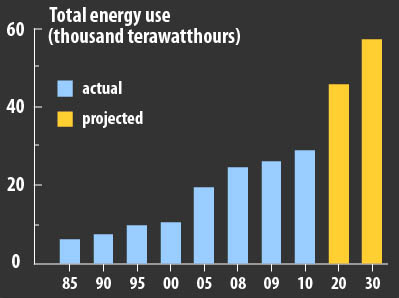
Water scarcity, rapid economic growth, and soaring energy demand are forming a tightening noose that could choke off China's modernization.
Writes my colleague Keith Schneider in the first installment of the new report, Choke Point: China, from Circle of Blue:
Underlying China's new standing in the world, like a tectonic fault line, is an increasingly fierce competition between energy and water that threatens to upend China's progress.
Simply put, say Chinese authorities and government reports, China's demand for energy, particularly for coal, is outpacing its freshwater supply.
The 12-part Choke Point: China series presents powerful evidence of the fierce contest between growth, water, and fuel that is virtually certain to grow more dire over the next decade. The project is produced in partnership with the Woodrow Wilson International Center for Scholars China Environment Forum.
Tight supplies of fresh water are nothing new in a nation where 80 percent of the rainfall and snowmelt occurs in the south, while just 20 percent of the moisture occurs in the mostly desert regions of the north and west. What's new is that China's surging economic growth is prompting the expanding industrial sector, which consumes 70 percent of the nation's energy, to call on the government to tap new energy supplies, particularly the enormous reserves of coal in the dry north.
The problem, scholars and government officials told us, is that there is not enough water to mine, process, and consume those reserves and still develop the modern cities and manufacturing centers that China envisions for the region. "Water shortage is the most important challenge to China right now, the biggest problem for future growth," said Wang Yahua, deputy director of the Center for China Study at Tsinghua University in Beijing. "It's a puzzle that the country has to solve."
The consequences of diminishing water reserves and rising energy demand have been a special focus of our attention for more than a year. In 2010, in our Choke Point: U.S. series, Circle of Blue found that rising energy demand and diminishing freshwater reserves are two trends moving in opposing directions across America. Moreover, the speed and force of the confrontation is occurring in the places where growth is highest and water resources are under the most stress -- California, the Southwest, the Rocky Mountain West, and the Southeast.
Stripped to its essence, China's globally significant choke point is caused by three converging trends:
- Production and consumption of coal--the largest industrial consumer of water--has tripled since 2000. Government analysts project that China's energy companies will need to increase coal production by 30 percent by 2020.
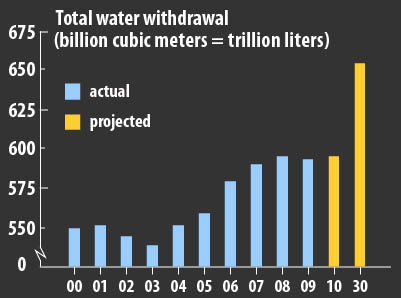
Fresh water needed for mining, processing, and consuming coal accounts for the largest share of China's industrial water use, a fifth of all the water consumed nationally. Though national conservation policies have helped to limit increases, water consumption nevertheless has climbed to record highs. China's total water resource, according to the National Bureau of Statistics, has dropped 13 percent since the start of the century. In other words China's water supply is 350 billion cubic meters (93 trillion gallons) less than it was at the start of the century. That's as much water lost to China each year as flows through the mouth of the Mississippi River in nine months. Chinese climatologists and hydrologists attribute much of the drop to climate change, which is disrupting patterns of rain and snowfall.Choke Point: China, though, is not necessarily a story of doom.
We found a powerful narrative in China in two parts, and never before told: First is how effectively the national and provincial governments enacted and enforced a range of water conservation and efficiency measures that enabled China to progress as far as it has.
Second is that despite the extensive efforts to conserve water, and to develop water-sipping alternatives like wind and solar energy, China still faces an enormous projected shortfall of water this decade to its energy-rich northern and western provinces. How government and industry leaders respond to this critical and unyielding choke point forms the central story line of the next era of China's unfolding development.
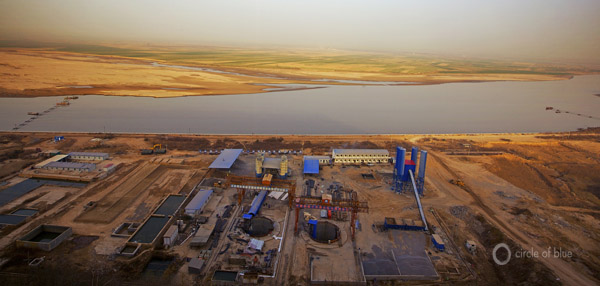
Photograph © Aaron Jaffe/Circle of Blue
Our 2024 Coverage Needs You
It's Another Trump-Biden Showdown — And We Need Your Help
The Future Of Democracy Is At Stake
Our 2024 Coverage Needs You
Your Loyalty Means The World To Us
As Americans head to the polls in 2024, the very future of our country is at stake. At HuffPost, we believe that a free press is critical to creating well-informed voters. That's why our journalism is free for everyone, even though other newsrooms retreat behind expensive paywalls.
Our journalists will continue to cover the twists and turns during this historic presidential election. With your help, we'll bring you hard-hitting investigations, well-researched analysis and timely takes you can't find elsewhere. Reporting in this current political climate is a responsibility we do not take lightly, and we thank you for your support.
Contribute as little as $2 to keep our news free for all.
Can't afford to donate? Support HuffPost by creating a free account and log in while you read.
The 2024 election is heating up, and women's rights, health care, voting rights, and the very future of democracy are all at stake. Donald Trump will face Joe Biden in the most consequential vote of our time. And HuffPost will be there, covering every twist and turn. America's future hangs in the balance. Would you consider contributing to support our journalism and keep it free for all during this critical season?
HuffPost believes news should be accessible to everyone, regardless of their ability to pay for it. We rely on readers like you to help fund our work. Any contribution you can make — even as little as $2 — goes directly toward supporting the impactful journalism that we will continue to produce this year. Thank you for being part of our story.
Can't afford to donate? Support HuffPost by creating a free account and log in while you read.
It's official: Donald Trump will face Joe Biden this fall in the presidential election. As we face the most consequential presidential election of our time, HuffPost is committed to bringing you up-to-date, accurate news about the 2024 race. While other outlets have retreated behind paywalls, you can trust our news will stay free.
But we can't do it without your help. Reader funding is one of the key ways we support our newsroom. Would you consider making a donation to help fund our news during this critical time? Your contributions are vital to supporting a free press.
Contribute as little as $2 to keep our journalism free and accessible to all.
Can't afford to donate? Support HuffPost by creating a free account and log in while you read.
As Americans head to the polls in 2024, the very future of our country is at stake. At HuffPost, we believe that a free press is critical to creating well-informed voters. That's why our journalism is free for everyone, even though other newsrooms retreat behind expensive paywalls.
Our journalists will continue to cover the twists and turns during this historic presidential election. With your help, we'll bring you hard-hitting investigations, well-researched analysis and timely takes you can't find elsewhere. Reporting in this current political climate is a responsibility we do not take lightly, and we thank you for your support.
Contribute as little as $2 to keep our news free for all.
Can't afford to donate? Support HuffPost by creating a free account and log in while you read.
Dear HuffPost Reader
Thank you for your past contribution to HuffPost. We are sincerely grateful for readers like you who help us ensure that we can keep our journalism free for everyone.
The stakes are high this year, and our 2024 coverage could use continued support. Would you consider becoming a regular HuffPost contributor?
Dear HuffPost Reader
Thank you for your past contribution to HuffPost. We are sincerely grateful for readers like you who help us ensure that we can keep our journalism free for everyone.
The stakes are high this year, and our 2024 coverage could use continued support. If circumstances have changed since you last contributed, we hope you'll consider contributing to HuffPost once more.
Already contributed? Log in to hide these messages.