On March 22 we observed another World Water Day, and this week we marked the fifth anniversary of the military conflict in Iraq. Water and war are bound together by more than the coincidence of time -- they are related by blood. Drought and Deluge are the weary parents of Desperation, Destruction and Despair.
Five years ago Mikhail Gorbachev, the former leader of the Soviet Union, put his heart forward on the podium as he addressed the media at the World Water Forum in Kyoto, Japan. Impassioned, he pleaded for the world to awaken from apathetic stupor and respond to one of the world's greatest unfolding tragedies. The simple lack of safe drinking water, he said, condemned thousands of children to die each day -- a needless, inexcusable tragedy. The drama of this appeal, coming from a man whose iron nation had rusted from within, spoke to the classic theme of the rise and fall of man. Only this man was determined to get up again and carry future generations on his shoulders.
I had a chance to interview Mr. Gorbachev at the forum, and I felt optimistic that his message was at last going to get some attention. The press corps seemed tuned in to a good story. But as he talked to me, I saw, out of the corner of my eye, that the video monitors in the halls were being tuned away from forum coverage and into CNN. The Iraq war had begun, and the flames of conflict drew all eyes away from the ticking time bomb of water. Mr. Gorbachev was whisked away to do commentary on the war, his attempt to save the world's resources evaporating behind him.
I cannot know what was on his mind just then. I wonder, if like me, he suffered a deep pang of irony. We drop our gaze from water when violence burns us. And yet, if we are to conquer war, we must court water.
Jeffrey Sachs, Director of the Earth Institute at Columbia University and Special Advisor to United Nations Secretary-General Ban Ki-Moon on the Millennium Development Goals, was a guest on NPR's Diane Rehm Show this past Thursday. She asked him about water, which, she said, many have called the gold of the 21st century.
"If you look at where the violence in the world is right now" Professor Sachs said, "in the worst cases -- places like Darfur, Sudan, like Somalia, like the Middle East, like Pakistan, Afganistan -- these are all water-stressed regions. We call them Islamic fundamentalist regions. We should call them water-stressed regions. We should understand that these are places that are hungry, where livelihoods have been put in grave danger, where old, traditional ways of living such as pastoralist communities are under life and death threat. And we then blame religion or we blame militarism or we blame terrorism without understanding those are symptoms of a much deeper challenge, and water is at the center of it...And we're already, in my opinion, seeing the resulting violence that can come from it. We send the army in response -- we solve nothing. We spend tens or hundreds of billions of dollars. We need to send engineers, not the army. And it's until we understand that the fundamental problems need to be addressed -- not the symptoms -- we're going to continue to get it wrong, waste lives, waste our money and not find solutions."
I think the engineers should have company. As Peter Gleick, founder of the Pacific Institute and a central advisor to our own journalism project, Circle of Blue, asserts, we have the technology. What we're missing is the political will.
Political will comes from engaged citizens, and engaged citizens require information, motivation and inspiration. That's where journalists come in, and we have real heroes when it comes to covering the world's conflicts. The Iraq war, for example, has become the most dangerous war for reporters in history, according to Andrew Marshall, former Iraq Bureau Chief at Reuters.
"Covering the news in hostile places is a worthwhile thing," Marshall says. "It can bring about change, it can inform the world. And it is worth us risking our lives."
Marshall's commentary introduces the new multimedia presentation, "Bearing Witness," produced by Reuters and MediaStorm, the Emmy-winning online production company in New York. In "Bearing Witness," we see, hear and feel the intensity of the conflict and horror of war. A father clutching his young, dead son, soldiers leaping from a burning military vehicle, mothers in gut-wrenching despair for their lost families.
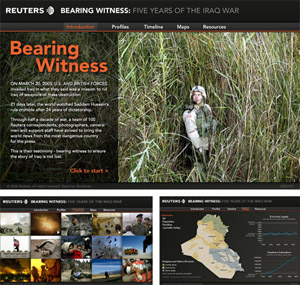
Words alone can't put the war and its reverberations into perspective. But MediaStorm and Reuters have pulled together, in one package, one of the most comprehensive, iconic multimedia and photojournalism presentations about the Iraq war. Its timeline is richly illustrated with captivating imagery that creates a visceral historical context. This is the kind of coverage that has brought scrutiny to the premise and practices of modern war.
This is the kind of coverage we need to focus on water and our other great challenges. And not just on the drama of tragedy, but also on the promise of opportunity. We have to bear witness and give water the global stage that eluded Mr. Gorbachev at that ill-fated forum. We have to connect water issues to our world affairs and, more crucially, our daily existence. If I might take a turn from Mr. Marshall, I am convinced that covering water extensively and deeply is a also worthwhile thing. It can bring about change. And it is worth us investing our lives.
I believe it can be done, starting with the courage and talent of journalists, and extending into the arts, sciences, education, culture and all the ways we as a society speak amongst ourselves. We can look farther and deeper into the roots of violence and show how very often water lies there. We can make the subtleties and complexities of a fundamental subject compelling, personal and comprehensible. We have the technology. We as communicators must summon the will.
The world water crisis is tapping on the world's front door. Drought and Deluge's children are already at home in so many places. Let us remember Mr. Gorbachev's plea, and turn our conflicts into collaborations. And let us turn our attention to the young citizens of the world. Their future is ours to write.
See Related:
Water and Conflict Chronology
Last week at Circle of Blue we launched WaterNews, a daily update from the front lines of the world's water crisis. This coverage is expanding to include additional comprehensive journalistic and scientific reports of this complicated, yet crucial story that's touching everyone.