iPhone app iPad app Android phone app Android tablet app More

Featuring fresh takes and real-time analysis from HuffPost's signature lineup of contributors
Jack Jennings

GET UPDATES FROM Jack Jennings
 

Teacher Pay: U.S. Ranks 22nd Out Of 27 Countries

Posted: 08/30/11 01:53 PM ET

A few weeks ago, yet another study showed American students being outpaced in mathematics achievement by students in other countries. In "Teaching Math to the Talented," published in the winter 2011 edition of Education Next, researchers from Stanford and Harvard compared U.S. math achievement at the advanced level with that of 56 other countries. They found that American students ranked about in the middle. Other international studies of core subjects have similarly concluded that U.S. students perform around or somewhat above the average for participating countries.

What has not received sufficient attention is a comparison of the salaries paid to teachers in the U.S. and countries -- and whether there could be a connection between salary levels and student achievement.

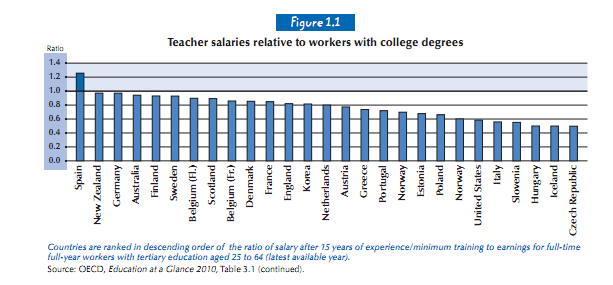
A few months ago, the widely respected Organization for Economic Co-operation and Development released Building a High Quality Teaching Profession: Lessons from Around the World, which analyzes how high-performing countries have created highly professional and effective teaching forces. Included in this report is a telling chart which shows that American teachers are paid less than teachers in many other countries.

For each participating nation, OECD calculated the ratio of the average salaries of teachers with 15 years' experience to the average earnings of full-time workers with a college degree. The U.S. ranked 22nd out of 27 countries on this measure. In the U.S., teachers earned less than 60% of the average pay for full-time college-educated workers. In many other countries, teachers earn between 80% and 100% of the college-educated average.
2011-09-28-Screenshot20110928at5.54.11PM.png

To address this issue and make teaching in the U.S. more attractive, U.S. Secretary of Education Arne Duncan has called for teacher salaries that start at $60,000 and eventually rise to $150,000 -- far higher than current teacher pay in nearly all U.S. school districts. Clearly, compensation is not the only reason why people do not go into teaching, but it is a major consideration. As Secretary Duncan said in a speech to the National Board of Professional Teaching Standards on July 29:

Money is never the reason why people enter teaching, but it is the reason why some people do not enter teaching, or leave as they start to think about beginning a family or buying a home. Today, too often the heart-breaking reality is that a good teacher with a decade of classroom experience is hard-pressed to raise a family on a teacher's salary.

Last year, McKinsey & Co, a major market researching firm, concluded that the U.S. was not attracting enough higher-performing college students to teaching. (See Closing the Talent Gap: Attracting and Retaining Top-Third Graduates to a Career in Teaching.) To make U.S. teacher salaries competitive with those of other careers open to top students would mean paying teachers around $65,000 to $150,000 a year. McKinsey found that three high-achieving countries recruit all of their teachers from the top third of the academic talent pool. In the U.S., by contrast, top-achievers account for 23 percent of all new teachers and just 14 percent of new teachers in high-poverty schools.

Secretary Duncan, OECD, and others who have studied how to improve the quality of our nation's teaching force have rightly called for a comprehensive approach that will lead to greater professionalization of teaching. On one hand, teachers must have greater autonomy similar to other professionals, and they must have the tools, resources, and support needed to be professional. On the other hand, there must be much greater rigor in admitting people into teaching and in determining who should stay in the profession. Higher salaries are a fundamental, indispensable ingredient for both new and veteran teachers.

The quality of the teacher is the most important school-based factor in determining how well a student will do academically. Common sense tells us this, and research, such as the Tennessee longitudinal study, has confirmed it.

If teachers are so important, why don't our schools attract and keep the best teachers? We have many good and dedicated teachers, but not always the best. A major reason is that we aren't willing to pay excellent teachers what they deserve. Further, we aren't willing to make other changes to ensure a high-quality teaching force.

It is difficult to advocate for higher salaries for teachers during these hard economic times, but we aren't going to make long term progress economically if we don't have a better educated citizenry. Business leaders have been saying this for years. Paying teachers higher wages and getting and retaining good teachers is integral to achieving that goal.


  • Comments
  • 220
  • Pending Comments
  • 0
  • View FAQ
Comments are closed for this entry
View All
Favorites
Recency  | 
Popularity
Page: 1 2 3 4  Next ›  Last »  (4 total)
HUFFPOST SUPER USER
roaddawg31
11:53 AM on 09/02/2011
We throw money at education like crazy. We spend spend spend--for what? While teacher salaries according to this article rank low, the spending on education in America is probably at the top of the list (of countries).

The reason I bring this up, is that TEACHERS (public school teachers) are the ones who refuse talk of an overhaul of the system that siphons off money from the classroom, that keeps them comfortably employed, and insulated from any accountability in/& of economic concerns...

I talk about a fundamental revamping of this corrupted system. Invariably, teachers respond and say we don't need it. Either they are precisely the LEMMINGS that this seems to indicate, or they realize that in revamping the system, the comfy nook that they've had built for themselves will suddenly be exposed.
11:45 AM on 09/03/2011
Teachers aren't resistant to reform. Teachers are resistant to reform led by inexperienced leaders who know little to nothing about teaching. And having been a student does not constitute experience. If your job were to do an overhaul, I'm sure it would be led by someone in that profession. Education requires the same thing. Teachers listen to and respect leaders who speak from experience. In all this talk of overhauling the system, politicians, business men, and the American public have dominated the discourse and dismissed teacher input. Out of all those people, teachers are the only ones in the classroom. Sorry, but when I need the advice of my doctor I don't turn to a fellow patient.
HUFFPOST SUPER USER
raggedhand
07:52 PM on 09/03/2011
Teachers are not resistant to reform. I'm an effective teacher and I'd love to have the opportunity to be paid for the amount of time, effort, and expertise I put in a classroom. I'll show anyone, any day, any time why I'm an effective teacher and why I should be paid more.

Teachers are resistant to BAD reform ideas that simply cut classroom support to the bone. I can't tell you how many times in my career I've been told of some reform that is billed as the next best thing since sliced bread and all it does is generate money for consultants, more non-productive work for me and zero benefit to my students. THOSE reforms I'm resistant to.

Over the years the loudest reformers seem to have the least experience with what is really going on in the public school class room. Just because you can eat doesn't make you a cook and just because you sat in a classroom in 9th grade doesn't make you an expert on education.
01:11 AM on 09/02/2011
You get what you pay for, folks! If you want good teachers, you have to pay them well and treat them with respect. We do neither - for the last 20+ years, educators have been the first to lose funding, both nationally and regionally. Why? Their value is "invisible." We don't realize what their worth is until years down the road. A HUGE reason for the "dumbing down" of America is that teachers are not allowed to teach our kids how to actually think, only to take tests. We should ALL be ashamed at the future to which we are consigning our children. Third world countries will take the US down because the US population will not be able to out-think them.
photo
HUFFPOST SUPER USER
TFT
It's the poverty, stupid.
02:15 PM on 09/01/2011
"The quality of the teacher is the most important school-based factor in determining how well a student will do academically."

So true! What is implied with the above quote is that teachers are more important than anything else, but we know that is not the case--there is a mountain of research, since the 60's, that shows us the MOST important factor impacting a child's education is socioeconomic status of the child's parents.

Views differ, but somewhere between 60-90% of factors influencing a child's ability to do well i school come from home. That means that the ever so important teacher can effect between 10-30% of variables in a child's education.

These numbers therefore indicate that SES and poverty have more to do with student outcomes than ANY in-school factor, yet reformers ONLY look at in-school factors.

Are they so narrow that they don't get it? Or, are they greedy entrepreneurs looking to marketize our public education system.

You decide.
08:14 PM on 09/01/2011
The quotation you cite includes the words "school-based factor," which does not include parents or SES. As I read it, the author is stating that research that indicates that above all of the other factors within the school itself (i.e. technology, playing fields, musical instruments, etc.), it is high quality teachers that really make the biggest difference.

I have taught for 19 years, and I am married to a spouse with a full-time job, and we struggle every month to keep our household afloat. It would be wonderful if, before I retire (assuming that is still an option for me in 13 years or so), this country would wake up and pay teachers something a tad bit closer to what we are worth.
photo
HUFFPOST SUPER USER
TFT
It's the poverty, stupid.
04:08 PM on 09/02/2011
Right. Since common sense tells us about teachers being important, the only reason--and there is precedent--to say it is to confuse people into thinking teachers are more important than anything, including the lie at home.

Michelle Rhee and her organization are notorious for forgetting to put the words "in-school" factor when discussing factors.

And that is why I made my comment, so there would be no confusion about factors and what the spinmeisters say.
photo
HUFFPOST SUPER USER
Protocolor
空耳モード
01:34 PM on 09/01/2011
"there must be much greater rigor in admitting people into teaching and in determining who should stay in the profession."

Well, America can't afford the pay increases, but you can always apply the "rigor" part! Just start firing "bad" teachers and see how things work out for you.

Hint: I have not applied for work in America in a couple years now (I'm an expat again), but I still get email from principals trying to staff their math departments. I suppose it is possible that those math departments have teachers that need firing, but then who will replace them? Certainly not me, as they are not offering enough in term or either compensation or administrative and community support.
04:28 PM on 08/31/2011
Raise teachers' salaries because they deserve it (and they do), but not because you think it'll make the education system better. It won't. Those people aren't primarily motivated by money.

If you want to make the education system better, you're going to have to go after the root cause of why it fails, when it does. That's poverty and inequality, and parents and communities that don't value education, or have more immediate concerns. But you might have to raise taxes on the rich to address that, so I'm not holding my breath.
09:19 AM on 08/31/2011
Those who worry the US will never do as well is based on drawback of the variety of cultures and languages faced within the US system. However Canada teaches in 2 official languages and within those two major language blocks there are a variety of languages that must be accomodated where the official language is the second language at home. For instance Ontario has the best outcomes in the English Speaking world but Toronto is 50%+ non Caucasian and 25%+ of all Canadians were born somewhere else and did not speak either of the 2 languages. I think the the US ain't serious about the problem or she'd solve it.
HUFFPOST SUPER USER
cmr86
Reality. Progressively-based.
11:01 AM on 08/31/2011
Most Europeans are, at the very least bilingual, too.
photo
HUFFPOST SUPER USER
Gurinder Dhillon
Federal Reserve is as Federal as Federal Express
08:43 AM on 08/31/2011
Well that explains why we are ranked 17th overall in education, in South Korea they call teacher nation builders, in Finland the leader in education, teachers can only be the elite of their doctorate graduate class, and in America we call our teachers a big part of the problem. We need to get rid of the seniority system in the public school system in America, a teacher who's been teaching about the Renaissance for 10 years, and that has seniority doesn't care about any 1 student enough to truly place all their effort into being the best teacher they can possibly be. There's no accountability on Capital Hill, every time test scores in the South drop Republican lawmakers there secretly pat themselves on the back for dumbing down the future electorate even more so they can get by committing more of their crimes.
03:14 PM on 08/31/2011
Actually, our upper-middle class and well-to-do students rank 2nd in the world. What we really have is a (growing) problem related to inequity. Possibly the most important time in a child's learning occurs before they ever set foot in a school. Non-linguistic reading skills, basic language acquisition, and the earliest forms of complex thought all develop most effectively prior to the age of 6. The gap between rich and poor in those skills was the basis for the creation of so many early childhood programs, as well as Sesame Street.

As inequity continues to grow in our country, so too will the disparity in schooling successes.
04:29 PM on 08/31/2011
Get rid of seniority, and you'll get rid of the best teachers in favor of the cheapest. Teaching is like everything else: you get better with practice.
08:22 AM on 08/31/2011
In wisconsin we pay our legislatures 50k a year and when they are in session 88 $ a day not bad for part time work.senator Johnson got elected with the help of a lot campaign money and a big bunch of his own money which he has now paid himself back his starting wage is 170,000 plus all the amenities that go with the job.That is pretty good entry level compensation of course we have,nt heard much from him here so we,re not sure wether he is earning any of it.My son is starting his first year out of college teaching math entry level 35,000 a year pays into his health insurance and retirement.Gov. Walker and his cronies in madison and their backers in the state consider teacher jobs as cushy jobs they are wrong the cushy jobs are the ones that pay 50,000 a year and 88$ a day moonlighting from their day jobs.
07:27 AM on 08/31/2011
Read this to learn about how Rhee's organization rewards politicians who do its bidding:

http://www.dailykos.com/blog/iTeachQ/
04:53 AM on 08/31/2011
Well the spending is going somewhere because supposedly we are third worldwide in per pupil spending behind only Denmark and Switzerland. So if the money isn't going to the teachers it is going to the administrators and bureaucrats.

So while we may need to shuffle around the education spending don't let anyone in fact tell you that we need to throw more money at the problem.

http://www.dailyplunge.com/tag/per-pupil-spending-by-country/
06:33 AM on 08/31/2011
Well toots, I seriously doubt that you have the numbers to prove that if cuts are made to admin pay and "bureaucrats" it will free up enough money to pay teachers what they should be paid. It is careless statements such as these that get us into the political swamps we get into. I think it will cost the taxpayers more money to pay teachers what they should be paid, and we have to decide whether we have the will to do it.
HUFFPOST SUPER USER
cmr86
Reality. Progressively-based.
11:04 AM on 08/31/2011
Agreed. It'll free up SOME money, but not enough. Furthermore, education needs that administrative structuring at both the school site and the district office.
01:16 AM on 08/31/2011
Are we a global economy? Do we believe in free trade? If you say yes, then we no longer believe in subsidies and tariffs. And we no longer believe in America as community. We are all just consumers and workers competing in a global economy. So pay for YOUR kids education yourself. We use H-1B at my company to import plenty of foreign labor. We offshore too. I bet you support that too.

So if you support free trade and globalization you can't turn around and expect me to pay for YOUR kid's school as you offshore jobs.
photo
mlaiuppa
Pres. Sarcasm Society. Like we need your approval.
02:07 AM on 08/31/2011
The people that are making the decisions to offshore jobs and use foreign labor are sending their kids to private school using the tax money they're NOT paying.
06:35 AM on 08/31/2011
The constitution doesn't say "we are a global economy that believes in free trade and America is not a community." It doesn't say that we are a market above all else. On the contrary, we are a nation and we are a community and I want everyone in it to be as educated as possible. I have absolutely no problem understanding why I want that and am willing to pay the taxes to make it happen.
11:29 PM on 08/30/2011
If we are the lowest teacher pay of western democracies, we can add this as a 3rd criteria to this elite club (poor or nonexistent health care and concealed weapon carry). Why doesn't Germany want to join our club?
HUFFPOST SUPER USER
francisco cortes
10:53 PM on 08/30/2011
Teachers do not get paid good because of human nature. Here in Puerto Rico a teacher make from $800 to $1,200 per month in private school meanwhile a car salesman in Puerto Rico can make from $2,500 to $7,000 per month. The car sales man sells something the customer need and want to buy a car therefore he or she makes good money but a teacher sells something the customer need but do not want to buy, an education, therefore even in the private schools teachers do not make good money.
01:17 AM on 08/31/2011
Uh, you should use "well" rather than "good".
HUFFPOST SUPER USER
francisco cortes
08:48 AM on 08/31/2011
English is my second language, thanks for the tip!
HUFFPOST SUPER USER
cmr86
Reality. Progressively-based.
11:06 AM on 08/31/2011
Uh, English is likely his second language--so chill.
This user has chosen to opt out of the Badges program
10:35 PM on 08/30/2011
I forgot to add to the work conditions list the state of the buildings. So many schools are covered with graffitti, literally falling apart, have mold growing in the walls, rats and other vermin crawling through the ceiling vents, leaks dripping on teachers and students, and much more that most people would not tolerate.
11:02 PM on 08/30/2011
f & f! And many have no air conditioning. Picture that in August and June. My relative won't drink the water at her school, it comes out brown.
This user has chosen to opt out of the Badges program
12:36 AM on 08/31/2011
I hear you. No air conditioning or windows in my room either (which is really an office I share with the school psych; I put a small table and some chairs in for the students),--which is really a room was split in two and I got the part with no windows, only cracked skylights. I used to have a real classroom three years ago (shared with school psych and occupational therapist) but it got taken over for the students too violent to be with other students. Only three water fountains have decent water and one is almost always out of order. We all bring our own water from home, including the students.
01:19 AM on 08/31/2011
I can import workers from all over the world using H-1b work visas. Obama wants more work visas so we can import even more workers. So why should I spend money on US schools? Its a global economy. I am not expected to pay for the schools in India and yet I can import workers from there for free!
04:50 AM on 08/31/2011
And lose your customer base in the process and drive this country further down the drain.
06:39 AM on 08/31/2011
And that is the truth about why our educational system is declining, esp. at the college level. In European countries, at least, perhaps elsewhere, a university education is tuition-free. So people get educated in their home countries and then come to the US to use their credentials. Businesses know this and have no interest in investing in education in the US; they certainly would fight tooth and nail against tuition-free university education. The truth is they don't care one bit about ed in the US. They can import the educated workers they need.
This user has chosen to opt out of the Badges program
10:25 PM on 08/30/2011
Even with all the talk about salary/pay, to me working conditions are even more important.

How many people with the education level of teachers are routinely sworn at, have things thrown at them, are assaulted, or (although rarely) been maimed or killed on the job?

In addition to the job for which they were hired ( which was to teach academics or whatever the area of specialty is), teachers are also expected to practically raise the students and teach them everything their parents have neglected to take the time to do.

Then, daily in the media, the entire profession is castigated for not curing every single social ill under the sun and for that over which they have no control or influence. Then, the media heaps praise on the "reformers" who make teachers' jobs even more difficult--even though many of them have little or no teaching experience themselves.

Also, more and more is expected with less and less money in the budget for materials and equipment. Many schools must have security officers to keep a modicum of safety. And, finally, teachers are expected to buy for students out of their own pockets.

If teacher retention is going to be seriously addressed, I would like to see all of the above included as issues to discuss and resolve.
11:03 PM on 08/30/2011
Violence against teachers:

From 1997 to 2001, teachers were the victims of approximately 1.3 million nonfatal crimes at school, including 817,000 thefts and 473,000 violent crimes (rape or sexual assault, robbery, aggravated assault, and simple assault).

Among the violent crimes, there were 48,000 serious violent crimes, including rape or sexual assault, robbery, & aggravated assault.

On average, these figures translate into a rate of 21 violent crimes per 1,000 teachers, and 2 serious violent crimes per 1,000 teachers annually.

Urban teachers were more likely than rural & suburban teachers to be victims of violent crimes (28 vs. 13 and 16 crimes, respectively, per 1,000 teachers). It's less for the burbs, but not minuscule.

http://nces.ed.gov/pubs2004/crime03/9.asp
06:41 AM on 08/31/2011
These issues would be addressed if there were real unions, but since those are being gutted and rendered powerless, do you think anyone will care about the safety of teachers? I don't think so. Another truth that is never spoken in the debate about ed in the US.
photo
HUFFPOST SUPER USER
Grogger
Nothing is guarded more fiercely than unfair gain
10:21 AM on 08/31/2011
You are exactly right, anyone with half a brain can see the reality of what teaching really is, and that includes me. Teachers and real education are not truly appreciated or valued in this country, it's all BS lip service to increase student enrollment and perpetuate the myth that college leads to success, it's marketing. You could say the exact same thing about the "American Dream" and that people aren't buying into any longer, they know damn well that hard work and decency DO NOT lead to success!