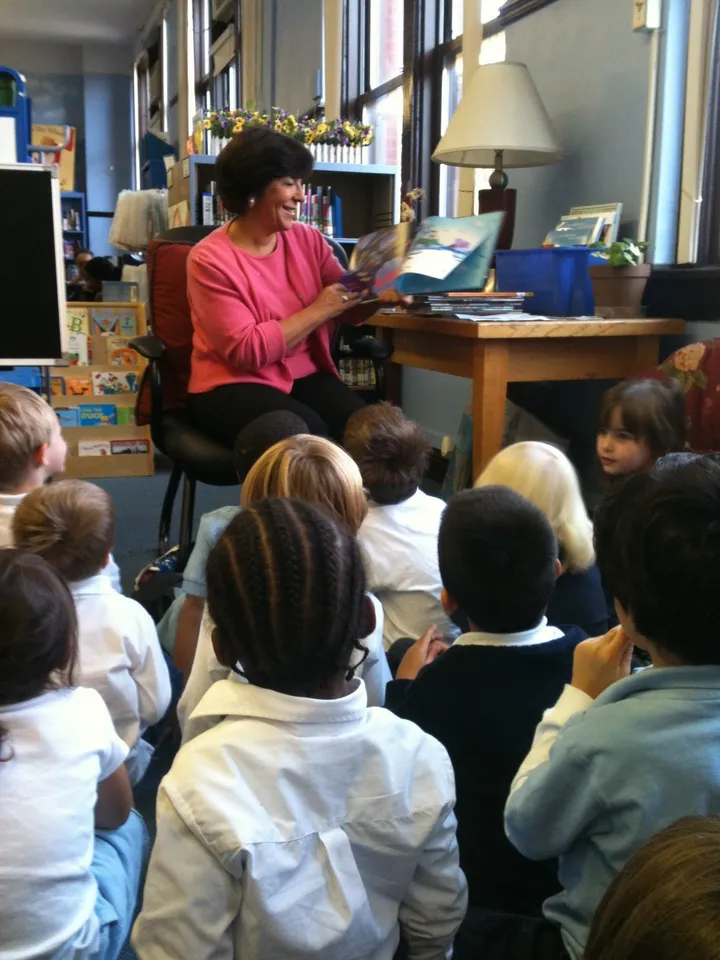
In the hothouse terrarium that is Chicago politics, a stormy debate over teacher accountability is looming large.
One thing everyone seems to agree on is that a quality classroom teacher is the single most important school based input-factor in student performance and lifetime achievement. The evidence has been mounting for years, but a recent groundbreaking study by superstar Northwestern economist and fellow Nettelhorst mom Diane Whitmore Schanzenbach actually quantifies it. Diane's team found that when a student moves from a below-average teacher to an above-average teacher, the child's adult earnings rise by about 3.5 percent per year, amounting to more than $10K in additional lifetime income. When you multiply a teacher's impact by the number of students in each class, a great teacher adds a whopping $320K in extra lifetime earnings to her entire class!
So, if a great teacher produces great results, what does an ineffective teacher produce? Turns out, it's a pretty shoddy product. A recent study by Eric Hanushek, the Hanna Senior Fellow at Stanford's Hoover Institute featured in Waiting for 'Superman,' proves that an above-average teacher produces a year and a half's worth of normal test score gains in a single academic year, while a below-average teacher raises their students' scores by only a half a year. Consequently, unlucky children saddled with poor teachers fall further and further behind.
In a city like Chicago, which suffers from a colossal achievement gap (only 6 percent of CPS high school freshmen will graduate from college), the disparity might seem insurmountable. Not so, says Hanushek. A great teacher can bring even the lowest performing students up to grade level in just three years. If great teachers, or even merely average teachers, replaced their lowest performing counterparts, Hanushek predicts the nationwide economic impact due to increased test scores and higher future earnings would amount to $100 trillion, roughly the same number of clams required to wipe out the entire national debt.
Knowing all this, it is maddeningly unclear why principals cannot easily remove the poorest-performing teachers from their schools, a fact I wouldn't have believed if I hadn't seen it with my own eyes. Eight years ago, when our group of mommy reformers first set foot in Nettelhorst, our neighborhood's underperforming and underutilized public elementary school, some teachers walked the hallways muttering obscenities, and one even had a restraining order against her for hitting students. I'm not saying these folks didn't love their craft, or that maybe, once upon a time, they were even decent educators, but by any reasonable standard, they didn't belong in any classroom, my kid's or anybody else's. We knew who shouldn't be there, the principal knew it, the students sure knew it, and so did all the other teachers. The stoic union investigators dispatched from central office even seemed to know it, too.
We didn't have time to sit around waiting for a Kafkaesque lumbering bureaucracy to self-correct. Our principal gave the curriculum team carte blanche to review curriculum and financial plans, weigh-in on hiring decisions, and most importantly, access to document teaching styles. Funny thing happened: with all those pesky parents roaming the halls and peeking into classrooms, within two years of our reform movement, almost every single ineffective teacher left Nettelhorst, voluntarily.
Unfortunately, it doesn't take too many disgruntled teachers to contaminate a staff. When the most negative forces left, the school's extremely toxic teaching climate improved dramatically. Test scores tripled across every demographic. My kids, who started at Nettelhorst in preschool, are now in fourth and sixth grade, and I'd put their education--one without any gifted program, selective enrollment or tracking system--on par with any private school in the country. Our teachers are that good.
While we can all cheer the parental pressures that helped to transform my little neighborhood school, and celebrate the extraordinary, award-winning teaching that's happening on the corner of Melrose and Broadway, the question still remains: In what backwards universe could adults allow this deplorable situation to fester? What about all those public school kids who don't have hyper-involved parents advocating for them, day in and day out?
In nearly every profession, job performance is reviewed annually, and individual excellence is recognized and rewarded. In Chicago, however, most teachers receive lifetime tenure after working just four years with "satisfactory" performance, a rubber-stamp rating that's given out like PEZ. Imagine running a business with tenured employees who only need to demonstrate "competence." Imagine a system that makes it nearly impossible to remove individuals who fall short of expectations. What would your workplace climate feel like? And, what kind of product would you produce?
In Springfield, home of Lincoln and all things straight and true, our representatives are debating a sweeping reform initiative called Performance Counts which links tenure to student academic growth, streamlines the dismissal process of ineffective teachers, and also makes the contract negotiation process more transparent and focused on what's best for children. The proposed legislation has some pretty sharp teeth:
While the usual suspects have lined up against the bill, some critics agree with its substance, but object to what they say is a rushed approval process in a lame-duck session. Gosh, we've been at this for years now, including last year, when all the stakeholders sat around the table hoping to grab a piece of Obama's $4.35 billion Race to the Top pie (FYI: still hungry). Here, at last, is legislation born from last year's hard-earned consensus. Like so many problems that seem intractable, I wonder how much money and clout is at play when various stakeholders drag their feet.
Let's be clear: I love, love, l-o-v-e teachers. You couldn't pay me enough money to spend all day in an elementary school classroom. I was also weaned on unions; during the teacher strikes in the seventies, my professor mom, who once taught seventh grade at Brooklyn's Ditmas Junior High School, kept us home for weeks in solidarity rather than cross a picket line (backgammon anyone?). That said, our current system's so out of whack that a step in any direction would be a net positive.
At the start of this shiny New Year, all full of hope and possibility, will our state legislators be bold enough to put kids first? And if they do, will the rest of country follow suit?
For the sake of my two little kids, and all their pals, fingers and toes crossed.
Follow Jacqueline Edelberg on Twitter: www.twitter.com/walktoschool
Tina Barseghian: Napa New Tech High: 5 Reasons This is the School of the Future
SUNY?Fredonia helping transform teacher education
The big squeeze is on in California classes
Toni Lardinois in 1st year at helm of education association
EDUCATION: Wesley College teaching program loses accreditation
GEHS teacher earns financial specialist title
I get the point about lousy parents but why shouldn't teachers be held to the same standard?
Sorry about raising my voice. I've calmed down now.
As we value children holistically, we need to look at schools that way too. I would like to see evaluation of data on the long term significance of a great team environments in learning communities.
A confluence of factors can support an ideal learning environment, and they're not the same in every community. Not every teacher is a fit for every child. As well, having worked in many private sector and public sector jobs, I think it's wholly unrealistic to expect every employee to be rated (and by whom?) a "rock star."
My child's school is a dual language environment. Research (Thomas & Collier) indicates that children perform on average, just below average standardized test scores until they've been in a dual language program for 4 to 6 years. After that, they outperform their monolingual peers. So should our teachers in lower grades be dinged because the cumulative effect of our curriculum demonstrates efficacy over the long term?
I truly worry that schools will lose the courage to adopt innovative curriculum techniques since tying student performance so literally to teacher tenure/evaluation will punish, and not reward it.
Dont' give me kids in 8th grade performing at the 4th grade level and expect me to get therm ready for 9th grade.
Don't tell me I am resonsable for the grades of kids who miss over 1/4 of the days in class.
Don't put special ed disrupters into my classroom and then expect me to control them and teach everyone equally.
Don't give me parents who never return phone calls but then complain when I fail their kid at the end of the year.
I and many teachers have faced everyone of these situations.
We really have to get out of the trap of thinking of everything in terms of the former. The question is: "what changes can we make to fix the problem?" And news flash - the answer won't necessarily be the same as the answer to "what are the causes?" We can't fix poverty (we've been trying for 50 years now, and it hasn't worked). Not saying we should give up on that, but we DO know that we can make a dramatic impact on education outcomes by ensuring that every child has an excellent teacher every year. Why wouldn't we do that, if we care about kids?
It makes sense to me that if a patient needs surgery that you would operate on the correct part of the body, not on a different part of the body, just so you can say you did something! Your goal should be to save the patient or not to decieve poor parents who already are overwhelmed.
The problem can only be fixed by addressing its source. These children need more time (hours) in school: longer days, longer school year. Who says school has to end at 3 o'clock? Excellent teachers are willing to do whatever it takes, but somebody is going to have to pay for it!
These students can learn, but instructional time is differnt than learning time. The learning time should be done after school hours, this is where the ball gets dropped. There is no way a teacher can teach and conduct study hall (in which memory work, homework, research is done)
You are fooling yourself (and whomever will listen to you) if you think that 8 to 3 is enough time to do it all!
2) In the inner city, the most senior teachers are assigned the most challenging students: the poorly motivated (from years of being passed on due to social promotion), non-English speaking students, mainstreamed Special Ed students, the most severe behavior problems, students with transiency and attendance problems, etc. are assigned to these teachers.
3) New teachers, especially the TFA teachers, are assigned the most motivated, easy to teach students in the inner city.
4) The quality of students from year to year makes a big difference.
5) Motivation and effort may decrease as difficulty level and demand of work increaes,espcially if the child is not supported in the home.
Research studies need to be duplicated by other reseachers to be considered valid and reliable. Using unreliable research amounts to one persons opinion.
I support the assessment and evaluation of teachers, and it having an effect on hiring and firing.
I do caution against any of the current "value added" formulas as the basis. Studies have found a wide margin of error. Its proponents make it sound straightforward, but its anything but.
Interestingly, the Gates Foundation is in the middle of a two year attempt to study teacher evaluation, and discovered that STUDENT feedback, when carefully crafted and accounted for, is a highly effective evaluative tool. A sample question asks students to evaluate the level of wasted time in the classroom...so yeah, lets work to evaluate teachers AND
cut class size AND
return school curricula to their former broad reach (not just language arts and math) AND
offer holistic social reform, because
Teachers are the biggest "in school" input. But they are dwarfed by other factors, and blaming them for all the system's problems is simplistic, narrow and unfair.
Finally, I cannot accept that any step is a net positive. With one step I can leave my brooklyn sidewalk and be in the path of a bus. Not a net positive.
-Teachers do not control the curriculum (NCLB does)
-Teachers do not control the amount of books, supplies, computers, materials, etc. they receive (the schoold budget controls this)
-Teachers do not control classroom behavior (Parents, School Boards, & Administrators control this)
-Teachers do not control if students come to school, do homework, or study for tests (parents control this)
-Teachers do not control student accountability (State School Board Social Promotion Ed code ensures there is no student responsibility). Social promotion means students get promoted from year to year, NO MATTER IF they "FAIL" EVERY SUBJECT, based on their ages.
-Teachers do not control the large class sizes of 30-40 students (School Board controls this)
-Teachers do not control the length of the school day or the length of the school year
THE CLASSROOM IS CONTROLED BY OTHERS BUT THE TEACHER IS THE ONLY ONE HELD ACCOUNTABLE...............TOO MUCH SCAPEGOATING!
This is a problem.
Lets say I am a teacher who has worked for 23 years. Lets say I am good, not great but good. Lets say the new teachers, who have worked for two years are very good. Lets say layoffs are coming. Firing the teacher who has worked for 23 years does not seem right in this situation. It seems like a betrayal.
I think seniority should be part of the decision making process.
To be fair I am a good, though not great, teacher who has been working for 17 years.
Not quiet. In case you havent noticed, US EDUCATORS exercised our democratic right and voted in a much more dedicated Union leadershipÂ. This new leadership (CORE) hit the ground running by allying itself with community groups much like yours and proposed bold initiativeÂs that would hold teachers accountablÂe without gutting whats left of public education.
The "usual suspects" that you mention in your blog are not the teachers who work their butts off day in and day out. But instead its these outside groups and privateers who wish nothing more than to break our union and establish private charter schools.
Before you become a mouthpiece for these non-educatÂors, take a look at what WE EDUCATORS (you know, the ones that are trained to teach) are proposing.
http://wwwÂ.ctunet.coÂm/legislatÂive/studenÂts-count-pÂlatform
Not quiet. In case you havent noticed, US EDUCATORS exercised our democratic right and voted in a much more dedicated Union leadership. This new leadership (CORE) hit the ground running by allying itself with community groups much like yours and proposed bold initiatives that would hold teachers accountable without gutting whats left of public education.
The "usual suspects" that you mention in your blog are not the teachers who work their butts off day in and day out. But instead its these outside groups and privateers who wish nothing more than to break our union and establish private charter schools.
Before you become a mouthpiece for these non-educators, take a look at what WE EDUCATORS (you know, the ones that are trained to teach) are proposing.
http://www.ctunet.com/legislative/students-count-platform
How wonderful you are to want to fire people in a profession you know nothing about and are truimphing the propoganda corporate WFS.
Here is is for you-we do not have magic teachers who fix all the problems of the world. You can interchange all the teachers from the high SES schools and the poor schools and guess what the
poorer schools will still have problems. Stop trashing working people in the helping professions and work on helping kids-the needy, the disabled, the delilnquient with social programs. The measure of a person is not how much money they make.