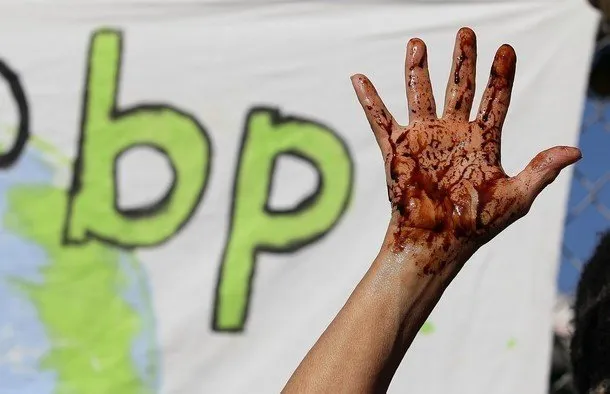
Now there's another reason to hate the company that America hates most--British Petroleum. BP has not only created the worst environmental disaster in U.S. history, it's trying to manipulate and control the news. According to the news blog Powering a Nation, BP had workers sign a contract that included a gag order, preventing them from talking to the media. Even as the birds lay dying in a sea of mud and oil, BP has tweeted, claiming that the company and the U.S. Coast Guard have not muzzled their workers. But according to the blog, there was a clause "prohibiting them and their deckhands from making 'news releases, marketing presentations, or any other public statements' while working on the cleanup."
Even more important, BP is using paid search to influence public opinion as people look for information about the oil spill and its consequences. Just Google any of the common search terms related to the disaster and what pops up first? BP. Since this catastrophe is one of the hot search topics of the year, you can imagine what BP is paying for the privilege of elbowing out other news and opinion sites that would normally buy at least one of these terms. But money talks--and oil money, as slippery as it may be, talks louder than most.
According to Scott Slatin, who runs a New York-based search marketing company, "While we have seen corporations use search-engine marketing to sway opinions, most recently in the health-care debate, it is always under the cover of a non-profit or lobbying organization. This is the first time I have seen a company use this tactic on such a wide scale. And it is very effective, because BP gets its message, 'Learn more about how BP is helping' atop almost every Google search permutation related to the spill, and effectively blocks non-profits (with much smaller pockets) from getting their message across."
The strategy appears to be working, as BP's ads show up on neutral searches like "spill," "gulf oil," "offshore oil," "oil spill," "Louisiana coast spill" and "oil cleanup," but not "oil disaster." And the costs? Slatin says, "I'd estimate that BP is spending at least $7,500 a day to own the top position on searches related to the oil spill on Google, and another $3,000 a day to cover both Yahoo and MSN's Bing." In April, says Slatin, the number of searches on Google for "oil spill" was 2,240,000, versus a 12-month average of 301,000.
In a phone interview with The Fiscal Times on Thursday afternoon, a company spokesperson acknowledged purchasing the search terms but declined to discuss costs. "Yes, you're right, we have been buying up search terms," said BP spokesman Robert Wine. "We've tried to pick terms which will help the people who are most directly affected in the Gulf coast states with information about how to get in touch with us and make claims for loss of earnings."
When pressed for examples of the terms they've bought, Wine said, "Some examples would be 'oil spill' and 'claims.' The main aim is a marketing tool, to help the people who are most directly affected -- fishermen, local businesses, volunteers in the cleanup. We want people to be able to find us, so we can work out how to minimize the impact on their lives and businesses." Wine said it is the BP web teams in Houston and London, together with the company's marketing executives, who are engaged in buying search terms.
BP may have lots of experience helping people it hurts since the company accounts for 97 percent of all flagrant violations in the refining industry, according to an analysis from the Center for Public Integrity. CPI found that the firm has been under intense OSHA scrutiny following a blast in Texas City, Texas, that killed 15 workers. A total of 862 citations were issued to BP between June of 2007 and February 2010. No wonder U.S. Attorney General Eric Holder is conducting a criminal investigation into BP