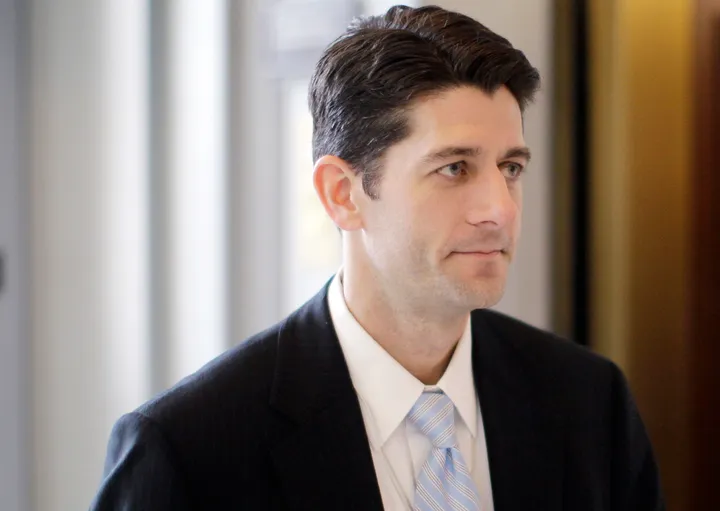
When Paul Ryan unveiled his budget today, he touted it as a "Path to Prosperity" and he and his colleagues kept saying it was "based in fact." In reality, Ryan's claims of prosperity are based on an analysis - written at his request by the conservative Heritage Foundation - that has more basis in magic than economics.
For starters, the Heritage analysis's unemployment projections alone are utter nonsense. It claims that - under the Ryan budget - unemployment will plummet from the current 8.8% to 6.4% next year, 4% in 2015, and 2.8% in 2021. Each number is totally impossible - we'll never see 2.8%, and 4% would require runaway economic growth. As Matt Yglesias points out, the Federal Reserve would respond to that type of growth by raising interest rates to avoid inflation, so the levels forecast could never be reached. (As a reference point, full employment is around 5%, so 2.8% is a total fabrication.)
Furthermore, the Heritage report uses an almost comical conceptual explanation (under the heading "Economic and Fiscal Results" on page 3) of how the tax cuts in the Ryan plan pay for themselves and reduce the deficit. This would be great, if it were actually true. The Bush tax cuts did not come anywhere close to paying for themselves, nor have other large cuts to upper income tax rates. From the Chair of Bush's Council of Economic Advisors, Greg Mankiw:
I used the phrase "charlatans and cranks" in the first edition of my principles textbook to describe some of the economic advisers to Ronald Reagan, who told him that broad-based income tax cuts would have such large supply-side effects that the tax cuts would raise tax revenue. I did not find such a claim credible, based on the available evidence. I never have, and I still don't.
The unfortunately truth is that this Heritage "analysis" represents the lack of reality in which conservative economic policymaking functions. Paul Ryan is getting a lot of credit today for pointing out a large challenge facing America. Sure, we do have a debt problem, but we need to view it in its proper economic context.
America has two large economic problems. The first is an economy that's just not working in the face of rising global competition: a lost decade of median household income decline and wage stagnation followed by a recession and financial crisis from which we have yet to fully emerge. The second is a long-term structural debt problem: the federal government's expenditures far exceed its revenue, and that trend will be exacerbated by rising healthcare costs. And debt is a problem because it can impact the economy itself; it's not right now.
The President's budget is a credible response to the economic challenge: investments in education, infrastructure, innovation, and industries of the future represent a viable economic plan. It also makes down-payments - if incomplete - on long-term debt issues. Let's not forget though, that he already passed the most significant piece of deficit reduction legislation in recent memory - the Affordable Care Act, which the GOP wants to repeal. As former Obama OMB Director Peter Orszag often said, health care reform is entitlement reform. And the Simpson-Bowles fiscal commission report, which Ryan voted against, recommends building on the ACA's cost-controls as a major form of deficit reduction.
Let's contrast the President's approach with the House Republican approach of massive cuts in the near-term and Ryan's budget, which focuses on dramatically reducing the size of government. In the near-term, the House GOP agenda of $61 billion in cuts would, according to McCain campaign economic adviser Mark Zandi, cause 700,000 jobs to be lost by the end of 2012, and, according to Federal Reserve Chairman Ben Bernanke, cause the loss of 200,000 jobs. Goldman Sachs estimates a 1.5 to 2% reduction in GDP.
In the long term, Ryan offers no strategy to make America more competitive, increase employment, or make people's lives better. Rather, he offers reduced benefits, namely to the elderly, the poor, and the handicapped, and cuts taxes for the wealthy. (His one sop to competitiveness is corporate tax reform, which President Obama also favors.) Forget about the immorality of his budget for a moment, (well, don't, it's pretty appalling) the fact is that Ryan's budget offers no real path to economic growth, other than fudged numbers from the Heritage Foundation, and a questionable, slash and burn approach to deficit reduction.
Taken together, it's clear that the GOP isn't focused on the real problems facing the country. At a time when Americans want more jobs and more growth, the GOP strategy - if you believe the analyses of George W. Bush's Federal Reserve Chair, a McCain economic adviser, and Goldman Sachs - is to create less. And, if you believe the analysis of Bush's Council of Economic Advisor Chair, their deficit reduction strategy is deeply flawed too. Unless, of course, you believe the Heritage Foundation's analysis that Paul Ryan's budget is made of magic.
Cross Posted at the NDN Blog.