iPhone app iPad app Android phone app Android tablet app More

Featuring fresh takes and real-time analysis from HuffPost's signature lineup of contributors
James Kwak

GET UPDATES FROM James Kwak
 

Fiscal Affairs: How Long Can We Finance the Debt?

Posted: 03/20/2012 8:55 am

Everyone should know by now that the Treasury Department can borrow money at historically low rates. That is a major reason why some very smart economists think that the federal government should borrow more money in the short term (i.e., this year and next) and use that money to boost economic growth.

In the medium term (say, the next decade), however, the big question is how long we will be able to finance new government borrowing at such low rates. Today's low rates are a product of several factors. One is certainly the slow rate of economic growth, in particular the depressed housing market, which has reduced demand for credit. But another factor is the Federal Reserve's aggressive moves to keep long-term interest rates down; another is foreign central banks' appetite for Treasuries.

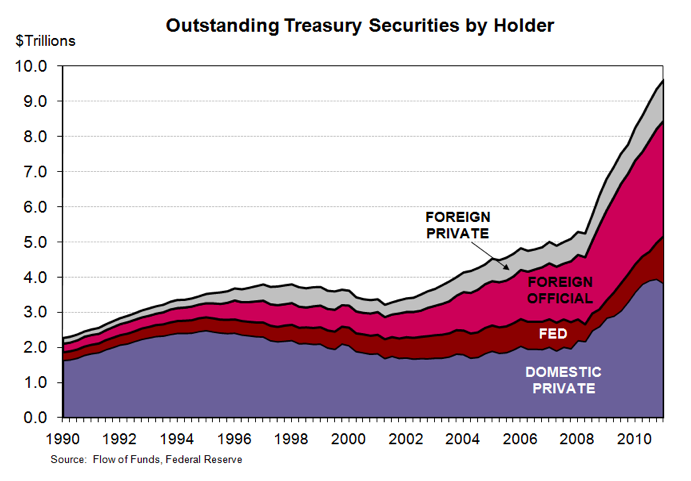
John Kitchen and Menzie Chinn have written a new paper (pre-publication version here) that attempts to disentangle these factors, which Kitchen summarized in a blog post. They show the large and growing role in the Treasury market played by the foreign official sector:
2012-03-20-screenshot20120320at43319am.png

Kitchen and Chinn also measure the impact of purchases by foreign central banks on interest rates. They estimate that as those central banks increase their holdings of Treasuries by 1 percentage point of potential GDP, long-term interest rates (measured as the spread between 10-year and 3-month rates) fall by 0.33 percentage points. Since the Federal Reserve is expected to reduce its balance sheet as the economy recovers, if foreign holdings of U.S. government debt simply remain at current levels (as a share of GDP), they expect that 10-year yields would climb to 7.9 percent by 2020--rather than 5.4 percent as forecast in the CBO's baseline.

The underlying issue is that interest rates have been kept low in part by increasing foreign holdings of Treasuries; so to maintain those low rates, we need foreign central banks to continue buying more and more Treasuries, which cannot go on forever. The policy problem is that we don't want to overreact and shift to austerity prematurely (that is, while we can still borrow money cheaply), but we don't know how long foreign governments will continue increasing their Treasury portfolios.

The current privileged status of U.S. dollar debt is a recent phenomenon, which we describe in chapter 2 of White House Burning, and one that is by no means permanent. This is a major reason why we think that it is important to begin reducing structural deficits during the next decade. And that means we need to have an alternative to the scorched-earth policies of austerity (and tax cuts!) being pushed by Republicans and by a growing number of self-proclaimed centrists.

James Kwak is the co-author of White House Burning: The Founding Fathers, Our National Debt, and Why It Matters To You, available from April 3rd. This post is cross-posted from The Baseline Scenario.


Follow James Kwak on Twitter: www.twitter.com/baselinescene


  • Comments
  • 56
  • Pending Comments
  • 0
  • View FAQ
Comments are closed for this entry
View All
Favorites
Recency  | 
Popularity
Page: 1 2  Next ›  Last »  (2 total)
01:26 AM on 03/21/2012
Why does the US have any debt at all? As Thomas Edison said, any government that can print interest-bearing bonds can as easily print non-interest bearing money. We could reduce the total US debt to zero in a few years by not rolling it over, by paying it down with Treasury-created money as bonds become due. Why don’t we do this? Who benefits from issuing US bonds instead of Greenbacks?

You say we must begin to reduce deficits in the coming decade. Why? Why not pay for deficits with Greenbacks rather than by increasing debt?

True, there is an upper limit – we will see inflation once full employment is reached. But why not incur Greenback-financed deficits till then?
photo
HUFFPOST SUPER USER
joebhed
Greenback Revolutionist
09:17 AM on 03/21/2012
I think its maybe because then they wouldn't BE deficits.
They would be tax-and-Greenback funded balanced budgets.

You are getting close here to hitting the nail on the head.
Mr. Kwak is out in economics la-la land.

The debate NEED not be about the balanced budget.
The debate NEEDs to be about a scientific paradigm change to our view of money.
Nobelist Frederick Soddy discovered the ponzi-nature of our money system, calling it a 'confidence trick'.

Rather than trying to make the budget work, we NEED to make the money system work.

How?

We need to separate "DEBT" from "MONEY".

Money is the national circulating media that provides the grease for the exchange of the goods and services we produce and consume - in the national economy.

Scientifically, there is no reason for money to be created as a debt.

As soon as Mr. Kwak and the other quasi-progressive econs see the monetary light, they will realize that the "confidence trick" nature of debt-based money is an unnecessary fallacy that has driven the quasi-science of economics for 150 years.

The Bill to introduce the Greenback balance to funding our government budgets is available right here.

http://kucinich.house.gov/UploadedFiles/NEED_Act_FINAL_112th.pdf

Thanks.
07:59 PM on 03/20/2012
Mr. Kwak we are not on a gold standard and therefore none of what you are discussing is applicable to our current monetary system.

Please real the following for an easy to understand explanation of our modern monetary system.

http://moslereconomics.com/wp-content/powerpoints/7DIF.pdf
photo
HUFFPOST SUPER USER
Drew Puli Wolf
dog trots freely in the street and sees reality
07:20 PM on 03/20/2012
I agree in the most part with this article. That at some point the debt needs to come down, but only after the economy is fully recovered. That to overreact now and shift to austerity mode prematurely would have disastrous effects, like what is happening in Europe now. What I disagree with is the extent and cause of foreign ownership of US debt. About 70% of US Government debt is held by Americans. The 30% that is held by foreigner has more to do with the Balance of Payments – when we by all this stuff from China they need to do something with the money so they buy US Treasuries (lately they been buying other investments). If you want to lower foreign ownership of US debt buy American. Also left out of the equation is American owned foreign assets (it's like you own money to the bank, but you also own its stock). The amount of American own foreign assets equal about 2/3 of our foreign debt.
HUFFPOST SUPER USER
mwr133
06:33 PM on 03/20/2012
Instead of listening to what pundits and politicians tell you, how about doing some research and look at the numbers for yourselves. For instance, Bill Clinton never had a surplus. The national debt went up every year. Go look at the OMB website. Also, a "cut" in political speak is a reduction in spending increases. We are being misled but people are too dumb to realize it. That is what happens when you get a bunch of lawyers calling teh shots in DC. But hey, as long as I get my free birth control and food stamps, then who cares.
photo
devondx
Totally De-regulate all RED states=JUSTICE..
06:26 PM on 03/20/2012
once we get rid of social security, medicare and medicaid....

then add more tax cuts for the rich....everything will be awesome....
06:05 PM on 03/20/2012
As of today, the Obama administration has added more to the national debt than the Bush II administration did in 8 years.

Just sayin . . .
05:21 PM on 03/20/2012
The negative impact of Lobbyists and Entitlement Fraud such as Medicare (100 billion annual) grow every year. This eats up a major portion of every tax dollar going to our Government. They are the fiscal vampires that suck the life out of our economy. No recovery or debt reduction plan will be effective until Americans declare war on this thievery.
03:37 PM on 03/20/2012
Think about this for a second: I was in a mcro econ class circa 1970 where the prof asked the question: What is wrong with the government debt, we owe it to ourselves? (our debt our savings)

And so it was in 1970. We were a national economy. We are now involved with a global economy where central banks of foreign surplus trading partners have monetized our debt (Treasury notes) to suck up their respect trade surplus'. When the dollar is no longer the reserve currency and all those obligations are sold by foreigners, then.... the dollar tanks like a Latin American currency and the problems of Greece will look small in comparison. The global economy will take a global currency and that does not exist.
photo
darquelourd
You Get What You Play For
05:06 PM on 03/20/2012
our debt is bought by foreign banks as the article noted. we don't OWN it.
05:46 PM on 03/20/2012
I think that was the point that Henry made. We use to own our own debt, now other countries own our debt. This means that you basically have no chance of getting your money back, and we are owned by foreign countries central banks. They run things now. He who controls the money controls the military.

"And I sincerely believe, with you, that banking establishments are more dangerous than standing armies; and that the principle of spending money to be paid by posterity, under the name of funding, is but swindling futurity on a large scale." Thomas Jefferson

"Give me control of a nation's money and I care not who makes it's laws" — Mayer Amschel Bauer Rothschild
photo
devondx
Totally De-regulate all RED states=JUSTICE..
06:32 PM on 03/20/2012
a lot of it is still held by US investors...but , 47% of U.S. debt is forign owned...

26% by forign goverments....and that % has been rising greatly...
05:53 PM on 03/20/2012
Another form of self-debt is borrowing from your own 401k, which is legal. You have to pay it back with 4% interest (I think). It seems harmless, as your econ prof says.

But if you quit saving, need money, borrow from yourself, then how can you afford another 4%. You can't. So you either don't repay it, or as our government does, borrow even more, often from "ourselves".

Eventually the bill comes due. In the case of retirement, you have nothing but an IOU for the money you borrowed years earlier. This is exactly what has happened to Soc. Security. Come to find out, money loaned to a bum is lost money, even if that bum is ourselves.
photo
BBackSoon
Hello, I must be going.
02:51 PM on 03/20/2012
Agreed, but for right now we have to get people back to work.
photo
HUFFPOST SUPER USER
waltifarian
Quis custodiet ipsos custodes?
02:30 PM on 03/20/2012
I understand the debt is important in the next decade. But realistically limiting carbon emissions is more worrisome. If we continue turning up the heat as we par boil the planet, even money --which even in the age of computerized credits as money -- ultimately reduces to ability to produce food for one's own or someone else's consumption. CO2 and pollutions growth rates are diminishing that regenerative capacity as oceans acidify and forests are replaced with deserts.
photo
HUFFPOST SUPER USER
Bart DePalma
Bart DePalma
02:26 PM on 03/20/2012
Two problems:

1) There is no evidence that a government borrowing and spending private investment capital creates economic growth.

2) The current low interest rates are an anomaly caused by the growing insolvency of the EU and will sky rocket after another 2-3 years of $1.3 trillion budgets.

Stop the madness and stop it now.
03:02 PM on 03/20/2012
you might think a wee bit about NASA. You have your government to thank for a myriad of technical advances that would not have otherwise have availed themselves to your convenience. (by the way... you cannot borrow "investment capital", you can borrow money to invest but you will likely need an equity buffer know as capital)
photo
HUFFPOST SUPER USER
Bart DePalma
Bart DePalma
05:12 PM on 03/20/2012
Did the billions we spent on NASA increase private GDP by multiples of those billions?

BTW, you can invest capital in debt or equity.
05:55 PM on 03/20/2012
Teflon pans and Tang orange drink? I think we over paid for those advancements.
04:41 PM on 03/20/2012
Yes, government spending in various infrastructure programs (oh, say Hoover dam, TVA, the national electrical grid, rural electrification, rural communications, highways, etc.) resulting in absolutely no gain whatsoever

lol.....
photo
HUFFPOST SUPER USER
Bart DePalma
Bart DePalma
05:38 PM on 03/20/2012
Keynes theory is that government borrowing and spending will create short term multiples of private GDP growth.

Infrastructure is a long term enhancer of existing private GDP that takes years to pay off the original investment.

Apples and oranges.
HUFFPOST SUPER USER
mwr133
06:27 PM on 03/20/2012
Oh so THAT is what we are spending $3.8 Trillion dollars a year on. Now it all makes sense to me. We are stil paying off Hoover Dam and highways. Gotcha.

Liberals have no clue about economics. This was a pretty good article for HP standards.
02:04 PM on 03/20/2012
We should take advantage of the fact that the US Dollar still is considered to be the safest currency and borrow now from foreign governments and private individuals, then use that money to repair our crumbling infrastructure (e.g., roads, dams, railroads, electrical transmission lines, etc.) and develop new infrastructure. That will benefit the US economy in the short term by creating jobs for people working on infrastructure projects and people manufacturing the materials used in those projects. It also will benefit the US economy in the long term in the same ways that development of the railroads, interstate highway system, dams that provide both hydroelectric power and irrigation water, etc., benefited our economy in the past and continue to benefit our economy.

Of course, we will need to pay for all of this. Much, if not most, of the money to pay for it should come from increased revenues generated by the improved economy. Other money can and should come from (1) reducing the DOD budget to its pre-9/11 levels, (2) going back to the pre-Reagan income tax structure, adjusted for inflation, and (3) following the lead of all other industrialized countries by adopting either a national health care system or a single-payer health care system.
HUFFPOST SUPER USER
mwr133
06:28 PM on 03/20/2012
But the guy above you claims that infrastructure is what we are spending our money on now. That god for the stimulus or we wouldn't have any roads to drive to work on.
photo
devondx
Totally De-regulate all RED states=JUSTICE..
06:36 PM on 03/20/2012
i'd settle for the pre-bush tax rates...
This user has chosen to opt out of the Badges program
LazarusRises
Tax The Rich, Feed The Poor!!
12:01 PM on 03/20/2012
Half a League...Half League...All into the valley of Depression charged the 300M. I am at a loss to understand what part of National debt surpassing National debt is not clear to everyone. We have blown past 100% debt to GDP & will approach 200% debt to GDP within 10 years. That is absolutely & totally unsustainable & the phenomenon will only accelerate. The end result will be the collapse of our currency & economy.

The only good news is that we are still large enough that we will drag the entire Western World down into Depression with US. Hurrah?
This user has chosen to opt out of the Badges program
photo
pshakkottai
retired engineer
11:43 AM on 03/20/2012
Everyone should know by now that the Treasury Department DOES NOT NEED to borrow money at historically low rates or any other rates because USA creates money.
For states (income = taxes + debt) = (expenses + savings) and for USA, a creator of money,
(Federal Deficits = Net Private Savings+ net imports), which is quite different. States have to balance the budget all the time. USA, the money creator has to be in deficit to keep the economy alive, the more the deficit the better. This implies all govt debt must be equal to cumulative private wealth. It is actually true as shown in
http://pshakkottai.wordpress.com/2012/02/27/national-debt-and-national-wealth-compared/
Govt deficit leads to private wealth dollar for dollar!
The debt limit debate which stopped useful activity in Congress for quite a while was all kabuki.
The budget equations are the ones that the treasury departments, federal reserve use except it seems to be totally unknown.
Now I ask why should the (national govt debt / GDP) be limited to 100% when it means exactly a limitation of (national people wealth /GDP) to 100%?
Professors of economics are also propagating the big lie!
02:07 PM on 03/20/2012
You might think about the more mundane practical things like accounting and debt service and taxation. It may be true that all money is debt, but it is a farce to state that "all govt debt must be equal to cumulative private wealth." There is a nasty little issue of liquidity that reality will use to expose your nonsense. Assume for a second that: All stocks were sold, what would be their worth? Same for housing and bonds. We have this pretend notion of wealth that gets thrown around as an abstraction. But for practical discussions, it is meaningless.
This user has chosen to opt out of the Badges program
photo
pshakkottai
retired engineer
06:33 PM on 03/20/2012
It is not my guess. It is a fact. Federal debt in dollars IS EQUAL to National wealth in dollars as the plot shows using data from years 1952 to 2010 by the federal reserve for net worth plotted versus cumulative debt (sum of T bills, savings bonds and agency backed GSEs), adjusted for inflation using their tabulated data Table 1.1.9 for Implicit Price Deflators.
The plot is a fact which actually follows from the equation of balance (the accounting identity):
(Federal Deficits = Net Private Savings+ net imports) by summing over all years. If you don't believe this data you find a new explanation! The data stands on its own merit.
03:23 PM on 03/20/2012
well in that case, why not give everyone in the country a million dollars. just print the money give it to everyone that wants it. if as you say, dollar for dollar wealth creation. you forget about inflation read about Germany after wwi. you sir are being mislead.
This user has chosen to opt out of the Badges program
photo
pshakkottai
retired engineer
06:41 PM on 03/20/2012
You should put as much as can be absorbed in the economy to bring it to full capacity and no unemployment. More than that causes inflation. Right now there is a lot of slack in the economy. Inflation in Germany and Zimbabwe has been discussed in
http://bilbo.economicoutlook.net/blog/?p=3773 "Zimbabwe for hyperventilators"
http://bilbo.economicoutlook.net/blog/?p=13834 "Printing money does not cause inflation"
http://bilbo.economicoutlook.net/blog/?p=17006 "Wir wollen Brot!"
11:09 AM on 03/20/2012
The FEDERAL RESERVE has the authority to wipe the debt clean with money printing. This produces a tax on all of us in the form of INFLATION. The best choice to to intitute a tax and spending regiment that provides the government with a surplus to pay down the existing debt. If we really cared about the future, we'd insist on the entire debt being eliminated within a decade.