iPhone app iPad app Android phone app Android tablet app More

Featuring fresh takes and real-time analysis from HuffPost's signature lineup of contributors
Jamie Bechtel

GET UPDATES FROM Jamie Bechtel
 

Spread of HIV Linked to Fishery Collapse: Is Fair Trade Fish an Answer?

Posted: 04/12/2012 5:20 pm

We hear a lot about the overfishing crisis. Overfishing is, in fact, a crisis and we are running out of fish. Frankly, this is a crisis that you and I will survive. But a billion people are running out of fish, and they won't survive because fish is their main source of animal protein. Importantly, the overfishing crisis is not just about food. It is, perhaps surprisingly, about HIV/AIDS. When a mom runs out of food and cannot feed her children and her children have stopped growing because they have not had protein in months, she will do anything she can to remedy the situation. As a last resort, she will trade sex for food. Women represent 50% of the fishing work force; in some countries that number is as high as 80%. When fisheries around the world collapse, millions of women are left without jobs, money, hope or options. Further, as fisheries collapse, men must travel further and further away from home to make their catch. The longer they are gone, the more likely they are to use drugs, have extramarital affairs, or start a second family. These behaviors increase the rate at which HIV spreads. As a result of these adaptive behaviors, fishing villages all over the world, from to Kenya to Cambodia to Honduras, have dramatically higher rates of HIV than other communities. For example, fishermen are five times more likely to die of AIDS-related illnesses than farmers in the Lake Victoria region. In some fishing communities the HIV/AIDS rates have been as high as 30-70%. The overfishing crisis is not only about fish, it is about people and it is a life and death situation.

Importantly, the fishing-HIV/AIDS link is increasingly about women and girls. Gender inequalities result in a higher rate of HIV in women in most fishing villages. In many places in the world, women begin their sexual activities earlier thereby increasing their vulnerability to HIV/AIDS (their young bodies are not yet ready for sex, so they are more prone to getting HIV than a sexually mature woman), they have sex with older men who are more likely to have HIV/AIDS, and they have fewer alternatives because of lower literacy rates and no alternative skill sets. Women also lack negotiating power; in other words, it is tough to ask a man to use a condom when you are sleeping with him for food because there is another woman who is willing to do the same thing and take her chances.

Well, that is all very provocative but it sounds pretty grim and it doesn't have much to do with you and I, right? Not quite. You have probably noticed that there are seafood and sushi restaurants in every major city in the world; Port Moresby, the capital of Papua New Guinea, has a fabulous sushi restaurant as does Des Moines, Iowa, and every city in between. It is hard to believe we are 'overfishing' anything when our access to fish is seemingly limitless. In fact, our supply is not limitless, and as our fish addiction grows -- our "suppliers" resort to more desperate and horrific fishing practices to meet our demand.

Right now, Europe can only meet 50% of its demand for fish with locally sourced products. The balance of fish comes from places like Senegal. Because the Senegalese government has almost zero enforcement capacity, the European fishing vessels can take their catch allotment and then take whatever else they can fit on their boat without fear of fines, jail-time, or vessel confiscation. The conservation community refers to this type of activity as IUU fishing (illegal, unregulated, and unreported fishing). Translation? The fish are stolen, without consequence, and the product is sold to us so that we can continue to enjoy our moderately priced sushi. The U.S. is the second largest importer of fish products behind Japan. About 57% of those fish come from developing countries. We are not without blame in this game.

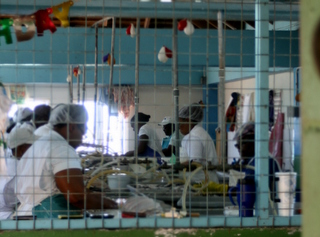
When we aren't eating sushi, we are usually eating some sort of processed fish. Fish are caught and then sent to factories for cleaning, cutting and marketing. Shrimp platters, calamari rings, and other processing are usually done by women working in deplorable working conditions often in violation of labor laws. We are somehow able to understand and object to sweat shop conditions that produce t-shirts and tennis shoes. As consumers, we don't understand that this concept applies to the fish we eat.
2012-04-11-091001.JPG
Women preparing fish for distribution in Barbados. (c) Jamie Bechtel, New Course


So if we are driving this fishing crisis, what can we do about it? We have all kinds of fish certifications that ensure the fish are caught sustainably. We have no certification to ensure that people aren't dying or being injured while catching and processing our fish. I want to eat fish that I am 100 percent certain was not caught using slave labor. I want to eat fish that I am 100% certain did not result in a woman having to sell herself to feed her children because local fish catch is being exported rather than giving locals options to eat first.

Should we stop eating sushi? I'll be honest. I love eating sushi. But I would be willing to pay top dollar for a sushi dinner that I knew was caught honestly, safely, without harm to another person. It is time for our food labeling to not only ensure that fish are caught, processed and sold sustainably; but that the people who supply the fish are protected as well.


Follow Jamie Bechtel on Twitter: www.twitter.com/Jamie_NEWCourse


  • Comments
  • 8
  • Pending Comments
  • 0
  • View FAQ
Comments are closed for this entry
View All
Recency  | 
Popularity
06:06 PM on 04/14/2012
By the association techniqe you have employed in this impressive piece of journalism, you could insert essentially anything terrible to what people in country X might do because of losses they have incurred due to overfishing. Bank robberies, arson, murder or beheadings, even rude comments at church on Sunday. All due because of overfishing, according to this story. I gotta hand it to you though, the spread of HIV was one that hadnt come to mind.
photo
HUFFPOST BLOGGER
Jamie Bechtel
11:39 AM on 04/19/2012
@Capt Prius - thank you for your comments. I invite you to read some of the rather robust body of knowledge on this topic, some of which is cited/linked in my article, and some i have included below. i am afraid i can take no credit for creative journalism. This issue has been reported in medical research and other scientific and policy forums for the past 5 years. It has not yet made its way into the mainstream. Nevertheless, if you don't mind wading through some technical language - the information is available and not at all obscure. For start you might refer to:
http://www.fao.org/newsroom/common/ecg/1000544/en/hivfishingEN.pdf the german development cooperation lists and links many references https://sites.google.com/a/ms-hiv-gdc.org/mainstreaming-hiv-in-german-development-cooperation/Home/sectors-priority-areas/fisheries-1 if you prefer links to some of the primary literature i am happy to provide that as well. i hope you find this useful. i can not help you with the links between bank robberies, arson or church on sunday and HIV. there is no data available to support. best jamie
08:55 PM on 04/13/2012
What do you mean "we"?

Many of us eat lots of seafood from identifiable and sustainable fisheries. And no one is dying while catching or processing the fish that I eat, and I know that because I know where my fish is coming from and none of it is imported from anywhere. Not a bit of it comes from Senegal, Chad, Cambodia, or Kenya. There's no slave labor in the domestic US seafood industry, and no women are selling themselves.

The conditions you describe in fishing villages are indeed heart-breaking, but you strike me as someone who knows next to nothing about the seafood industry and who may want to back it up a bit before allocating blame or suggesting solutions.

You might do best to simply highlight the problem as you know it. Then consumers can avoid fish that is being imported from nations and waters where the problems you describe are found. Our labeling laws already make that possible, BTW.
photo
HUFFPOST BLOGGER
Jamie Bechtel
06:33 PM on 04/14/2012
@simonbao thanks for your comments. I refer primarily to imported fish, (= 80% of fish consumed in the US depending on species). We can currently track import locations. The shorter the supply chain the easier this is. Knowing the location of a fish does not provide insight as to circumstances at point of catch or point of process. The recent case of fish imported from New Zeland, sold in prominent US stores, relying on slave labor is an example. http://www.bloomberg.com/news/2012-02-23/slaves-put-squid-on-u-s-dining-tables-from-south-pacific-catch.html.
With the exception of a nascent program in Switzerland and a failed attempt in Germany - there are not currently any fair-trade certifications for fish. Certifications provide information on sustainability of the resource only. There are individual communications between point of sale (restaurants and grocery stores etc) with fishermen. These products are usually costly and are not verified by third parties such as MSC. The laws do not allow is for products to be discriminated against in terms of imports. In other words, it does not matter if the fish are caught with sustainable fishing methods or with fair trade methods - under WTO guidelines, a fish is a fish is a fish. We must rely on the marketplace to define acceptable terms of catch.
re:mislabeling. a recent report is useful http://www.boston.com/business/articles/2011/10/24/from_sea_to_sushi_bar_a_system_open_to_abuse/
08:00 PM on 04/14/2012
Not to quibble, but knowing the location of a catch DOES most certainly provide insight as to circumstances at point of catch or point of process. The case you cite of New Zealand illustrates the point. That case is remarkable because such abuses with seafoods from New Zealand are exceptional and extraordinary.

When you write on this topic in future, I strongly suggest that you draw clear distinctions between domestic US seafoods and imported seafoods... and between those imported seafoods where sources can be assumed to be reasonably responsible (Norway, Italy, Greece, Canada, etc) and those that are not.

Such efforts to educate the public about sustainable seafoods has had some success and you should be copying them.
12:55 AM on 04/13/2012
HIV positive singles face very difficult challenges when it comes to dating. They have to either date someone with HIV or

disclose their HIV status. Disclosing to someone that's HIV- is a terrifying task and finding someone else with HIV.

HIVromances.com help you Dating and Finding Love for HIV Positive Singles
10:03 PM on 04/12/2012
I'm quite allergic to seafood but I completely agree with what you're saying. I'm glad that as a tea-addict, I have access to fair-trade teas. I don't see why we can't have fair-trade fish. :)
photo
HUFFPOST BLOGGER
Jamie Bechtel
11:40 AM on 04/19/2012
Brenda - many thanks for your comment. The idea is intended to start a conversation. So many people disregard the role of women in fisheries and these supply chain innovations have potential to address the issue. We have a long way to go, but we have to start somewhere. Thank you!