
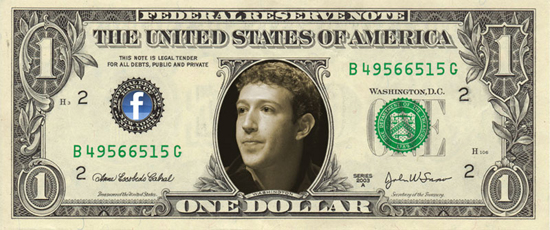
If Facebook's new facial recognition software isn't scary enough, imagine Mark Zuckerberg's face replacing George Washington's on the dollar bill. Or rubbing out all the dead presidents on every bit of American currency.
July 4th may be Independence Day for America, but on July 1st Facebook is making a declaration about its new virtual currency, "Facebook Credits," that could well put the Internet powerhouse on the road to dominance of all online commercial transactions, well beyond just the $2 billion market of virtual goods it already monopolizes.
Until Friday any credit card or PayPal would do to buy games and virtual goods on Facebook, like tractors for the popular game Farmville. Starting Friday you must go through "Facebook Credits," which comes with some one-sided terms and conditions. This isn't just about fun and social games, but films, music and other real goods soon to be purchased on Facebook.
As Facebook stock gets ready to go public in 2012, the social network is now becoming a closed commercial network in order to gain an upper hand over consumers and businesses -- gauging by its "Facebook Credits" declaration anyway.
Gamers using the Facebook platform now must exclusively utilize Facebook Credits in the operation of their games; such developers must agree not to charge lower prices to consumers outside of Facebook; and game developers must pay a 30% service fee for all Facebook Credits purchases.
Given Facebook's power, Consumer Watchdog filed an anti-trust complaint with the Federal Trade Commission Tuesday to stop the power grab. The Washington Post covered the story today.
With over 500 million users, Facebook is now the online Titan. Facebook is the most visited website in the world. One of every two Americans uses Facebook. Imagine the power Facebook would have over a new type of online currency if Zuckerberg is allowed to dictate the terms.
While Facebook has not disclosed revenue data, analysts estimate Facebook controls well over 50% of the market for virtual goods offered in social gaming. Facebook exercises monopoly power in that market. Now imagine the extension of Facebook Credits to everything else we buy online?
Here's Consumer Watchdog's argument to the FTC about Facebook's games:
"By prohibiting game developers from offering lower prices to users outside the Facebook platform, Facebook has fixed prices and therefore stifled competition outside the Facebook platform because developers cannot provide the incentive of a discounted price on another social network or website that would draw players away from Facebook. Further, the 30% service fee exacted by Facebook from game developers, along with other Facebook Credits terms described in detail in this complaint, will make it far more difficult, if not cost prohibitive, for smaller game developers to compete inside the Facebook platform against larger developers. The effect of these terms is to create a barrier to competition between social game developers, and between potential competitors to Facebook--social networks or websites operating as a platform for games."
And, like many monopolists, Facebook gives preferential treatment to the biggest game developer, its only potential rival, but shafts the little guy.
As the complaint, states:
"Facebook's apparent joint venture agreement with developer Zynga to provide it with a special exemption from some of the Facebook Credits terms that Facebook imposes on all other game developers would, if accurate, be an improper joint venture agreement between competitors and an unreasonable restraint on trade. Though Zynga is a game developer, Zynga has developed a large enough customer base that it is the single company in the market that could conceivably compete with Facebook if Zynga chose to leave the Facebook platform and/or establish a new social gaming site. The agreement between Facebook and Zynga, if published reports are correct, would therefore constitute a conspiracy between competitors and further extend Facebook's already overwhelming monopoly power. The antitrust laws protect users against unfair methods of competition and unfair practices that reduce competition, discourage innovation, limit consumer choices and increase prices. That is precisely what will result if Facebook is permitted to enforce its new Facebook Credits terms."
When a company with a half billion customers moves from being the social network into gaining a financial grip over consumers and web developers, Pandora's box is open. Let's hope the Federal Trade Commission shuts the lid very soon.
Jamie Court is President of Consumer Watchdog and author of The Progressive's Guide To Raising Hell.