More

Featuring fresh takes and real-time analysis from HuffPost's signature lineup of contributors
Jane Chafin

GET UPDATES FROM Jane Chafin
 

MFA: Is It Necessary? -- The Debate

Posted: 07/13/11 06:54 PM ET

I participated in a public debate on Sunday. The July 10 debate was part of Artillery Magazine's ongoing series "Artillery Sets the Standard," and was held at the Standard Hotel in downtown Los Angeles. Many thanks to publisher Paige Wery and editor Tulsa Kinney for inviting me to participate. There were four debates and it made for a lively and informative afternoon (the free vodka didn't hurt).

The debate was: "MFA: Is it Necessary?" I was debating the "con" side of the question. The format was a four-minute presentation, followed by a two-minute rebuttal, a one-minute rebuttal and a 30-second conclusion. When Artillery posts the full video of the debate, I will post it on my blog. Meanwhile, here is the text of my presentation and conclusion along with my Power Point slides:

Hello. My opponent has made some interesting points, some of which I'll address in my presentation, others will have to wait for the rebuttal.

I don't have a degree in anything -- I dropped out of college in my junior year. I felt I was wasting my parents' money, majoring in marijuana and guitar.

A degree is not something I look for when selecting artists for Offramp Gallery. The bottom line is always the work. I look for work that's honest, creative, original, skillfully executed and intensely visual. It's supposed to be VISUAL art after all.

Everyone has an opinion on this subject. But I wanted data, facts to back up my point of view.*

First of all -- the only situation for which you are required to have an MFA is if you want to teach studio art at the university level. There are precious few tenured teaching positions available and competition for them is fierce. Most artists I know end up chasing adjunct jobs across several counties and/or have an unrelated day job.

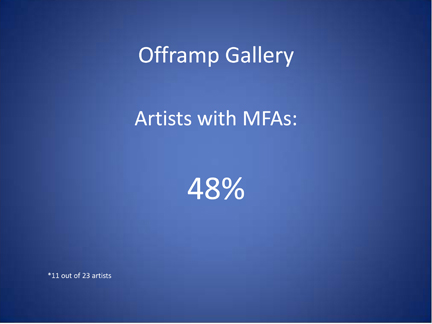
Then I looked at the artists I've shown at Offramp. 48% have MFAs. So, there is no advantage, no disadvantage.
2011-07-12-MFAdebate2x6.jpg

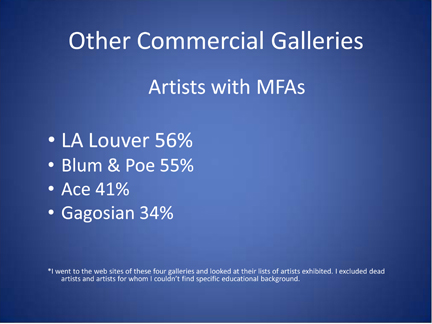
But what about other commercial galleries? I spent an insane amount of time researching artists from several successful commercial galleries. You may be surprised at what I found.

LA Louver: 56% have MFAs
Blum & Poe: 55%
Ace: 41%
Gagosian 34%
2011-07-12-MFAdebate3x6.jpg

If you put those numbers all together (including Offramp), only 40% of the artists have MFAs.

2011-07-12-MFAdebate4x6.jpg

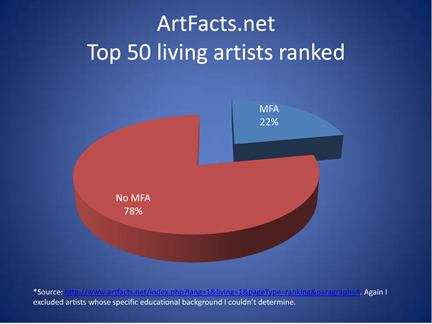
Next I looked at ArtFacts.net which ranks over 200,000 artists using a special algorithm based on which galleries and museums artists have shown at, with whom, etc. I looked at their top 50 living artists -- and of those 50 top living artists only 11 out of 50, or 22%, have MFAs.
2011-07-12-MFAdebate5x6.jpg

Typical costs for a two-year MFA in studio art are $28,000 - $73,000, and a three-year program would be $41,000 - $109,000. That's a lot of student debt to carry after graduation.

2011-07-12-MFAdebate6x6.jpg

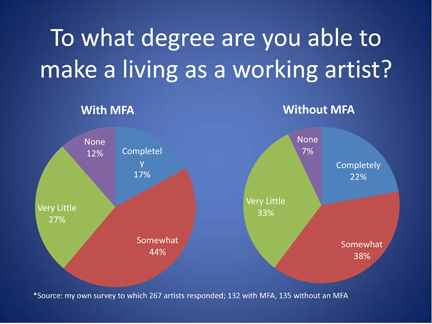
I also put together a little survey and sent it to my email list. I asked the respondents who were artists to what degree they were able to make a living as an artist. As you can see there wasn't that much difference between artists with or without an MFA.
2011-07-12-MFAdebate7x6.jpg


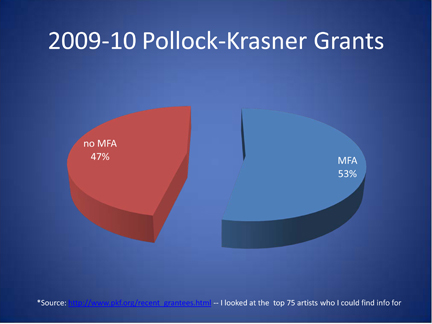
I looked at the Pollock-Krasner Grant recipients for 2009-10. Out of 75, 40 have MFAs, or 53%. Again, no clear cut advantage.
2011-07-12-MFAdebate8x6.jpg

So, from all the statistics I was able to put together there seems to be no distinct advantage to having an MFA -- for getting a gallery, showing in museums, for making a living as an artist and for getting grants.

And what are these schools teaching? I personally think there is an over-emphasis on dialog and an under-emphasis on content. We're teaching artists to TALK about art. Anything is art as long as you can justify it using the codified language of academia. As my friend Ted says, there's no good art, no bad art, just an endless dialog about art.

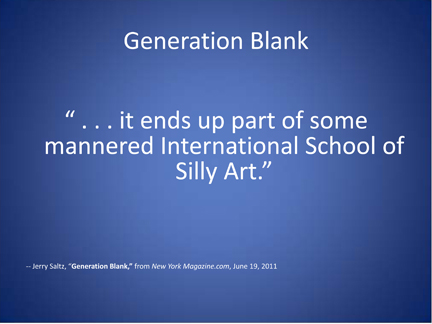
Finally I want to quote New York Magazine art critic Jerry Saltz in a recent article about the Venice Biennale and what he calls "Generation Blank":

"It's work stuck in a cul-de-sac of aesthetic regress, where everyone is deconstructing the same elements... A feedback loop has formed; art is turned into a fixed shell game, moving the same pieces around a limited board. All this work is highly competent, extremely informed, and supremely cerebral. But it ends up part of some mannered International School of Silly Art. " 
2011-07-12-MFAdebate9x6.jpg

I couldn't agree more, and I do believe that MFA programs are largely to blame.

Conclusion:

To go over my main points again:

My research shows that an MFA doesn't give you an advantage in getting into commercial galleries or museums, making a living as an artist or getting grants.

It's very expensive and saddles you with student debt that you have very little chance of paying off by working in your chosen field.

Save your money, live your life, read, travel, pay attention, learn to think for yourself. Work hard, look inside yourself and make yourself the best artist you can be.

Oh, and BTW, I won :-)

*A word about my research: it is completely unscientific and was limited by time and resources. I included only living artists and excluded artists for whom I couldn't find enough information. I feel I just scratched the surface, but results were fairly consistent across the board.

Cross-posted from Jane Chafin's Offramp Gallery Blog.


  • Comments
  • 44
  • Pending Comments
  • 0
  • View FAQ
Comments are closed for this entry
View All
Favorites
Bloggers
Recency  | 
Popularity
03:53 AM on 07/27/2011
What about a BFA? Could the same be said for a BFA?

Please people. Art schools/mfa are just tools. they help some. They dont others. They aren't the end all be all. Why people want to make silly aristotelian arguments about whether you are better off not going or going is pretty ludicrous. As if the world works in aristotelian logic.

I guess us westerners need it to feed our big ego huh? Tools.... just like the internet. Please don't make them into anything else.
photo
HUFFPOST BLOGGER
Mat Gleason
Criticism is Like Coffee, it Wakes You Up.
02:27 AM on 07/26/2011
The artwork of MFA artists has no demonstrable quality that separates it from the art of non MFA artists.

Your art school conspired with a big Wall Street bank to lock you into a long period of indentured servitude. You got two years of playing art theorist in a Summer Camp environment structured as an EST program.

Your parents are disappointed, you are never getting a solo show and your teachers worked especially hard to make sure you were never their competition in the field in the future. So lord that piece of paper over everyone else, sucker, it is all you got out of the deal.
03:45 AM on 07/27/2011
Do you always paint with broad strokes? Tell this to Mark Bradford.
03:58 AM on 07/27/2011
Do you always paint with such broad strokes? Tell that to Mark Bradford.

While agree with you to a point... your generalizations have handicapped your logic. Please think more clearly like Jerry Saltz does.
photo
HUFFPOST BLOGGER
Mat Gleason
Criticism is Like Coffee, it Wakes You Up.
05:23 AM on 07/27/2011
Yes I always paint with such broad strokes. I will think as clearly as I choose, this subject requires very little thought, MFA degrees are worthless in indicating anything about the quality of an artist's art. I was half-asleep when I wrote that and you cannot debunk it wide-awake. Good night.
09:33 AM on 07/21/2011
I think the problem is a little deeper, or rather occurs earlier, before the hallowed halls of a University are reached. I recently attended the MFA shows at a school I will be attending in the fall for my own MFA (I already show, I want to teach)- I was frankly depressed by the quality of the work but I wasn't surprised.Art education is dismal these days, as evidenced by the work I was seeing, yet these grads were now equipped to compete for teaching jobs? No they are not. No mater how much milk is poured into the container, the cream will rise to the top and the weak will take jobs in cubicles.
photo
HUFFPOST BLOGGER
Mat Gleason
Criticism is Like Coffee, it Wakes You Up.
05:25 AM on 07/27/2011
The jobs don't exist any more and the glut of MFAs assures any teaching positions are taken by the artists with commercial careers who look good in a school's recruiting literature. Sometimes these "art star" teachers don't even (gasp) have an MFA. Repeat after me: Suckers.
09:15 AM on 07/27/2011
Haters gonna hate. Which "art star" with an MFA did you wrong?
03:24 PM on 07/27/2011
...correction, the 'milk' will either end up working in cubicles or writing criticism of the art world they were unable to be a part of.
04:10 PM on 07/20/2011
Twenty-four years ago I moved to New York and earned an MFA from Brooklyn College. At the time I was excited by the whole experience, the moving, the creating, the time for painting. By the time I graduated two and a half years later I was literally sick of it all. Painting, framing and getting everything together for my final show gave me vertigo and nausea. I was disillusioned, broke and the excitement of creating art had become a chore I did not want. So, I threw myself into my part-time graphic arts job, worked all the overtime I could get so I could build up my savings and rarely look back. Since the computer has taken all the fun out of my graphic arts job I am attempting to get back into my painting but it is a daunting task. My MFA experience killed the joy for me, still is is nice to say I have one none the less.
09:19 AM on 07/20/2011
Since no institution promises a successful career as an artist if the MFA credential is earned then what is the rationale for an institution offering such a degree? The answer is quite simple: only a few have the maturity, the discipline, the knowledge, skills, attributes, networks, and good fortune to make it without some type of process in place to help the individual gain the maturity, discipline, knowledge, skills, attributes, networs, etc. (we used to use the apprentice process for this purpose but it's cloning nature renders this an ineffective "training ground" for the contemporary artist). The parallel with sports, say basketball, should be apparent; some kids go directly from high school to the NBA but very few. Why? they need to mature, they need to develop more skills, etc. Does college basketball guarantee an NBA career? No. But without higher education there would not be a sophisticated professional conference.
photo
HUFFPOST BLOGGER
Mat Gleason
Criticism is Like Coffee, it Wakes You Up.
05:27 AM on 07/27/2011
You are implying that MFA programs in Studio Art instill some or all of that long list of values and training. They demonstrably do not. They flatter and massage egos that pay tuition.
11:57 AM on 07/27/2011
I agree to a point. I will agree that an MFA is not a measure of the quality of artwork. In my opinion, frankly, neither is the fact that an artist shows in a commercial gallery. No matter how one cuts the cake, there is a lot of crap out there. The fact that I'm writing as someone in the process of an MFA currently, I'm sure, is something that you'll use to poo-poo this comment regardless of any other factors. That's okay though, you're entitled to your commentary no matter how generalized or slanted. A professor I once spoke to said something interesting, though- "Being an artist in New York, you basically have the choice of going to grad school or spending that same amount of time between a (hopefully) cheap studio and bars in Brooklyn." ......
11:57 AM on 07/27/2011
(cont from previous)...
To me, it's always been about being able to capitalize on as much as I can. Though i couldn't justify spending 40k/year, I realized that getting my degree from a city university only cost me about $600 a year more than what my friends were spending on studio space, and for that extra investment I would get a degree, teaching experience, a great studio space (which I'll be extremely depressed to leave when I'm done), great shop facilities that are always free, and a network of other artists and curators. The way I see it, if this doesn't hinder my ability to get a job then I've lost nothing except money I'd be spending on a studio anyway. People do things for different reasons, and sometimes, decisions that for some are inherently useless or stupid can for others be helpful or even (gasp) cost effective. Regardless of school, one needs to bust their asses to get where they want- no matter what the field. If schooling and an added degree somehow contribute to that or are a part of it, then I have to disagree with the notion that its only function is to potpourri in ones stink. But that isn't to say that no one does.
06:34 PM on 07/18/2011
Good God, art and literature should be able to rest on the work alone not the credentials.

If you send the same people through the factory (or university) there will eventually evolve a pattern or similarity to their work--look at Washington DC. MFA/No degree, it really doesn't matter unless as you have pointed out, one wants to teach. What matters is the work. The ability to provoke and inspire. The work must be able to speak for itself.
03:58 PM on 07/18/2011
Though it seems to be about 50/50 on artists that are selected to work at the galleries, we also should see what percentage of applicants had MFAs. If only 10% of the applicants had an MFA, then 50/50 *would* represent an advantage.
02:44 PM on 07/18/2011
Jane, your presentation at the Artillery Magazine debate was flawless. Congrats.
I agree. For the artist: Life first, MFA second.
10:16 AM on 07/18/2011
Great Post, love the Salotz quote - will save to use in arguments about art that is more concerned with visual experiences than theory. Gratefully there are still many viewers who want to feel emotion in their art rather than play head games -
photo
HUFFPOST SUPER USER
seckhoff
Famous in the apple barns
08:35 PM on 07/17/2011
College, etc., is the history of ideas. Maybe people w/o MFAs have had more time to ply the commercial seas, and more money to do it with. I got my head rethreaded in an MFA program and I think it was worth it, but then again I've always been great at throwing money into the flames. I am an artist, after all.
08:55 AM on 07/16/2011
To echo some of what Seth said: the terminal degree is necessary for anyone who wishes to teach at the university level. I do wish they would spend a little time teaching about teaching. The MFA program gives you 2 years of serious contemplation, discussion, and practice in Art. You cannot get the same experience in any other place. Hanging around galleries won't do it, nor will reading any amount of text. The degree is no guarantee of anything, just as any other degree. It truly depends on the school. All other things being equal work will always trump degree. But there are benefits and purposes for the MFA.
03:05 PM on 07/15/2011
Did you think about the percentage of kids with an MFA who get their first NYC show, and then pretty much never get another one. Mostly because after school these artists begin to slowly change their work, and a lot of galleries DON'T like change.
photo
HUFFPOST BLOGGER
John Seed
Arts blogger
02:52 PM on 07/15/2011
If an MFA degree program gives you a great social life, including contact with strong faculty and other ambitious students, that can be a big plus. Of course, maybe the thing to do is to just hang around great people, which is free. In this economy, with tuition rising for all degrees, MFA degrees do look like less of a good investment. Thanks for a great blog Jane.
thebigbike
ran away to be a cowboy
10:16 PM on 07/13/2011
absolutely the most intelligent discussion of "art" vs art I've seen on here!
photo
Seth Abramson
Poet and Attorney
08:09 PM on 07/13/2011
Jane, I'm wondering if your advice about visual arts MFAs would be the same for someone who had gotten into a fully-funded visual arts MFA program and was able to think for themselves (i.e., if they planned to use the time to create new works, not simply to, as you've said, "dialog")? Also, would your advice be the same to someone who had always dreamed of being a university art professor -- assuming that that artist knew the odds of getting a job in the field were very long (perhaps about as long as becoming a recognized visual artist in the first place, odds every visual artist has already by definition embraced)? Would your advice be the same for someone who was, say, thirty-seven, and had already "lived [their] life, read, travel[led], pa[id] attention, learn[ed] to think" for fifteen years, and now just wanted some paid time to make visual art? Would your advice be the same to someone who'd always dreamt of being a visual artist but had grown up in rural Nebraska, and who now wanted to attend an MFA to find a day-to-day community of like-minded individuals -- a much easier proposition than just moving to a big city and loitering in galleries?
photo
HUFFPOST BLOGGER
Jane Chafin
Director of Offramp Gallery
12:10 AM on 07/14/2011
Hi Seth -- It was a debate and I argued the con side. I'm not against anyone getting the education they want, but an MFA is only one way for an artist to go. Ultimately, it's a very personal decision and if you can do it, especially without going into debt, go for it!
11:56 PM on 07/27/2011
What is with the western aristotelian logic? Do you always think of the world in these closed minded terms?