Update below.
This just in: AUSTERITY DOESN'T WORK!
It doesn't work here, it doesn't work in Europe, it doesn't work for state and local governments. I'm tempted to ask how many data points we need to recognize this crucial economic truth, but I'm afraid data points don't have much to do with it.
Another weak jobs report for April, with only 115,000 jobs added -- 130,000 in the private sector -- and a lower-labor-force-induced tick down in unemployment, from 8.2% to 8.1%.
You can see the trend in payrolls in the figure below, with acceleration toward the end of last year morphing to deceleration over the past few months. After last month's disappointing report, I was careful to point out that "one month does not a trend make" and there are some technical reasons -- mostly seasonal adjustments that haven't caught up with unusually warm weather -- to consider as well.
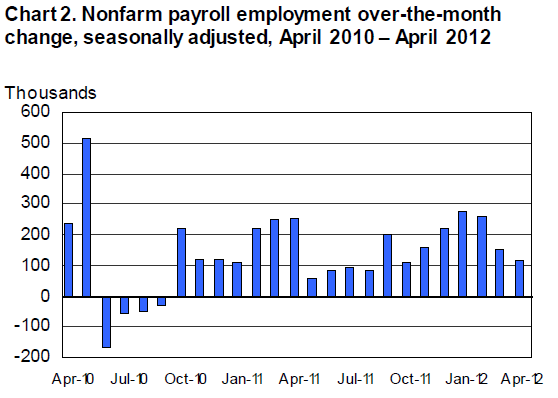
Source: BLS
Well, two months doesn't quite a trend make either, but it's getting closer. Average out some of the monthly noise, payrolls are up 176,000 per month over the past three months, compared to 218,000 over the prior three months. So, somewhat of a deceleration on a more reliable quarterly basis. But remember, the 200k trend was just okay -- typically coming out of such a deep trough as was the Great Recession, you'd like to see much bigger monthly numbers than that.
Key points for now with more to come later:
- State and local governments continue to shed jobs. They would be my first target for stimulus in a sane world. Last month, local education jobs were down 11,000 and they're down about 100,000 over the last year. Next time your friendly politician is jawboning about a) the benefits of austerity and spending cuts, and b) the importance of education, please point out the hypocrisy.
- A few bright spots worth noting: upward revisions of 53,000 to payrolls March and April and manufacturing keeps on trucking, up 15,000 last month and about 230,000 over the past year.
- The labor force contracted by 342,000 last month -- that's a volatile monthly number so I wouldn't make a big deal about it, but the low growth in the labor force of late and the low participation rates we've been posting are also indicative of weak demand.
- Wage growth remains weak, with paychecks for most workers falling behind inflation.
That's the punchline, I'm afraid. Weak labor demand is upon the land, and no one in power seems willing to do anything about it.
Update: A few more observations:
- One of CBPP's Unemployment Insurance experts, Hannah Shaw, tells me the following: since the beginning of the year 17 states with unemployment rates above 6.5% have triggered off of EB (extended benefits: extra weeks of UI in high unemployment states -- learn about it here), 8 of those states have unemployment rates of 8% or higher. It's possible that some of these folks leave the job market after their benefits run out and that could be playing a role in the low and stagnant participation rate.
- Hourly and weekly earnings are growing more slowly: 1.8% over the past year for average hourly earnings and 2.1% for weekly earnings. The most recent inflation reading is 2.7%, Mar11-Mar12, meaning paychecks are not going as far as they were a year ago. Nominal hourly earnings have been hovering around 2% for awhile, but increased hours of work were goosing weekly earnings for awhile, which were up around 3% a year ago. That's fading; that's bad for family budgets and for a macro-economy that's 70% consumption.
- I always like to take a look at the diffusion index in the monthly jobs report. It's a measure of the percent of private sector industries adding jobs, so it provides a quick look at the question of how broad-based hiring has been. Last month, about 57% of firms added jobs, compared to 65% last month, 70% in January, and less than 20% in the heart of the Great Recession. So, a lot more industries are expanding than in the worst of times, but there's been a pretty broad pullback of late.
This post originally appeared at Jared Bernstein's On The Economy blog.
Follow Jared Bernstein on Twitter:
www.twitter.com/@econjared
The strategy, which involves taking demand out of the economy, is nothing more than that. But more importantly, the benefits accrue exclusively to a small clique at the top of society. Reducing governmental spending involves weakening labor unions and selling off valuable publicly owned assets for pennies on the dollar. Furthermore, lowering basic social benefits in turn lowers the wage floor, which again results in an upward transfer of wealth. And when the resulting contracting inevitably creates instability and raises long term interest rates on government bonds, they benefit yet again.
Austerity has zero redeeming value as the PIIGS are making crystal clear.
The American voter's response? Elect a Republican senate and put Mitch McConnell in charge of it to counterbalance the blah in the whitehouse and change the name of the USA to "Post-Reagan America, Land of the Oligarchs".
Are Americans really that stupid?
They apparently believe so.----Obama has failed to bring back fully an economy they broke..
Infrastructure investment would of saved my financial status----mine and millions of Americans like me-----which would of added to the consumer demand needed to keep suppliers hiring--not to mention adding to the percentage of renues coming into the govt--SS and medicare...
Instead we only invested in the banking industry----we need to find out what obstruction stopped the obvious solutions needed to lower unemployment---govt investing in the auto industry worked so that should tell all americans where the govt should invest now--
Austerity looks like big business and govt teaming up on the population---as it represents both stopping investment in the American family..
I agree forced austerity is a disaster, but then, there was a reason it was forced. So pay now, like trim some of the growth from the government graft, or pay later like in Greece where unions take a 40% hair cut on pensions.
We've already tried the Bush policies-----going back would be insane.
The reason the US economy prospered after WWII is because most all other countries were in shambles from the war. We were relatively intact and essentially rebuilt the world. You correct though, FDR policies did nothing to get us out of the depression - it was the end of WWII.
And regarding Reagan - he invested in the military to end the Cold War, which we won. Clinton received that peace dividend.
Convinced now that smaller governments result in greater prosperity?? Vote for Mitt and you'll get that benefit.
You add govt austerity to that and consumption will drop off,, killing the need for supply which effects hiring and layoffs making prosperity a more seasonal thing---a strong middle class keeps up with supply and sometimes forces suppliers to work overtime or increase the workforce.
China's consumer base is foriegn---their own population never could keep up with suppliers who took advantage of the slave wages----The Chinese govt is beginning to understand the benefits of having their own population of middle class consumers to back up their own economy when the world is in depression/recession----China's economy will storm ahead of America's if they're developing their own middleclass-----something America used to be proud of and backed up the belief in the American dream...
The private sector pulled its money out of the America economy and instead of the new deal solutions that should have kicked in--infrastructure investment---big business proposed austerity.
Obstructions are not solutions unless the idea is keep consumer demand down.
Everything is connected---A Divided America to create a third world America...
Americans can whip the competion on the job site and they have all of the skills anyone else in the world has for these future jobs, however complex they may or may not be.
'Austerity' is merely what we should have been doing all along, living within our means.
Living within means is not 'austere'. It is common sense.
'Austerity' is merely what we should have been doing all along, living within our means.
Living within means is not 'austere'. It is common sense."
If you were caught up in a financial crisis, would you think that asking the boss for a raise would mean you're not living within your means? We did balance the budget under Clinton, but Bush saw that surplus as an excuse to cut taxes. I would expect the advocates of "living within our means" to remember why we've had a deficit for the past 11 years.
Another point: would you say that when an enemy attacks, the civilians run away; therefore the army should do likewise? The government has responsibilities greater than just keeping its own house in order.
I'm sure your omission was an honest mistake.
EVERYBODY, Republicans and Democrats have had their hand in putting us where we are deficit-wise. Of course, everyone remembers Bush had an awful lot to do with increasing the deficit. And everyone also ought to admit that Obama is making matters worse.
But today too many have been promised and expect services we can not afford to provide without turning to deficit spending. And this population of dependents is consistently growing. Once this group becomes the majority, and it will, they'll only elect politicians who refuse to stop feeding the beast.
And please don't try to argue that trillion dollar deficits are austerity.
http://krugman.blogs.nytimes.com/2012/04/28/four-fiscal-charts/
How much extra are you willing to contribute so we can pay off the debt? Because right now, you are paying record low taxes, and we cannot get out of debt unless government increases revenue. Anyone who is really in favor of decreasing the deficit, should be in favor of raising taxes?
Did you support the war in Iraq? Do you support the war in Afghanistan? Have you paid your fair share for either of those wars? Since no taxes were increased to pay for these wars, let's start by getting all the patriots who favored these conflicts to pony up. Let's pay the war deficit first.
Here is where you can start paying your share of the war deficit:
Gifts to the United States
U.S. Department of the Treasury
Credit Accounting Branch
3700 East-West Highway, Room 622D
Hyattsville, MD 20782
Or are you for austerity so long as it doesn't touch you?
The reason the cost of the wars wasn't added to the budget until 09 in the form of credit card debt to China----was to pile it on and set up the debate for Austerity---which is the opposite of new deal infrastructure spending---which is the divide--R vs D..
So President Romney would have to:
1. Continue the war in Afganistan (since his party is the war party)
2. Lower taxes.
3. Pay off large amounts of debt.
Perhaps the 200 million Dollar Man can pull it off.