While chatting with a colleague today about the new CBO long-term budget outlook, we agreed there wasn't much new there, but then he said something that stuck with me:
"Of course, it shows that we can afford the entitlements."
To hear everyone from the Washington Post editorial page to Bowles/Simpson to all the Republicans and many of the Democrats, there's an entitlement crunch, crisis, death spiral, or whatever... waiting for us out there in the future if we fail to muster the steely-eyed courage to face it. And "face it" invariably means cutting benefits, privatizing, voucherizing, raising the retirement age, means testing... basically, fixing them by breaking them.
This morning's Washington Post has a case in point: "New estimates the Congressional Budget Office (CBO) released Tuesday underscore that Medicare must change, a lot." A few lines in: "...a death spiral of ever-higher interest payments."
Well, look at this chart, one I'm sure will be showing up all over the place. It shows the debt as a share of GDP projected well into the future under two different scenarios. Under the explosive scenario -- the one on which all the scolds will focus -- debt swamps the economy, reaching 200% by 2037.
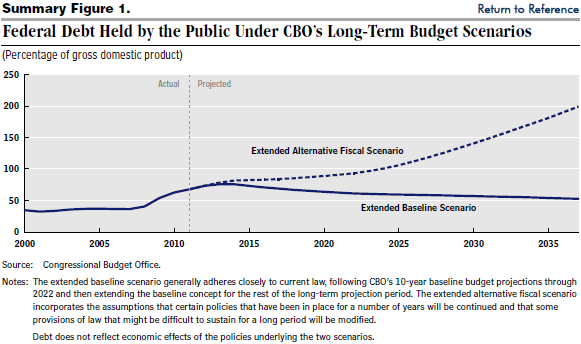
But look at the other line. Under that scenario, which in fact happens to be current law (meaning all the Bush tax cuts expire, for example), debt stabilizes as a share of the economy in a few years and then starts down a slow glide path. And Medicare, Medicaid, and Social Security as we know them today are all in that bottom line.
Under that scenario taxes go up and spending is restrained compared to the alternative baseline. Some of the assumptions -- like we allow Medicare payments to doctors to fall sharply or all the tax cuts permanently expire next January -- are wholly unrealistic. But there are unrealistic assumptions under the other scenario too (the federal gov't is not going to be spending 36% of GDP by 2037 (the historical average is about 21%)).
But generally speaking, and with some tweaks, there's no reason why something like that bottom line's baseline couldn't prevail. The Bush tax cuts would all have to eventually sunset, and we'd need to continue-and ramp up-what looks like early progress on slowing the growth of health care spending.
But aside from dysfunctional politics feeding a largely misleading public debate, we could do this. If we, as a nation, decide that we want to achieve fiscal sustainability and preserve the entitlement programs, along with government's other critical functions, it is well within our means to do so.
So sayeth the CBO.
(H/t: JH)
This post originally appeared at Jared Bernstein's On The Economy blog.
Follow Jared Bernstein on Twitter: www.twitter.com/@econjared
Jim Wallis: The Missing Religious Principle in Our Budget Debates
Alan Grayson: 11 Years Ago Today
Vice President of the United States; Former Republican Representative (WY)
Cheney to Treasury: "Deficits don't matter"
Former Treasury Secretary Paul O'Neill was told "deficits don't matter" when he warned of a looming fiscal crisis.
O'Neill, fired in a shakeup of Bush's economic team in December 2002, raised objections to a new round of tax cuts and said the president balked at his more aggressive plan to combat corporate crime after a string of accounting scandals because of opposition from "the corporate crowd," a key constituency.
O'Neill said he tried to warn Vice President Dick Cheney that growing budget deficits-expected to top $500 billion this fiscal year alone-posed a threat to the economy. Cheney cut him off. "You know, Paul, Reagan proved deficits don't matter," he said, according to excerpts. Cheney continued: "We won the midterms (congressional elections). This is our due." A month later, Cheney told the Treasury secretary he was fired.
The vice president's office had no immediate comment, but John Snow, who replaced O'Neill, insisted that deficits "do matter" to the administration.
Source: [X-ref O'Neill] Adam Entous, Reuters, on AOL News Jan 11, 2004
"Under that scenario taxes go up and spending is restrained compared to the alternative baseline. Some of the assumptions -- like we allow Medicare payments to doctors to fall sharply or all the tax cuts permanently expire next January -- are wholly unrealistic. But there are unrealistic assumptions under the other scenario too (the federal gov't is not going to be spending 36% of GDP by 2037 (the historical average is about 21%)).
"But generally speaking, and with some tweaks, there's no reason why something like that bottom line's baseline couldn't prevail. The Bush tax cuts would all have to eventually sunset, and we'd need to continue-and ramp up-what looks like early progress on slowing the growth of health care spending."
the Bush Tax Cuts were equal percentage rate cuts, across all tax brackets
and letting the cuts expire ONLY on those making over $250,000/yr., like Obama's hollywood friends 1) won't happen and 2) would do nothing to change the trajectory of the top line in that graph
When Congress passed the repatriation tax holiday in 2004, the legislation specified that the funds should be earmarked for activities like hiring workers or conducting research and prohibited using the money for executive compensation or buying back stock. Companies that brought back profits earned abroad saw them taxed at roughly 5%, instead of the top 35% corporate tax rate.
Meanwhile, the top 15 repatriating companies also accelerated their spending on stock buybacks and executive compensation after the tax break. The top five executives at those 15 companies saw their compensation rise 27% from 2004 to 2005 and then another 30% between 2005 to 2006.
The 15 companies that repatriated the most after the 2004 tax break on the return of overseas profits later cut a net 20,931 jobs between 2004 and 2007 and slightly decreased the pace of their spending on research and development, found the report surveying 19 companies' activity.
While you suggest that Bernstein is not qualified to discuss the issues (PhD Social Work), just remember that the entire republican economic plan has been created by a congressman with a BA from Miami University (in Ohio) who only briefly held a private industry job (given to him by his family's business) before he became a congressman when he was 28 years old (he's now 42). That seems to be enough for you.
Pre-Bush 2: The deficits are killing us. The deficits are killing us. Deficits are BAD!
During Bush 2: Deficits don't matter. Deficits aren't all that important. Forget deficits.
Post-Bush 2: The deficits are killing us. The deficits are killing us. Deficits are BAD!
Look it up people.
Jared Bernstein is far more qualified to write Progressive Propaganda than Paul Ryan, I will agree with you.
What we can say about Paul Ryan is he has more courage than Obama or Harry Reid. He puts it out there and take the heat.
That Reagan rewrite-of-history from David Axelrod is a desperate move from a desperate campaign.
Your view is completely unsupported by fact.
Gen. Ike Eisenhower is Rolling in his grave..."Beware of the military industrial complex" well I guess todays GOP is NOT the party of him anymore or of Lincoln (they went with Strom Thurmond) or of Teddy Roosevelt the progressive environmentalist all would be thrown out of todays GOP
Once again:
Through the 1984 election, the old guard earnestly tried to control the deficit, rolling back about 40 percent of the original Reagan tax cuts. But when, in the following years, the Federal Reserve chairman, Paul Volcker, finally crushed inflation, enabling a solid economic rebound, the new tax-cutters not only claimed victory for their supply-side strategy but hooked Republicans for good on the delusion that the economy will outgrow the deficit if plied with enough tax cuts.
***
It is not surprising, then, that during the last bubble (from 2002 to 2006) the top 1 percent of Americans — paid mainly from the Wall Street casino — received two-thirds of the gain in national income, while the bottom 90 percent — mainly dependent on Main Street’s shrinking economy — got only 12 percent. This growing wealth gap is not the market’s fault. It’s the decaying fruit of bad economic policy.
David Stockman – Reagan OMB director
The Extended Baseline Scenario assumes large tax increases even on the middle class.
so, what's your point?
AMT will be rough on the middle class.