Larry Mishel, president of the Economic Policy Institute, has an extremely useful piece up collecting all the reasons -- with evidence -- why the conservatives' "uncertainty" talking point is shovel-ready nonsense.
First, "uncertainty" in this context refers to the Republicans argument that it's government and central bank actions -- taxes, regulation, fiscal/monetary policy, health care/financial regulation reforms -- that are holding back the economy, not any of that ill-begotten Keynesian stuff, like lack of customers, orders, investors.
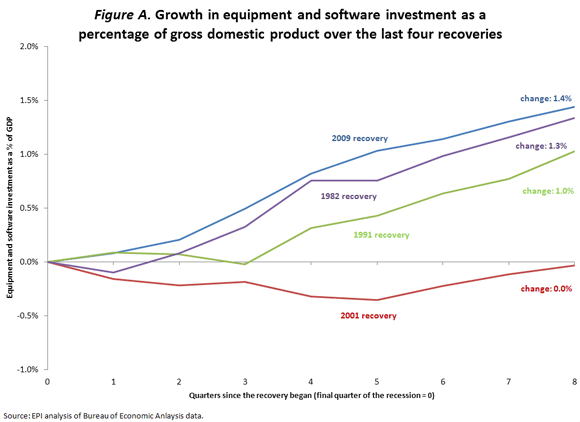
So how might you test for something like that?
Well, what about actual investment?
Investment in the current recovery has increased more than in it had at the same time period in the prior two recoveries and roughly the same as it did during the 1980s recovery [see figure]. In other words, this recovery is far more investment-led than the recovery under the pro-deregulation George W. Bush administration.
Private sector jobs, you ask?
...private sector job growth in this recovery looks much like job growth in recent recoveries, suggesting that businesses are not reacting to a new threat of potential regulations and taxes (the difference with this recovery is actually the loss of public sector jobs.
And then, of course, there's what the business folks, as opposed to their DC reps, actually say about what's bugging them:
...the regular National Federation of Independent Business (NFIB) surveys of small businesses found that the most common answer to the question, "what is the single most important problem your business faces?" was "poor sales." And while a number of businesses also cited regulation, the numbers were not substantially higher than under Presidents George W. Bush or Ronald Reagan and were lower than under Presidents Bill Clinton and George H.W. Bush.
None of this is to say "uncertainty" is not a problem. But while conservative politicians are busy jamming their perennial tax cut/deregulate agenda into the current context, the thing that businesses are truly uncertain about is when they're going to start seeing some customers again.
This post originally appeared at Jared Bernstein's On The Economy blog.
It's hard to have confidence when the constant talk from the Republican House is about cutting spending - cutting social programs - the social safety net that the average people depend on. This is not about wasteful spending but things that most of us have been contributing to for decades.
Playtime is over - let's get back to work.
I work in the financial industry and business loan requests are very low. The businesses have little reason to expand their operations when there is no demand, despite near record low interest rates. Instead, the big banks are investing in commodities and driving up prices that are making them more income than loans would do.
Finally, we have 100's of job openings and our biggest issue is finding qualified applicants. There is a dearth of high skilled (BS+ engineering, real Computer Science, etc) technical workers, qualified sales people, high skilled executives and finance people.
These issues obviously are less than 1/2 the problem, demand being the majority of the issue but they should not be discounted.
Does taxes and regulations play a role in my bottom line, sometime positively and sometimes negatively. but if I waited for things to be always be in my favor, I would have been out of business long ago. As I see it, the corporations have created a negative environment for the consumer and that is driving demand down. I can deal with regs but not the lack of customers.
Unfortunately, the consumer problem is not about corporations. It's about a lending environment that was promoted by Congress starting in the Clinton time and continuing through Bush. Lending was loose, the ability to lever up people's single biggest asset, houses led to a huge consumer driven expansion. It has been further exacerbated by borrowing from 401K's. Approximately 1/3 of 401K's have been borrowed against. Finally, we loaded up on CC debt.
Today, the consumer is tapped. There are approaches to putting more money in consumer pockets including lower rates on mortgages. But we do not have the asset base or consuming capacity to easily drive up demand.
Among other things, we need to drive exports. Unfortunately, a worldwide continuing crisis is conspiring to keep the $ high.
Any time you step into the arena, there is uncertainty. Will the other side out compete me? Are they better at buying and selling than I am?
You address this type of uncertainty by continually striving to make sure you are the best.
There is another kind of uncertainty. Will the ref be fair? Will he enforce the rules? Will he change them in the middle of the game? Has the other side paid him to throw the game in their favor? Is he biased in their favor?
How do you deal with such uncertainty? You can’t overcome it by being the best. That does not matter. Your best option is to either stop playing the game or to put your time and effort into making sure the ref is in your pocket instead of theirs.
The first type of uncertainty is part of the game, and every successful business has become good at mastering it.
The second kind of uncertainty destroys the game.
It is this second kind of uncertainty we need to get under control. Democrats and Republicans can scream and point at each other all they want about who is at fault, but they are both guilty.
We need a reliable referee (and we don’t currently have one), so we can get back to the game of life.
With either low-paying (minimum-wage) or no jobs, who can afford to buy anything? Many people are struggling to buy food and pay the rent alone. There's no money left for them after basic necessities, particularly with soaring health care and fuel costs, to buy consumer goods.
Even those with decent wages and benefits are 1 paycheck from disaster, and many are either saving what they can, and/or paying down their debts (student loans, credit-card balances, etc.) to get some relief.
Corporations sending plants off-shore to maximize profits, while politicians claims that lower taxes and less regulation are good for the economy are clueless. We've had plenty of both during the past decade, and the results were what we have today:
Deregulated financial institutions engaging in predatory, illegal, reckless practices that collapsed the market, their own firms, and put the global economy into a tailspin.
Mass exodus of manufacturing jobs, technology and investments in China, India (and Third-World countries) didn't help create a middle class in those areas, and have decimated the middle-working class in the US. More people live in poverty than at any point in modern US history.
Tax-cutting didn't create jobs during Reagan's, Bush Sr's., nor "W's" tenures.
More of the same won't create jobs, either. Fools can't learn from past mistakes. They just repeat them, expecting a different outcome.
Then the Ds too Congress
And, can you name one bill that was passed by the Democrats that caused any of this to happen? Would Bush have not vetoed anything and did not the Republicans filibuster any bills the Democrats offered?
Look again and notice that the jobless recovery of 2002 - 2004 was instrumental in lowering the interest rates that generated the boom in housing - and the deregulation of banking provided the vehicle for the collapse of the financial industry and the eocnomy. I would not compare Bush to Obama if you want to win a debate...