I know we're all up to our necks in the spectacle of the Republican candidate debates and the last gasps of the super committee (hmm, is it possible some put kryptonite in their meeting room? Not sure that the Secret Service scans for that). But there is still an economy out there so let's (too) briefly take its temperature.
GDP growth and employment remain pretty much in slog mode; we're adding enough growth and jobs to keep the unemployment rate stuck at the much too high level of 9%. What will it take to knock it off that ugly perch? Fiscal policies that appear out of reach to our gridlocked politics. And, as shown here, the combo of high unemployment and inflation running at around a yearly rate of around 4% means real wages have been trending down, which is a problem for:
Consumer confidence and retail sales: Confidence remains low but at least in some surveys is climbing off the bottom. Still, it's shaky and could head south again if things worsen. Retail sales have actually been pretty steady, but there's a disconnect, as the figure below reveals, between, earnings and sales growth. Hmmm...spending out of savings when earnings are weak...where have I seen that before?
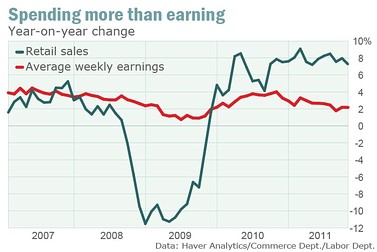
Source: Marketwatch
Housing: Most recent GDP reports show investment in residential homes remains at historically low levels (around 2% instead of its normal range of around 5%) but remember, this measure is bound by zero and so it's unlikely to get much worse. So the question is: have home prices finished their swoon? And the answer is probably not, at least not in areas with significant foreclosures in the pipeline. So put this down as a major slog contributor, though not everywhere across the nation.
Deleveraging: We live in a 70% consumption economy -- quite different from Europe, where they consume about 55% of GDP. So if consumers are servicing debt as opposed to spending, it's hard to gain much growth traction. The sales figure above shows that you just can't keep the American consumer down, but this isn't the go-go 2000s in terms of credit markets -- and, in fact, the figure below shows household debt service continues to fall, i.e., deleveraging (the figure shows debt service as a share of after-tax income). It will take more than this one indicator to get a handle on the deleveraging cycle, but until this trend changes course, it probably means ongoing deleveraging and inconsistent, subpar consumption.
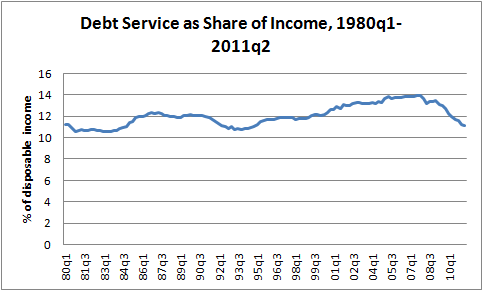
Source: Federal Reserve
Europe: I'm headed for the UK next week, so I'll have a more granular feel for this then. But for now, the problem with contagion is that it's contagious. The more the debt crisis spreads to the large economies of Italy and France, the more we're exposed in lots of ways, including our banks (which hold little southern European debt but a good deal more of France's and Italy's), exports, equity markets, and the general loss of confidence that anybody who works for an advanced economy can intelligently and purposefully attack the problems we face.
Final analysis: It's the job market that matters most -- and not just jobs, but earnings. If real GDP remains at 2.5% or less, we won't see much improvement there. Most forecasts expect growth in that range at best... very few are higher, most are lower. On the plus side, I guess, I think it's more likely we slog along than we hit an official recession, but I worry less about double dips into official recession territory than about the growth recession in which we're stuck. That, and the absence of political will to enact policy solutions are our worst economic enemies right now.
And, also on the plus side, at least we didn't talk about the supercommittee for a few minutes.
This post originally appeared at Jared Bernstein's On The Economy blog.
Richard (RJ) Eskow: Sabotage the Super Committee? We Say Go For It!
---
Frontier Strategy Group
http://blog.frontierstrategygroup.com
What if instead of looking to the past, we let ourselves imagine a future with limitless possibilities? While the world panics about Greece and Italy and France, the markets are bursting with money that is drawing negative returns. People are paying the US to keep their money for them. What if we thought outside of the box?
Greece is a sovereign state with industrious people and plenty of resources. They are no worse off today than they were when they were loaned all that money. Lets sell a few more US bonds at ridiculously high prices and buy the Greek debt at ridiculously low prices. Greek crisis gone. And how much do you think that Greek debt will be worth in an economy not panicking about Greek debt? The US will make a killing selling that debt back.
But the point isn't to make money. The point is that if we start to look at the world as a global market as the corporations do, perhaps we can realign our priorities. In today's world the rich get richer. And the US is the richest country in the world. That is worth something.
"(Thrift) is equivalent to a lowering of the standard of living. In the competition for...work, the man with a lower standard of living will underbid the man with a higher standard. And a small group of such thrifty workers in any overcrowded industry will permanently lower the wages of that industry. And the thrifty ones will no longer be thrifty, for their income will have beeen reduced till it balances their expenditure. In short, thrift negates thrift...."
--Jack London, "The People of the Abyss"
But the US over supply of low skilled labor, the cultural pattern of 2 or more breadwinners per household and the abysmal housing market and the high cost of education or training has rendered us to be a virtual closed system.
http://viableopposition.blogspot.com/2011/11/united-states-debt-100-percent-is-not.html
America will soon join such notable members as Japan, Greece, Italy, Portugal and Belgium in the "100 Percenter Club", most of whom have been heavily covered in the mainstream media for unsustainable levels of debt.
But you bring up a good point, the debt ratio to GDP is an important measure. It has 2 components. Debt and GDP. Those items have an interesting relationship.
Republican pseudo-voodoo economics says paying down debt increases confidence and increases GDP. As anyone with a brain knows, this is patently false. No business gives a rats backside how much the government owes. Paying down debt diminishes activity and reduces GDP.
This is the problem in Europe. Each round of austerity kills GDP and lowers government revenues so as they pay down debt they have to take on even more debt to stay afloat. Lower the denominator and raise the numerator and you drive that percentage of debt to GDP right through the roof.
But mainstream economics and common sense says that to make more you have to spend more. How does Trump make his money? He borrows heavily and invests. He then has earning assets and is able to pay down some of that debt and sometimes has a healthy balance sheet.
The US has to do the same thing. By investing, the US will drive up GDP improving that percentage but also increasing revenues (assuming they haven't eliminated all taxes on the wealthy) that lets them pay down the debt and improve the ratio from the top as well.
And that investment can yield returns long into the future as well.
The baby boomers -- that huge population bubble -- are beginning to retire. Yes, some are feeling pinched into never retiring, but some have been forced to retire early, and a retired person will spend savings. It is not a bad thing for our current economy when someone spends and also "gives" their job to an unemployed, younger person.
It seems like the art of modest living might be catching on -- it might be healthy to cool materialism a little, especially if one hopes to save humanity from the curse of climate change. At some level, it pleases me, but at another level, it is becoming painfully clear that nobody has the slightest idea how to run an economy that isn't geared toward excessive consumption. American employers have failed, as well, to offer any model other than producing ever more with ever fewer, ever lower paid employees, which is totally self defeating. We can do better, if we can just honestly focus on the actual problem.
All of the trade rules are written specifically to benefit the top management of international corporations while destroying the American worker. It's time for that to change. It will take a massive growth of OWS into a global movement that can't be stopped to even begin to make a dent in the corporate and banking control of our country, but since almost all other countries are experiencing the same thing at the hands of global elites, the movement is already underway. It just needs to grow until it's unstoppable.
What was eye-opening and a little scary was how arrogant and determined these CEOs are, and how accustomed to power and to making demands of government. Some seemed quite angry that OWS was questioning their "right" to do exactly as they pleased, to make as much as they could scam out of the economy, and to thumb their noses at the rest of us.
I admit it's loathsome to me that these three would be so open about their status as servants of the corporations. Mr. Ryan and Mr. Cantor I can half stomach - as Representatives they can decide they were elected to be tools. But Geithner is supposed to represent the rest of us. Geithner represents Mr. Obama, and we didn't elect him president for this betrayal to Wall Street banksters.
I saw a schedule of events for a right-wing affair sponsored by the Koch brothers. Every event was about "FREEDOM!!!". Reading event descriptions showed that to them freedom means they and their peers get the right to do exactly what they want and to who ever they want. There was with no concern for the rights and freedom of other folks.
It is much more simple now: 1% - 99% ... the rest is dictum.
http://blogdredd.blogspot.com/2011/09/homeland-big-brother-plutonomy.html
In August, McClatchy Newspapers canvassed small businesses, asking them if regulation was a big problem. “None of the business owners complained about regulation in their particular industries, and most seemed to welcome it,” McClatchy reported.
The September survey of its members by the National Federation of Independent Business shows that poor sales are far and away their biggest problem, regulation didn't make the list.
70% of GDP is consumer spending. Wages make up the lowest share of GDP since the government began tracking in 1947. The middle class has not seen a wage increase in 30 years. Europe now outpaces the United States in upward mobility.
The number of Americans living in communities of extreme poverty (annual income of $22,314 for a family of four) soared by one-third between 2000 and 2005-09. Compared to 2000, residents of extreme-poverty neighborhoods were more likely to be white, native-born, high school or college graduates, homeowners, and not receiving public assistance. The numbers rose twice as fast in suburbs as in cities. Poor residents in extreme-poverty tracts increased by 41 percent in the suburbs.
Capitalism in America is consumer-based, not investment-based. And Republicans plan to fix the economy is attack wages and increase taxes on the poor and middle class.
http://jec.senate.gov/public/?a=Files.Serve&File_id=91975589-257c-403b-8093-8f3b584a088c
The report found Income inequality may be part of the root cause of the Great Recession. Stagnant incomes for all but the wealthiest Americans meant an increased demand for credit, fueling the growth of an unsustainable credit bubble. Bank deregulation allowed financial institutions to create new exotic products in which the ever-richer rich could invest. The result was a bubble-based economy that came crashing down in late 2007. 70% of GDP is consumer spending.
One of the really interesting graphs was Financial Deregulation (figure 5):
http://rwer.wordpress.com/2010/09/21/5-graphs-on-income-inequality-and-the-great-recession/
Which shows that Financial Deregulation precipitated the rising income inequality. Meaning that deregulation of banks on Wall Street causes an EXPLOSION in the inequality between classes.
This is class warefare. And the middle class is losing.
You omitted the major culprit in your list of constraints; the privately owned controller of our currency known as the Federal Reserve System. What is it that the media, academics, and pundits don't get? There is no economic recovery until there is sustainable demand. There can be no sustainable demand absent capital investment. And, where non-government entities will not lend, (e.g., the Fed, and its banks and their major and minor banks), the only funding source is the government.
"The only entity that can provide the non-government sector with net financial assets (net savings denominated in the currency of issue) and thereby simultaneously accommodate any net desire to save (financial assets) and thus eliminate unemployment is the currency monopolist – the government."
Source: Bill Mitchell, http://modernmoney.wordpress.com/2010/09/27/budget-surpluses-are-not-national-saving/
"CBO estimates that ARRA's policies had the following effects in the second quarter of calendar year 2011 compared with what would have occurred otherwise:
* They raised real (inflationÂ-adjusted) gross domestic product (GDP) by between 0.8 percent and 2.5 percent,
* Lowered the unemploymeÂnt rate by between 0.5 percentage points and 1.6 percentage points,
* Increased the number of people employed by between 1.0 million and 2.9 million, and
* Increased the number of full-time-Âequivalent jobs by 1.4 million to 4.0 million...."
In short, the problem with the 2009/2010 stimulus was that it wasn't nearly large enough! So what we need, but won't get anytime soon, is a 2nd, much larger stimulus.
Your statement should have read,
"You could throw a handful of pebbles down Michigan Avenue in Chicago at lunchtime and, probably, hit three or four people that would know more about how to regulate and spur the economy and utilize tax policies to bring jobs home than any of the Republican Presidential candidates or President Obama."
President Obama is a Rockefeller Republican, socially liberal pawn of Wall Street aka a Clinton Democrat. The Republicans are socially conservative pawns of Wall Street.
What we need to create jobs is a Roosevelt Democrat!
A Roosevelt Democrat knows on an instinctual level BANKS TO BIG TO FAIL will destroy the financial markets because at the end of the day the government has to bail them out!
A Roosevelt Democrat Knows on an instinctual level UNRESTRICTED FREE TRADE hurts the poor disproportionately more. A Roosevelt Democrat knows that the first step out of poverty is and has been since the start of the industrial age that entry level factory job! That job prepares an individuals to appreciate an education. That kid seeing his Mom or Dad coming home dead tried wants and desires to obtain the next rung out of poverty an education! Doubt me see how hard the Chinese leaders will fight to keep those entry level factory jobs!
What this nation needs is a Roosevelt Democrat and I don't care about his Party affiliations!
http://www.fairfightfilm.org/crf/TRTrustBustingProduction.pdf