iPhone app iPad app Android phone app Android tablet app More

Featuring fresh takes and real-time analysis from HuffPost's signature lineup of contributors
Jared Bernstein

GET UPDATES FROM Jared Bernstein
 

Full Employment: A Force Against Rising Inequality and Stagnant Incomes

Posted: 03/ 4/2012 8:15 pm

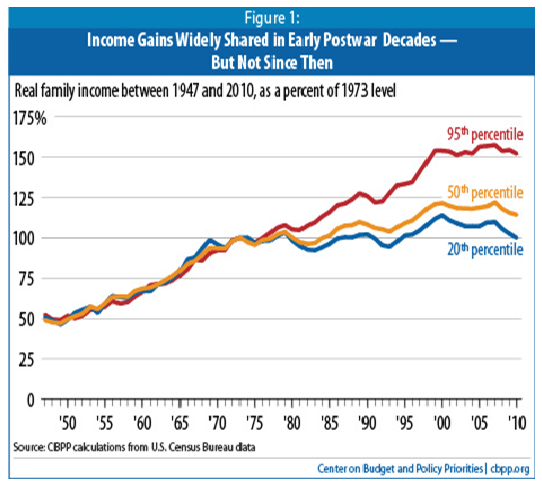
One of the more compelling graphs in the inequality debate is the growth of real family incomes for low, middle, and high income families, going all the way back to the 1940s. The reason for its popularity is that it's one of the few pictures (though not the only one) that very clearly delineates a period of growing together and a period of growing apart.
2012-03-05-Screenshot20120304at7.36.36PM.png


For example, comparing two roughly 30 year periods, 1947-79, when inequality was relatively unchanged, incomes just about doubled for each group shown in the figure. But between 1979 and 2010, income growth at the middle and bottom was pretty much flat, with the important exception of the mid-1990s, discussed below. High incomes rose more consistently over the period, though that trend too looks flat in the 2000s. That is, however, an artifact of these data, which exclude realized capital gains, an important income source in reference to inequality's growth over this period. In fact, other data which include capital gains show that the share of national income accruing to the top 1 percent grew to historic highs in 2007, before falling with the financial bust in 2008.

Now, there is of course a lot more than unequal growth delineating the two periods. The latter period saw many more women entering the workforce, demographic changes, including more single parent families, and importantly, at least until the mid-1990s, a significant slowing of productivity growth. But there's no question that inequality was a major factor in play (see note #1).

Another big distinction between these two roughly 30 year periods was the tightness of the labor market. Over the first period, 1947-1979, the average unemployment rate was 5.1 percent; over the second period, 1979-2010, it was 6.3 percent (6.1 percent through 2007). That doesn't sound like that big a difference in terms of labor market tightness, but it is. Let me explain.

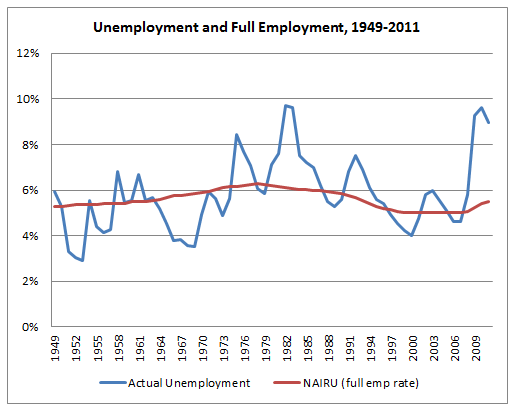
One useful way to assess labor market tightness is to compare the unemployment rate to a construct called the non-accelerating inflationary rate of unemployment, or the NAIRU. The idea behind the NAIRU is that a) there's a tradeoff between low unemployment and inflation, and b) there's a rate of unemployment that's consistent with stable inflation. The implication is that if unemployment falls below the NAIRU, inflation will keep accelerating.

In fact, it's a slippery concept, this NAIRU idea, and the historical evidence for its existence is mixed at best. Back in the mid-90s, economists though it was 6 percent, and when the jobless rate fell below that, they badgered the Fed to raise interest rates so as to forestall the inflationary spiral they were sure was forthcoming. But it turned out that the spiral was a phantom menace -- price growth actually decelerated in these years and the jobless rate fell below 4 percent for a few months in 2000. Most importantly, from my perspective, very low jobless rates in the latter 1990s shows up quite clearly in Figure 1 as helping to generate uniquely favorable income trends for middle and low-income families.

But I still think the concept is useful, and that the estimated NAIRU provides a rough benchmark against which to compare the actual unemployment rate. For example, analysts like those at the Congressional Budget Office, who estimate the NAIRU, make adjustments for demographics that are useful in figuring out the full-employment unemployment rate. As our labor force ages, we'd expect the NAIRU to fall, because older workers tend to have lower unemployment rates.

The figure below plots the CBO's NAIRU against the actual unemployment rate since the late 1940s. Obviously, we're way above full employment right now, thanks to the Great Recession. But what's notable from the perspective of the income trends above is how much more common full employment was in the period when incomes were growing together versus when they were growing apart. There's an important, substantive linkage here between growth and inequality: at full employment, middle and low-income workers have much more of the bargaining power they require to claim their fair share of the growth they're helping to generate.
2012-03-05-Screenshot20120304at7.37.33PM.png
Sources: BLS, CBO


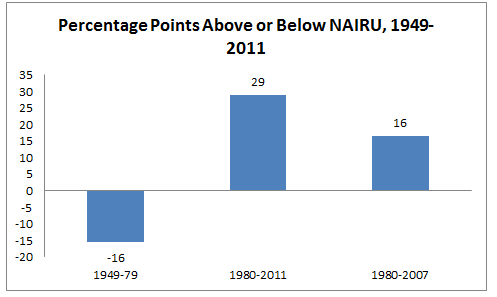
One way to compare how tight the labor market was over these two periods is to ask how many cumulative points of unemployment were spent above and below full employment in each period (to be clear about polarities, "above full employment" means the actual unemployment rate is "too high," i.e., above the NAIRU, and vice versa -- generally speaking: below is good, above is bad).

The next figure shows that over the first period, 1949-1979 unemployment was often below the NAIRU, for 16 cumulative percentage points over the full period (CBO's NAIRU series starts in '49). Conversely, unemployment was above the NAIRU for 29 points, 1980-2011. However, 13 of these points are due to the GR -- through 2007, we spent 16 points above the NAIRU.
2012-03-05-Screenshot20120304at7.39.59PM.png
Sources: BLS, CBO


But do these differences really play a role in generating the differences in income growth shown in the first figure? A little regression analysis suggests that they do. Again, this is correlation, not causation, but there's a lot more detailed evidence, not to mention common sense, that confirms these relationships (see, for example, this book by Dean Baker and me; see also note #2).

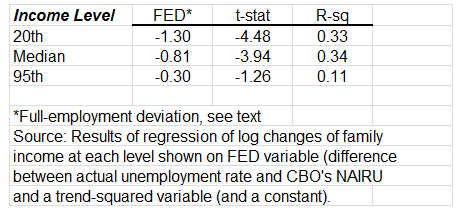
The table below shows the result of regressing (log) changes in real incomes -- the ones shown in the first figure above -- against the annual difference between actual unemployment and the NAIRU. In other words, if the NAIRU in a given year is 5 percent and the actual unemployment rate is 6 percent, this variable equals 1 percentage point in that year, and the regression asks how that measure correlates with real income growth.

The full employment hypothesis developed above would predict that the coefficient on the full-employment deviation variable (FED...like the central bank... hee-hee!) would be "large" and negative for low-incomes and small and not particularly significant for high incomes.

The table shows that the results largely fall out as predicted. The coefficient on FED tell you the percent change in real income at each level that you'd expect to see for each point you're above the NAIRU. So, for low-incomes (20th percentile), that elasticity is -1.3 percent and statistically significant. For middle incomes, it's about -0.8 percent and again, significant. For high incomes, it's -0.3 and insignificant, meaning that deviation from full employment doesn't much hurt high income families. R-squared, a measure between 0 and 1 of how well the regression explains changes in real incomes, is around 0.33 for middle and low-income families and only about one-third that amount for high-income families.

2012-03-05-Screenshot20120304at7.41.04PM.png

Source: my analysis of Census, BLS, CBO data.

Armed with these simple relationships, we can examine how income growth might have been different had unemployment in period two been more like that of period one -- i.e., had we hewn closer to the path of full employment.

The figure below shows actual median incomes -- the same series as in Figure 1, though now in 2010 $'s instead of indexed to 100 -- along with two different simulations. One simulates full employment, meaning the FED variable was set to 0, 1980 forward. It's not a realistic scenario, of course, but gives you the flavor of the cost of slack labor markets. The second scenario is more realistic -- it's takes the actual FED value over these years and divides them in half, basically asking how middle incomes might have fared had the job market been half as slack as it actually was.
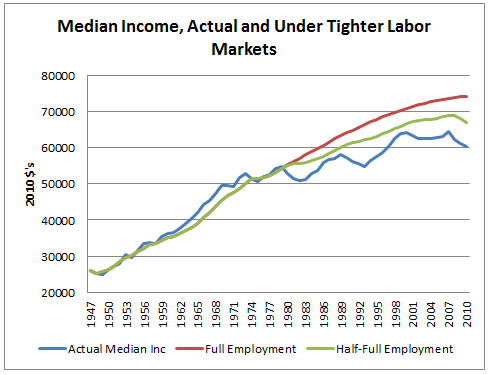
2012-03-05-Screenshot20120304at7.42.40PM.png
Source: Census data and results in previous table.

In the first simulation, by 2007, right before the GR, middle-class incomes under "pure full employment" were $9,200 above the actual; under "half-full employment," they were $4,400 higher. Where would this extra income come from? In fact, we're sacrificing output when we run slack labor markets, so some would come from missing growth. But another source would be more equitable distribution of growth, such as prevailed throughout the first period shown in Figure 1.

In other words, no matter how you cut it, slack is awfully costly to middle and low-income families.

OK -- I hopefully have convinced you that full employment matters, it's a good thing, and it's particularly important to middle and low-income families. Now you'd probably like to know how we recreate a job market that generates a bar more like the first one in Figure 3 above.

That's to come. Right now, time to go cheer on the kid, whose team made the local basketball playoffs!


Note #1: I unearthed this excellent Census study -- one I recalled finding quite compelling back in the day -- which examines the impact of demographic changes on the growth of inequality. It finds they were more important in the 1970s than in the 1980s, while inequality was a factor in both decades, especially the 1980s (e.g., note that in table 7, the fully standardized income shares are about the same as the actual shares, suggesting that demographics were not the driving factor in share changes over the decade ).

Note #2: Interestingly, the whole NAIRU schtick is based on low unemployment leading workers to push for higher wages, which then feed into higher prices. Once workers realize that their higher incomes are getting eaten up by higher inflation, they push for even higher wages, and that sets off the alleged wage/price spiral.

This post originally appeared at Jared Bernstein's On The Economy blog.


One of the more compelling graphs in the inequality debate is the growth of real family incomes for low, middle, and high income families, going all the way back to the 1940s. The reason for its popu...
 
 
  • Comments
  • 72
  • Pending Comments
  • 0
  • View FAQ
Comments are closed for this entry
View All
Favorites
Recency  | 
Popularity
Page: 1 2  Next ›  Last »  (2 total)
photo
HUFFPOST SUPER USER
gerald4
licensed mechanical and electrical engineer
02:25 PM on 03/05/2012
US "FREE TRADE AGREEMENT" treaties mean that US workers must (generally) compete with foreign worker pay scales, benefit packages (none), the more productive foreign labor work rules (none), foreign corporate tax rates (lower or non-existent), property taxes (lower) and the lower environmental manufacturing costs that are available in foreign countries.

If US citizens are not willing to work for lower wages than the foreigner workers employed in foreign countries are paid, then the USA cannot compete based upon lower product costs since US located businesses must pay EPA compliance costs, unemployment payroll costs, Medicare payroll costs, FICA payroll costs, and other costs PILED ON TOP of US labor payroll costs.

If US Businesses cannot compete on lower product costs, then maybe we could become competitive internationally through other areas such as superior technology, as the USA did to win WWII and for a couple of decades following WWII when Science, Technology, Engineering and Mathematics (STEM) were the focus of our educational systems, instead on non-STEM subjects.

The "Free Trade" laws and other anti-business laws that the US congress created in the last 20 years by our elected Democrat and Republican party members of the US congress and the US Senate allowed and/or ECONOMICALLY REQUIRED that every US business, and US corporation to ignore the plight of the US "blue collar" middle class worker, and utilize foreign labor OR FACE BANKRUPTCY.
HUFFPOST SUPER USER
rhettphive
GOP- unaccountable since Y2K
01:43 PM on 03/05/2012
Why is it so easy to believe that the 99% are lazy and only wanting handouts? But so hard to understand that the 1% are crooks who have stacked the deck in their favor since the sainted Reaganomics.
10:34 AM on 03/06/2012
It's not that hard for anyone with a brain...that leaves out far too many Americans who prefer to live in fantasyland with the GOP.
This user has chosen to opt out of the Badges program
11:29 AM on 03/05/2012
Millions of non-manufacturing jobs have been offshored...

Any job that can be performed at a desk or a computer can be performed overseas for much less; e.g.:

o computer programmer

http://www.liveleak.com/view?i=4ea_1195705444
LiveLeak.com - "30 Days: Outsourcing" (2006) (Part 1/2)

The "star" is Chris Jobin, a programmer whose job was outsourced to India. He traveled to India and stayed for 30 days as an employee of a call center.

o accountant
o architect
o engineer
o radiologist
o car designer
o legal services:

http://www.manufacturingnews.com/news/10/0126/outsourcing.html
Outsourcing Firms And Foreign Countries Target More American Service Industries, Especially U.S. Law Firms

"...Until recently, companies were outsourcing functions because they could not find qualified workers. The primary reason now for outsourcing is cost savings..."
photo
HUFFPOST SUPER USER
den1953
The National Inquire of Politics the GOP!
08:37 AM on 03/05/2012
Just think if Americans listen to the Koch Brothers and ALEC in the approach of middle class workers Americans can have that race to the bottom of the economic chain, it only can get worse?
photo
Democrat in the South
Empathy, the most important word
08:36 AM on 03/05/2012
Grover Norquist is on Morning Joe right now foaming at the mouth about how great Reagan was and how everything is Obama's fault for not being as good as Reagan. He looks like he might blow a gasket!!! Or worse......He is so desperate to win republican control he will tell us any minute that your mamma is planning to do away with all her children if we don't elect a republican President.. This man is out of freakin' control!!!!

Grover needs to go the way of Rushbo......
photo
Hally
It's all stinky.
08:32 AM on 03/05/2012
I really wish someone would address the issue of robber baron CEOs who stack their boards with their buddies, give themselves obscene salaries while laying off workers, gut their companies by selling off parts and still receive bonuses while sending their companies into bankruptcy.

This shortsighted approach to governing a company enriches a few while giving shareholders the illusion that the company is doing well. Meanwhile, it contributes to unemployment and massive losses for the company in terms of institutional knowledge, highly honed skills of employees the company paid dearly to train, and in the end, the loss of shareholder value especially when the company goes bankrupt.

I worked for one company whose board had the audacity to vote themselves the lifetime benefit of flying for free, whether they were on the board or not, and there was nary a peep from anyone.
This user has chosen to opt out of the Badges program
11:40 AM on 03/05/2012
Two words: interlocking directorates.

CEOs are on each other's boards.
10:39 AM on 03/06/2012
It is called nepotism. It also goes by the name of Incompetence, Inc.
photo
HUFFPOST SUPER USER
eddy joe
welcome to the machine
06:32 AM on 03/05/2012
I too would like to see things change, but the reality is that the rich have the money, and the power to keep it.
This user has chosen to opt out of the Badges program
12:22 PM on 03/05/2012
"This struggle may be a moral one, or it may be a physical one, and it may be both moral and physical, but it must be a struggle. Power concedes nothing without a demand. It never did and it never will. Find out just what any people will quietly submit to and you have found out the exact measure of injustice and wrong which will be imposed upon them."

— Frederick Douglass, 1857

"At the banquet table of life there are no reserved seats. You get what you can take and you take what you can hold. And you can't hold anything without power. And power comes from organizati­on."

— A. Phillip Randolph
photo
HUFFPOST SUPER USER
carlkirsch
06:10 AM on 03/05/2012
Thoughtful charts and article, but not helpful because it does not address the problem, i.e., chronic unemployment caused by outsourcing.

Because of outsourcing, we make nothing in this county anymore. Everything is made aboard. (Check the shelves at WalMart and Home Depot). We may design it here, but it is all made abroad. (Example: Gov. Romney’s wife drives two Cadillacs, he says. Cadillacs are designed in Detroit, but made in Mexico.)

In the period 1947-79, unemployment was low, income disparity was low, says Mr. Bernstein. Why? Because most of the stuff Americans needed for their day-to-day living was made here: Refrigerators to tacks. Not so now. So, when a recession hits, recovery or the bounce-back is slow because there are no factories or assembly lines that start back up; no factories that recall laid off workers, thus reducing unemployment, eliminating the fear of economic insecurity fear for the American consumer, thereby fueling pent up buying.

(By the way, when you outsource jobs, you also outsource your tax base because you have less people paying taxes. Result: Deficits and budget cuts by government at all levels.)

Carl Kirsch
Atlanta, GA
photo
HUFFPOST SUPER USER
duegger
onto others
08:30 AM on 03/05/2012
In a large part I can agree with you, but outsourcing has been around for a long time. In the 60's, many comusner items were labeled made in Taiwan, Mexico, or Japan. What I do notice is that the graphs show that as Trickle Down Economics became the model for our economic and tax policies the middle and lower classes have suffered in income compared to the richest.
photo
HUFFPOST SUPER USER
carlkirsch
06:18 AM on 03/06/2012
Duegger: You are right about the 60;s. But, outsourcing became huge after NAFTA adopted in 1994.

My argument is that, if you hollow out your industrial base by outsourcing everything, not only do you create an environment for chronic unemployment, perpetuate the need for the welfare state, but you also, as mentioned, outsource your tax base, impoverishing or diminishing the ability of state and local governments to deliver common services, thereby increasing their reliance on the largesse of Washington.

Thanks for your reply.
05:49 AM on 03/05/2012
USA: THE FAIREST NATION ON EARTH

There is no place on earth that is fairer with a more level playing field for achieving success and the good life than the United States of America. But listening to Obama and leftist pundits like Jarad Bernstein (who work from an unrealistic static, zero-sum game model of the economy) you'd never no it.
photo
HUFFPOST SUPER USER
Denis Higgins
06:14 AM on 03/05/2012
"you'd never no it"....and you got that whole apostrophe thing down, too!
HUFFPOST SUPER USER
charlie smerlick
the dog barks but the caravan still moves on
07:56 AM on 03/05/2012
Your correct AppolloSpeaks2U, which goes to show you that it is a very cruel world indeed.Obama is all about change and the old guard is against it ( the right wing, the super rich, those who profit off of wars and fear, and those who are just plain afraid of change ). The world has become smaller and we all feel the effects of one anothers mistakes sooner rather than later.New energy sources must be looked for , a better way of distribution of food and medical supplies and attention must be sought out,and a more fair way of rewarding labor must be found. If these challenges are not met soon then I am afraid that a true and extensive bloody revolution that turns into a chaotic last battle will become our future....
photo
unionave
Old Codger
05:18 AM on 03/05/2012
Over the time period of the graph a very profound change happened that is often ignored . It happened so slowly we slept through it .

We went from one salary providing for the family , which included health care , dental care , education through formal , home purchase , auto purchase , and all other necessities of life ; to today where it requires several incomes to provide for a family .

Centuries before labor was allowed to form Unions the business enterprises formed Chambers of Commerce . Which are Unions formed for the enhancement and welfare of commercial businesses .

As the Chambers became more powerful politically the cost of goods and materials rose and labor salaries purchasing power fell . If the laborers complained about long hours starving and made homeless a word from the Chamber would bring the gendarme to pummel the laborers in to submission .

In case no one has noticed today many of the public protection laws have been erased and are still being whittled away while police powers have been enhanced . The usual suspects can now be incarcerated with out due process because the final nail has been driven in to the coffin of Habeas corpus .
photo
HUFFPOST SUPER USER
carlkirsch
06:25 AM on 03/05/2012
Right on Unionave! But, what about outsourcing? We did not have that from 1945-1979. Doesn't outsourcing play a role in today's chronic unemployment and slow recession recovery? And what about the loss of your tax base when you outsource? Doesn't that play a role in deficit creation and budget cuts by government at all levels? Please put outsourcing on your list of changes too.

WalMart and Home Depot have simply become huge Chinese outlet stores. If we made all that stuff here and kept the money here, the price point for most of the stuff would be the same as if it had been made in China (or India or wherever). And even if the price point was higher, as consumers we could afford it because good American jobs would pay us good and decent American wages. In short, what goes around comes around. If a country adopts a trade policy that deliberately hemorrhages jobs, it is doomed to be a land where the rich can play, not a land for the people and by the people. (This struggle is a constant in America history. Just read some of Teddy Roosevelt’s speeches and read something about America’s Gilded Age at the beginning of the 20th century.)

Carl Kirsch
Atlanta, GA
photo
bdgrizcp
Fan of Clanthus
06:58 AM on 03/05/2012
Don't be so quick to blame American Corporations for the failing of our work force. We cost too much to be a player in consumer item manufacture. For domestic corporations, the 70's was that make or break time. In 1979 US manufacturing had its best year ever. After that, it became cost ineffective to manufacture here, and we see the results. We gave away the basic industries (clothing, electronics, consumer staples) and kept (to a certain extent) cars, trucks, boats and airplanes. Also we make the best weapons in the world. But the proof here is that it is only those industries where shipping, size or national security play a role that we remain in the game. Those industries where labor cost is not a huge factor. Because the people of my generation (post war baby boomers) don't work cheap.
photo
unionave
Old Codger
07:37 AM on 03/05/2012
f/f ! Outsourcing began shortly after WWII . It started with small electronic items . Pocket radios etc. Then mushroomed in to TV and every other electrical item . Nixon wiped out the textile industry , and RWR started putting names on the outsourcing . (Check CBI) .

Corporate free trade was the death knell for labor in America . The reason for assessing duty on imported goods is to level the marketing price between imported and made in the USA . Without import taxes American labor is at a huge disadvantage . Corporate free trade allows "corporations" to import without import taxes . The huge loss of government revenue has done the most damage in our history .

It turned our nation from a lender to a beggar .
photo
HUFFPOST SUPER USER
Hamid Lorette
Ignorance and Extremism are the Enemy
05:15 AM on 03/05/2012
As long as companies like Apple can employ the Chinese for 3 dollars a day there will never be full employment in the US unless there are some FDR type projects started by the government like fixing the infrastructure or installing solar panels on all government buildings. I thought Obama was going to start these kinds of programs which was why a lot of us voted for him.
photo
BigBearcatBill
This is the real Bearcat - a Binturong
03:49 AM on 03/05/2012
Since full employment is the goal, I will put in my once a week or so plug for the only republican bitching that I can agree to an extent with (and I am sure you hear it from your conservative relatives and acquaintences to): 1 - All those illegal immigrants are here because they must be doing some work, not all or many of them are living off of handouts or robbing people. They probably have the equivalent of several million full-time jobs, although likely minimum wage and no benefits I still would rather see Americans performing those especially low-skilled unemployed which I am sure we have a couple million of, plus our kids are having harder times finding part-time jobs they used to get all the time. 3 - Stop the abuse of gov handout programs including those faking disabiity, get all who are healthy enough back to work. Now on the liberal side, we have less work to do in this country because we have become more efficient with robotics and computers, etc. - the engineers were put to work by the owners to unemploy our 99% from jobs they could have a robot do, SO shorten the work week to well below 40 hours and require more paid vacation and sick/family leave.
photo
AvgJoeBlow
We are smarter than any of us.
07:17 AM on 03/05/2012
Right to work solved all their problems at many levels.
No illegal allien ever got a Union card.
With no Unions, who needs one.
photo
HUFFPOST SUPER USER
Susan Aker
08:40 AM on 03/05/2012
I have one major issue with your post - there are actually very few people who fake disability. What we usually see, however, is where a person can no longer do the job they were doing. For instance, I was in a truck accident and now I have BPPV, which is a possibly recurring cause of dizziness. This actually makes it ILLEGAL for me to drive a truck. In that sense, I'm disabled (btw, I do not collect disability.) If we had better retraining programs and more jobs that could easily be done by the disabled (like a human on the phone instead of a *bleep* machine!) then we would have fewer on the disabled list. If they could make something close to their old salary, most people would choose to keep working.
photo
BigBearcatBill
This is the real Bearcat - a Binturong
12:39 PM on 03/05/2012
Thanks for qualifying that, just passing on the statement you hear from the cons who think that about half of society does not want to work and just wants to live off of them. I believe there are a few percent who do, but they could be cons as well too and not just dems. Anyway point is if liberals want more credit from the cons, got to toughen up on those areas of welfare/unemployment/disability abusers. However knowing them they won't believe any statistics we tell them, they are the chosen ones they think.
lofttypeofaview
I pledge allegiance to the poor!
02:53 PM on 03/05/2012
Exactly Social Security is usually half of what is considered poverty level income, unless the disabled person has been receiving it for about forty to fifty years upon the current rate of our minimum wage; then they are receiving the equivalent to minimum wage because of cost of living increases and the fact that once a person receives Social Security, the benefits unlike wages don't decrease; at least not yet.
03:08 AM on 03/05/2012
It's good stuff, but the present political system lacks the ability to remedy this problem unless conditions get even worse and more people go into full-on resistance.
photo
LoneTree
Liberty is more precious than life.
02:17 AM on 03/05/2012
1947-79: Europe and Asia in ruins (no foreign competition), the Greatest Generation back from global war with boundless energy and courage and self-reliance, no transfer payments through taxing the "rich" to pay the "poor" enabling very high marginal tax rates.

1979-Present: Every element of that has changed.

Jared, leave the charts and graphs on your desk and get out and walk around. You won't find the answers in the numbers, you'll find the answers through an analysis of history. Numbers will confess whatever their interrogator wishes to hear.
HUFFPOST SUPER USER
Robert SF
08:28 AM on 03/05/2012
The problem with that theory is that our exports were not higher after WWII. In other words, we did not make the stuff that rebuilt Europe an Asia. Further, we had lots of transfer payments. Not only did we have a rich (by today's standards) safety net, but what about the billions spent on the GI Bill? Besides, we created our own competition.

But you're so invested in the rightwing fantasy that all our problems are due to "too much welfare to the poor," that you can't see that.
photo
LoneTree
Liberty is more precious than life.
11:10 AM on 03/05/2012
"The problem with that theory is that our exports were not higher after WWII." - - - I didn't say they were. What is a fact is that our imports were lower. As a consumer society, we've always been our own most important market. Post-War, that domestic demand was satisfied by domestic manufactures.

"In other words, we did not make the stuff that rebuilt Europe an Asia" - - -Again, I neither said that nor require it (see above).

Welfare itself isn't the problem, the problem is far bigger than that.

My pragma sees and raises your dogma.
photo
HUFFPOST SUPER USER
Susan Aker
08:43 AM on 03/05/2012
That's a big misrepresentation of the tax rates. The top marginal rate in 1947 was 86% and in 1979 it had dropped to 70%.

You're right that top marginal rate has certainly changed!
photo
LoneTree
Liberty is more precious than life.
11:11 AM on 03/05/2012
"That's a big misrepresentation of the tax rates" - - - Show me where I cited a specific tax rate?
photo
HUFFPOST SUPER USER
PotomacOracle
The Solution:debt free credit clearing systems
01:35 AM on 03/05/2012
There is, I'm certain, a correlatrion between the abandonment of the gold standard and the behaviour of the 20% with regard to taxation of individual and corporate income. The 20% knew that under a fiat currency monetary policy, income tax revenue, per se, was not needed to fund government expenditures. The U.S. through the Fed and Treasury would now be the sole issuer of the currency and could issue as much as was needed and would never be constrained by revenue to spend.

Therefore, they lobbied for and received massive cuts in effective tax rates between 1971 ad 1980 from 75% to 35%, while rates for the 80% were hardly reduced at all. Tax cuts for the rich created a windfall for corporations and CEO's and contributed to widening the income gap.
HUFFPOST SUPER USER
Robert SF
08:30 AM on 03/05/2012
However, the entire world got off the gold standard, yet the entire world didn't slide into inequality. On the contrary, it is since ditching the gold standard that First World countries have pulled ahead of us. In 1970, we were #1, the most economically equal country in the world. Today, we're 18 or 19, depending on whether they include Mexico or Turkey in the list. Nice company, eh?