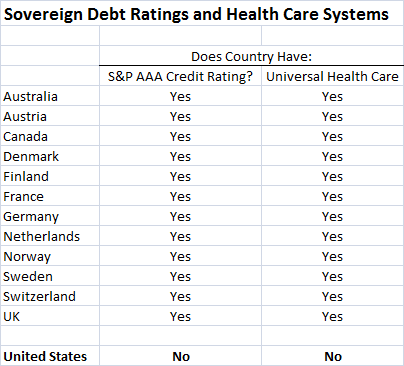
S&P's downgrade "analysis" makes it clear that we need to "contain" the growth of entitlements. EG, in discussing their displeasure with the budget plan, they note:
...the plan envisions only minor policy changes on [sic] Medicare and little change in the other entitlements, the containment to which we and most other independent observers regard as key to long-term fiscal sustainability.
Now, look at the below list of countries that both maintain a triple-A rating from S&P (though some are on their downgrade watchlist) and have some version of universal health coverage, in other words, an "entitlement" that goes much further than anything we've got over here.

That doesn't imply Medicare is on solid footing. But the problem is the growing cost of health care system wide (in fact, cost pressures are worse in the private sector), and the solutions exist in every other advanced economy, as they essentially cover their whole populations and do so for about half of what we spend relative to GDP.
Yet, S&P needs to see cuts in Medicare if we want our triple-A rating back.
Now, I really don't need to see the rating agencies get into the analysis of comparative international health systems. I'd be content if they did a better job on stuff like, oh...I don't know...mortgage back securities.
But if they're going to make judgments like this, then they should do it right. An honest analysis of fiscal sustainability would point toward a larger, not smaller, role for publicly provided health coverage.
This post originally appeared at Jared Bernstein's On The Economy blog.
http://www.pbs.org/wgbh/pages/frontline/sickaroundtheworld/countries/
Five Capitalist Democracies & How They Do It | Sick Around The World | FRONTLINE | PBS
Many people are thinking of Britain's socialized health care when they hear "universal health care".
http://www.nytimes.com/2005/07/25/opinion/25krugman.html
Toyota, Moving Northward - New York Times
"...But education is only one reason Toyota chose Ontario. Canada's other big selling point is its national health insurance system, which saves auto manufacturers large sums in benefit payments compared with their costs in the United States.
You might be tempted to say that Canadian taxpayers are, in effect, subsidizing Toyota's move by paying for health coverage. But that's not right, even aside from the fact that Canada's health care system has far lower costs per person than the American system, with its huge administrative expenses. In fact, U.S. taxpayers, not Canadians, will be hurt by the northward movement of auto jobs.
To see why, bear in mind that in the long run decisions like Toyota's probably won't affect the overall number of jobs in either the United States or Canada. But the result of international competition will be to give Canada more jobs in industries like autos, which pay health benefits to their U.S. workers, and fewer jobs in industries that don't provide those benefits. In the U.S. the effect will be just the reverse: fewer jobs with benefits, more jobs without.
So what's the impact on taxpayers? In Canada, there's no impact at all: since all Canadians get government-provided health insurance in any case, the additional auto jobs won't increase government spending..."
http://www.huffingtonpost.com/2010/11/28/health-care-tax-break-deficit_n_788852.html
Job-Based Health Care Threatened
"WASHINGTON — Job-based health care benefits could wind up on the chopping block if President Barack Obama and congressional Republicans get serious about cutting the deficit.
Budget proposals from leaders in both parties have urged shrinking or eliminating tax breaks that help make employer health insurance the leading source of coverage in the nation and a middle-class mainstay.
The idea isn't to just raise revenue, economists say, but finally to turn Americans into frugal health care consumers by having them face the full costs of their medical decisions.
[snip]
Repealing the tax break would raise several hundred billion dollars a year, depending on how it's done. Many economists believe employers would boost pay if they didn't provide health care..."
Anyone who thinks employers would boost pay to compensate is delusional.
By the way, you left off a few countries that have triple AAA that do not have universal health care and some, like Hong Kong and Singapore that just let open and free markets provide the solution
Ministry of Health: Healthcare System
"...Singapore Healthcare System
Our healthcare system comprises public and private healthcare, complemented by rising standards of living, housing, education, medical services, safe water supply and sanitation, and preventive medicine.
Over the years, MOH has followed the principle of ensuring that good and affordable basic medical services are available to all Singaporeans. We have been continuously fine-tuning our system to ensure we are always aligned with this principle and developed our healthcare system into one that has received praise and recognition both locally and internationally.
MOH would like to share some of the accolades received for our healthcare system.
Philosophy
Singapore healthcare begins with building a healthy population through preventive healthcare programmes and promoting a healthy lifestyle.
Good, affordable basic healthcare is available to Singaporeans through subsidised medical services at public hospitals and clinics. Our hospitals and healthcare system will never withhold help to a Singaporean because of financial limitations. Yet our philosophy promotes individual responsibility towards healthy living and medical expenses. Medisave, Medishield, ElderShield and Medifund schemes exist to help Singaporeans “co-pay” their medical expenses.
Primary Healthcare
Primary health care includes preventive healthcare and health education. Private practitioners provide 80% of primary healthcare services while government polyclinics provide the remaining 20%. However, public hospitals provide 80% of the more costly hospital care with the remaining 20% by private hospital care...."
Again, thansk for your support. You have backed up so many points of mine in the past, I am thinking that you must be one of the biggest free market proponents in the world. hansk again.
As an aside, Singapore clinics are known as one of the best places for transgender operations. Apparently the price-quality combo is quite good and they attract a lot of people from Thailand. This is a great example signals through pricing affecting supply and demand. Free markets work!
Kai
Every working person in Singapore (Singapore Permanent Resident/ Singapore Citizen) and the self-employed are obliged by Singaporean law to make a payment to Medisave from their CPF (Central Provident Fund) account. These Medisave funds are used to pay for hospital expenses for the contributor as well as their dependents. These dependents have to be permanent residents or Singaporean citizens and can be a spouse, a child, a parent, or grandparent.
I did not say that they did not have public health care at all. I said that they did not have universal health care and that their markets are open meaning that I can just show up and start working as a doctor assuming I have graduated from a recognized medical system, even if that school was in the states. In the US, the markets are cartelized. There is no shortage of ably trained doctors and nurses that would love to come to the States and work and that would bring the price down.
A friend of mine, graduated at the top of her class from Spain’s best medical school, and was a heart doctor in Brazil for 12 years. She got married to my best friend who lives in Phoenix (where I lived spend a good part of my young adult life) and has been waiting 4 years to get accredited just to get an entry level job in a US hospital. She is fluent in Spanish and willing to work emergencies in some of the rougher neighborhoods…but no dice. If she wasn’t married to an American she would have no choice.
In Hong Kong, where live now, the review takes a few weeks…and you are fine to practice. As a result, healthcare here is so cheap I d not even use my insurance. Just not worth it to fill out the forms.
My point is that the author was being misleading.
Kai
Why is it still seen to be an unobtainable goal in the United States of America? Why do politicians and some citizens here try to represent the "socialised" model of health care that the rest of the western world has adopted successfully for decades, as undesirable? Could it be because the USA has become governed by plutocrats/dictators etc etc...i.e. business men and politicians who care only about their own bank accounts......who tell you that health care is something you have to earn!
Now he is dangling a carrot at the Tea Baggers of Medicare so he can get taxation of the rich ( job creators.)
He is taking the position of a college proffessor, not some one in the real world. No one cares if he takes the high road by comprimise with people who will not budge a centimeter.
We need to let him know that there should be a liberal line in the sand and that WE WILL NOT BUDGE! Leave Medicare alone.
Most people don't like to go to the doctor. Now Ryan and his ilk want to make us pay the first $5,000 to inhibit us going to the doctor or getting medical care.
Medicare eligibility age should be left at 65. Anything else is a big gift to insurance companies. If the Medicare eligibility age is moved up that gives that many more years that the health insurance companies can get premiums and keep us from getting health care by overcharging.
Raising early retirement and full retirement for Social Security will be a big cut. Every year you don't retire that is more money you are paying in to the programs and not drawing out.
Raising any of the ages in Medicare and Social Security is a big cut in benefits. You will be paying in more for two years and drawing benefits for a shorter period of time.
If we as a people can not afford Medicare for our seniors when everyone chips in, how do we expect to pay for healthcare for ourselves?
If we can't afford Medicare, we can't afford health care.
Even before the new bankruptcy laws, health care costs were a factor in over 80% of bankruptcies. Our healthcare system is like Russian Roulette with our household finances and our lives and limbs on the line.
A major contributor to the demise of the middle class is Health care costs (HCC). HCC are traditionally covered by employers. If you have a union job, your union has battled hard to keep those costs from increasing for their members. So the employers have had to cover those exploding costs. HCC are a large reason for the attack on unions and the outsourcing of jobs overseas.
If you aren't in a union, your comapany has been passing HCC through to you and so, maybe you get a raise, but your contribution to your health insurance has wiped that out and then some.
We always say, look at Europe, how do their companies survive higher tax rates? One reason is because they don't pay for healthcare. Why do we force American companies to act as health care insurance brokers? It is especially troublesome for small businesses. If you want to eliminate a huge weight around the neck of US companies? Get them out of healthcare.
And if you want to save costs, get into single payer.
Uh, you might want to check out Europe's corporate tax rates.....without fail, they're lower than ours. You can check everything from 2007 - 2011.
http://www.deloitte.com/view/en_GX/global/services/tax/8dd894e1f382e210VgnVCM1000001a56f00aRCRD.htm
As far as saving costs for medical care via single payer? No thank you. I'd prefer paying more for the higher quality medical care and choices that I have here. No-where has single payer been an unqualified success or provided everyone with either prompt or quality care.
http://www.bloomberg.com/news/2011-04-14/u-s-companies-pay-world-s-sixth-highest-tax-rate-study-finds.html
But you would agree that having employers administer health insurance is burdensome and inefficient?
There is no reason we can't have both unlimited luxury private care and efficient yet effective universal care for the rest of us. If I can't afford the world's greatest heart surgeon, that's fine but let me be able to afford some schlock at least.
"No-where has single payer been an unqualified success or provided everyone with either prompt or quality care. "
No place is perfect but most places are much better than here and certainly for the bottom 90%. The top 10% will always be able to take care of themselves. We need a health care system that works for the rest of us. We get sick and injured too.
I never saw any long lines or anyone not able to get the care they needed.
When you have real life experience you don't need Fox "News" or Rush Limbaugh to tell you what to think.
You only have higher quality medicare care in America if you are superwealthy and can afford to buy it on demand.