More

Featuring fresh takes and real-time analysis from HuffPost's signature lineup of contributors
Jared Bernstein

GET UPDATES FROM Jared Bernstein
 

Mitt and the 1%

Posted: 01/27/2012 10:49 am

Saying nothing about the quality of the candidate himself, I'm increasingly struck by the economic issues the Mitt Romney brings to the table. Because of his professional background, in no small part amplified by the caustic primary debates (and OWS, and partisan dysfunction, and more), the national echo chamber is filled with debates about the bloated income share of the top 1%, the favorable tax treatment of investment income over paychecks, and whether debt-leveraged private equity firms actually add net value to the economy.

In this regard, I wanted to return to one of the points I made here yesterday: the increase in the use of "pass-through" income. One reason multi-millionaire investors like Gov. Romney face 15% tax rates is because they engage in corporate activities but avoid corporate taxes. They do so by taking advantage of policy changes that have made it easier to pass capital gains through the corporation to their personal income, where, in the case of private equity managers, they tap a double loophole. First, capital gains are taxed at less than half the rate of normal income, and second, even though these gains are really earnings for the fund managers, they get to claim them as capital gains (this is the notorious "carried interest" loophole).

As my Center on Budget and Policy Priorities colleagues Chuck Marr and Brian Highsmith wrote here:

Although businesses operating through C corporations [standard corporations] are subject to corporate taxes, the capital income of non-incorporated businesses is "passed through" to the business owners. These owners benefit from the same tax deductions and credits as do corporations, but are taxed only at the individual level. Over the past half century, and particularly during the 1980s and 1990s, states and the federal government significantly expanded the legal benefits of pass-through entities. These changes have made it easier for firms to operate through such legal structures as S corporations, partnerships, limited liability companies, and sole proprietorships -- while also benefiting from limited liability and other provisions that formerly were available only to corporations.

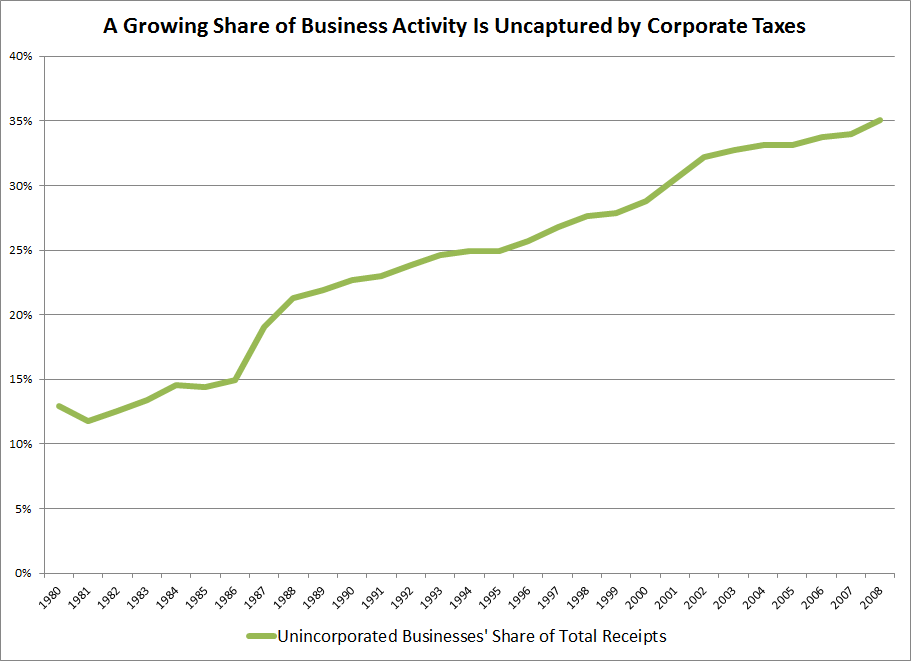
As you see in the figure, the share of receipts passed through to non-incorporated business has almost tripled since 1980s, up from 13% to 35%.
2012-01-27-passthru1.png

Source: IRS, (h/t: BH)

Moreover, it's a good example of what happens when you open up these loopholes. The elasticities attached to changes in tax rates are wildly exaggerated by conservatives and trickle downers who argue that the slightest increase will end the economy while any decrease will trigger boom times. The evidence belies their view in terms of jobs, investments, and growth.

But when it comes to sheltering your income (e.g., passing through corporate income to the personal side to tap loopholes like carried interest), how you structure your investment vehicles, your preference for debt over equity financing (debt financing is very much favored by the tax code) -- there you see very significant responses.

The question is, as posed above, does any of this add value -- real value -- to the economy beyond further enriching the rich? It's not a simple question and the answer is probably less obvious than it sounds. There are unquestionably examples of private equity firms that have taken over companies and discovered new efficiencies.

But neither is it a coincidence that the ascendency of this type of economic activity and the policies that support it have occurred during a period of sharply increasing inequality, weak job creation, and stagnant incomes for the middle class.

These are the type of dots we need to keep connecting as this debate progresses and we can thank the former MA governor and his opponents for introducing them so effectively.

 
Saying nothing about the quality of the candidate himself, I'm increasingly struck by the economic issues the Mitt Romney brings to the table. Because of his professional background, in no small part...
 
 
  • Comments
  • 270
  • Pending Comments
  • 0
  • View FAQ
Comments are closed for this entry
View All
Favorites
Highlights
Recency  | 
Popularity
Page: 1 2 3 4 5  Next ›  Last »  (6 total)
This user has chosen to opt out of the Badges program
photo
OneTop
Uh, is that a beer hall?
07:16 PM on 01/27/2012
""The question is, as posed above, does any of this add value -- real value -- to the economy beyond further enriching the rich?...""

The vast majority of the income is generated from activity that serves no real economic purpose.
The value of the OTC derivative market is roughly $600 trillion, 50 times the world's annual GDP. This is where much of the income, gains, etc. of hedge funds, pension funds, investment banks comes from. It's raw financial speculation, bets on other bets that serve no economic purpose. However, it does make the 1% vastly richer.
e.g.
Food prices rose 17.2% in 2009 and 26.5% in 2011. Primarily from index fund speculation, which brings no new investment to increase output of capacity, i.e. no economic purpose. http://www.srfood.org/images/stories/pdf/otherdocuments/20102309_briefing_note_02_en_ok.pdf

Food is but one example, currency, oil, minerals etc. all are part of the shuffling of wealth from hand to hand, sans any economic purpose.
Jeff Madrick: [the former economics columnist NYT]
http://www.abc.net.au/pm/content/2011/s3332160.htm
""I hope the American establishment has the courage to ask one fundamental question; what is Wall Street for? What are they supposed to do?

Do we need a Wall Street that takes 40 per cent of American profits? No way. Let's rethink that. But the American establishment seems anyway afraid to ask that question and we have to start asking that.""
06:33 PM on 01/27/2012
The funny thing about Mitt Romney is, the only thing he may want more than to be president, is to get the Capital Gains tax lowered.

And yet, because of his campaign, he may be more responsible than anybody else if the voters start pushing Congress to increase it.
photo
HUFFPOST PUNDIT
Marcospinelli
an old liberal Democrat, a 'New Deal'-Democrat
photo
CalSailor
lex orandi, lex credendi
05:40 PM on 01/27/2012
We need to separate coporate income (profits) from personal income: capital gains vice wages. Corporations should pay taxes according to the tax rates, but we need to close the various loopholes that allow some of the richest companies in the world avoid taxes.

But we also ought to separate out the distinction between capital gains and wages and salaries. The test ought to be the income we receive. If we receive income from having invested money in a company, or having income (wages) as a result of investing our labor, or knowledge, etc., to a corporation, these should both be taxed at the same rate. The guy who sweats on a construction crew should not be taxed at a higher rate than the guy sititng on a beach while his money is donated to the corporation in return for a return on that donation should pay as income taxes. This would simplify the tax structure, and equalize the way we value contribution to our society. People whose family assets allow generations to live off investments, I believe, should not be rated as more valuable than the labor of joe-sixpack, working in hospitals, etc.

Pr chris
06:26 PM on 01/27/2012
Wrong on all counts! We need to stop double taxation! I invest money in a business/corporation (even a Mom-and-Pop business) buy buying shares or bonds or a "part" of the business. The business makes money and can pay out a portion of its profits to its investors. The money should only be taxed at one place - either to the business that made the money, or at the recipients of the portion of the profits paid to them on their investment - but NOT both. IMHO.
photo
CSDofNM
I speak lolcat
06:51 PM on 01/27/2012
I agree completely, but we all face the same problem that Jared ignores. How to do it.

We know that the tax code has been perverted since Reaganomics. Yet no one demands the repeal of Reaganomics.

We are barely able to get support for taxing capital gains the same as ordinary income, despite the fact that is a one line bill that could be passed on a voice vote.

The problem is we have a handful of people who see it our way in Congress, while more than half of them are millionaires who wouldn't vote to end their parking privileges, much less double their taxes.

Just like Dylan Ratigan's repeal of Citizen's United, there is no way across the finish line.

Until OWS.

OWS changed the discussion. OWS will change the Congress.

As said by Will Rogers "Representatives should be changed like underwear, and for the same reasons".
3RawBob
Gone Paleo: no more raw sugar
05:13 PM on 01/27/2012
If there were an honest person in Washington, s/he would inform the people that our most pressing problem is Medicare. The present program costs twice as much as is generated by the payroll tax, so the tax has to be doubled to 2.9% for the employee, and 2.9% for the employer. All income should be taxed.
05:37 PM on 01/27/2012
Or, we could demand that our health care providers become more efficient. Probaby 30 to 40% of total medical costs are non-value added, just like every other business that has been closely studied.

Until the people paying the bills (we-the-people) demand improved efficiencies, lower costs and improved quality it will never happen, just ask the American auto industry circa early 1980's.
05:51 PM on 01/27/2012
How to you propose that healthcare providers become more efficient? What medical costs are non-value added? Specifics please.
05:11 PM on 01/27/2012
The income tax is the most 'gamed' tax in the world. Why don't we get rid of it for both individuals and companies and substitue a 15% cash flow tax on all corporate cash flow (both for profit and not for profit businesses). Those who spend the most (i.e., who use the most resources) will pay the most. What could really be more fair?
06:30 PM on 01/27/2012
That has the effect of making stuff very expensive compared to people.

Lots of manufacturing is very low margin over several levels. It also pushes companies to do thing internally instead of outsourcing. Fewer, larger, more vertically integrated companies.
HUFFPOST SUPER USER
Celt Glen
05:02 PM on 01/27/2012
OWS is principally responsible for bringing these issues to the front...not any one candidate
05:50 PM on 01/27/2012
Perhaps but have you noticed that the right is paying attention to these issues now, whereas before they just looked for any old reason to ignore OWS; but when it's one of their own, it's a different story, which I think is Jared's point.
photo
HUFFPOST SUPER USER
Bayard Waterbury
social philosopher
04:52 PM on 01/27/2012
Thanks for the great article, Jared. Of course, the real overarching question is, what does Mitt offer us in a President which is better than we have now, leaving aside all theory and conjecture, we've yet to see real, substantive policy proposals such as those offered by BHO in the SOTU. Not that I am a fan of our current President. Only that I am looking for a really viable alternative. Aside from the fact that Mitt knows how to make multi-millions as a business man, just how does that qualify him to be our President? When he revealed his tax situation, I was struck by the fact that he is quite representative of the 1% which keeps getting every break and preference, assured by their willingness to purchase political power and get all of the laws written to their benefit, and enhanced by the resources to employ the best attorneys and accountants to assure that they keep all of that wealth. I have yet to seen anyone dressed in Republican ideals who can offer a really good alternative to what we presently have, which is very little. Obviously Republicans feel the same way, because the "candidate of the week" show keeps going, with about eight thusfar showing up as front runners. Now it looks as if it will be Mitt or Newt. Anyone care to explain in rational terms what would make either a superior replacement to the dreadful leader we now have?
05:47 PM on 01/27/2012
Mitt comes to the job with a different mindset than does Obama and he will bring in a different group of support personnel. Depending on which side you're on, it will be a different approach to the issues.

I mean ... how does a community organizer carry greater qualifications to deal with significant problems.
photo
HUFFPOST SUPER USER
jerryengelbach
Working class heritage
06:02 PM on 01/27/2012
I don't think Romney's advisors would be any different from the Wall Street insiders and CEOs appointed by Obama.
photo
HUFFPOST SUPER USER
allwarisbad
06:12 PM on 01/27/2012
It does not matter - they take orders from the elite-banker-cartel ...
photo
HUFFPOST SUPER USER
drgrph
06:20 PM on 01/27/2012
Executive experience, both in private business, but more importantly as a former Governor. Our current President lacked executive experience and, boy, does it ever show. His experience, government-wise, was as a legislator.

I'm NOT a Mitt fan in the least. But I can appreciate what he could bring to the table in 2013 that we do not have now. The man clearly is certainly more qualified than what we have now.

Newt is an idea man, but not really of executive experience. Again, he was a legislator. While he is at least as intelligent as our President, that does not translate to being more qualified. The question is whether Newt would exercise more wisdom than the alternative.

To summarize: if the choice was between Mitt, Newt, or the President, I'd have to give the advantage to Romney.
HUFFPOST SUPER USER
pauliji
Don't crush that dwarf, hand me the pliers
08:34 PM on 01/29/2012
I live in MA, and did so under Romney, and I can tell you a few things about the experience. He tripled the cost of everything citizens pay for when dealing with the state: fees, licenses, etc. He took a state with a surplus and plunged us in to debt, and hid the debt in the budget of the transit authority. He failed to spend any time in supervising the bid dig, which was the largest engineering project in human history up to that point, finally going over budget about 9 billion dollars. By most estimates, there are at least 1 billion dollars which either went missing during the process, or were wasted, and he never bothered to pursue any of it. He spent an enormous amount of his time in office pursuing dreams of becoming president. He was gone from the state more time that he was in it, during his tenure. He shoved a Mormon temple on the tallest hill in his home town of Belmont down the throats of the residents of the town, all of whom opposed the project, except for the other Mormons. It's an eyesore, that stands out like a sore thumb, completely out of character with the rest of the area, and yet two stories taller than anything else, including the tallest trees around. He hired two different companies to work on his property with illegal aliens, claiming ignorance, all the while whinging on about illegal immigration.
HUFFPOST SUPER USER
kubisiak5
Votes are weapons. Progress requires action.
04:51 PM on 01/27/2012
Awesome article.
04:49 PM on 01/27/2012
Judging strictly on the posts I see on this site defending the Bush Tax Cuts almost daily, I think we either seriously underestimate how many people are making over $1M a year! Wow. And you would think that if this is the case, their contributions to the tax pool would make most economic arguments today dissapear. I guess this must not be the case...
05:41 PM on 01/27/2012
Taxing income is not the answer, income varies from year-to-year for most people and as they progress through their career ladders. What we need to tax is accumulated wealth. Americans have a combined net worth in excess of $115 trillion. A 3% annual tax on all net worth in excess of $1 million would bring in enough tax revenues to replace our current income tax in total; including, eliminating the annual deficit. Plus, that 3% tax would provide enough funds to rebuild our crumbling infrastructure in less than 10 years.

How does a 3% annual tax sound to you?
HUFFPOST SUPER USER
smr3226
07:15 PM on 01/27/2012
We have both an income and estate (death) tax. The latter is difficult, but necessary to enforce. An annual net worth tax would be extremely difficult and very expensive to enforce. It would amount to a windfall for lawyers and accountants. Look at the cases and tax litigation over family limited partnerships and non traditional use of business and estate planning life insurance (proceeds not taxable). As far as volatility of business income is concerned, the present tax code provides for leveling out net operating losses through carryforwards and carrybacks of deductions.
04:52 PM on 02/03/2012
Hey, I'm no economic wizard, nor am I a successful businessman. I do hear a multitude of successful businessmen and women saying authoritatively that this tax break is in absolutely no relation with their ability and need to hire. I am all for getting rid of the cuts and returning to a tax rate of better budgetary and economic times for all. Why give something away to those who want it but don't need it if it does nothing in return for the country or those who need it the most? Makes no sense to me and obviously to a majority of Americans both Rebulican and Democrat alike. I never claimed it was the answer, but it definitely can and should be done. Plus if taxing income is not the answer, why is there a tax on everyone's income??? Nobody's saying that spending should not be cut, but why can't you admit increased revenues is a great thing for the budget as well? Name one positive thing that's been done with money from the tax cuts, and then specify whethere this is being done on a large enough level to keep our economy balanced. Why should the US gov't give money to send some rich family on a summer vacation. If our goal is to increase jobs, and these cuts were supposed to do that, and they have not, and the recipients say openly they will not, why leave them there? Please answer that one question for me...
05:55 PM on 01/27/2012
If the top rate were moved from 35% to 40%, it would only generate approx $35 billion more per year. Against a $1.5 TRILLION deficit, it represents less than a rounding error ... it solves nothing.

Regarding the capital gains rate, there are millions of citizens including most retirees that depend on their dividends to make it on through.
04:36 PM on 02/03/2012
Millions of retirees depending on dividends of over $1M a year to make it through???? ARE U SERIOUS or are you f'ng with me
04:35 PM on 01/27/2012
Not taxing the rich is definitely not helping. The purpose of the tax cut for the rich was to help the economy (For God sakes they were titled economic and jobs growth acts, short)
- Smaller Budget + Increased Revenues is the definition of a balanced budget
- a budget is balanced when current expenditur­es are equal to receipts.
- 11yrs since 1st Bush Tax cut, how can you possibly attack the current POTUS for economic failure without acknowlogi­ng the failure of current policy still in effect created by previous POTUS? BHO didn't undermine progress made by Bush tax cuts, that progress doesn't exist. GIVE ME ONE REASON TO NOT END THAT POLICY
- The Bush Tax cuts were not designed to grow the economy... It was all a scam or they were and obviously are still really foolish to believe so. Any "liberal" economics book, a.k.a. economic book says job growth requires demand for services & products (supply side is null without demand side). Call it socialism, people must have money & spend to create demand. These tax cuts are the socialism you despise only into the pockets of those who will not use and do not need them. Taking the kids to Australia with your tax cut doesn't add to demand or help anything. BRING BACK THE STIMULUS, it pays for itself.
- You CAN'T have an argument with current economic policy without admitting to this. Any bi-partisa­n progress begins & ends here. Get on board...
05:44 PM on 01/27/2012
The reduced tax burden on the "job creators" has been in place since 1982 when Reagan cut the taxes on the rich by over 60%.

Bush 1, Clinton and Bush 2, have nibbled around the edges up and down by at most 3%. Clearly these piddly little changes hvae not negated the overall negative impact that Reagan's voodoo economics has had on the American Middle Class these past 30 years.
06:38 PM on 01/27/2012
It wasn't Reagan that did that - it was John F. Kennedy who reduced the upper tax burden from 90% to 35%. He was the last reasonably intelligent Democrat president. The one's since him have been a bloody disaster!
05:54 PM on 01/27/2012
fanned!
photo
HUFFPOST SUPER USER
mrfreeze
A Disciple of Nietzsche
04:31 PM on 01/27/2012
Actually, I'm also glad that Mr. Romney's "legal tax cheating" has been brought taxation to the forefront. For so long now most Americans just assumed that "the wealthy" were "entitled" to their low tax rates. As Thomas Frank writes in his new book "Pity the Billionaire," the 1% have been whining for decades about how terrible their "tax burden" is and how they would simply quit being productive or "create opportunities for others" were they to be forced to pay more in taxes........Now the truth comes out: The wealthy self interests in Washington DC have been "fixing" the game so that their wealthy benefactors pay far less than average Americans in taxes.
I think there's a clear and straightforward solution to the "carried interest" issue. Simply let anyone who has investments pay the 13.9% rate that Romney does. What is it about the wealthy that bestows them with the tax break? Of course, think of the outcry from the lawyers and accountants who would lose their jobs if the tax code was made more simple and....dare I say fair in this regard.
photo
HUFFPOST SUPER USER
TRex86
Enjoying life in West Ohio
04:19 PM on 01/27/2012
Here's a thought coming from a devout left-progressive: call their bluff. Implement the President's "Millionaire AMT" ASAP (30% minimum over one million no matter the source of income)but eliminate corporate income taxes altogether. My reasoning is as follows. A relatively small portion of the federal government's revenues come from corporate taxes. Eliminating the taxes obviously eliminates tax loopholes and incentives to offshore profits. No negative taxes of course. Zero is zero. Here's the hitch. Public companies must become pass-throughs, distributing retained earnings to their shareholders as FULLY TAXED dividends. (They can keep some working capital). While we're at it, tax capital gains and dividends at ordinary rates and simplify the tax code, phasing out most exemptions and deductions over the next few years. Once the economy gets on its feet we should amortize the federal debt over say 30 years. That which is spent must be collected via progressive taxation.
photo
HUFFPOST SUPER USER
Bayard Waterbury
social philosopher
04:59 PM on 01/27/2012
I have this proposal under consideration. But, at first blush, I definitely like it. The present system is simply not set up to trap clever rich folk. The proposal seems to make for a nice clean trap for much of what now goes along untaxed. There is one absolute certainty, and that is, unless we can generate substantive additional revenue, things won't improve. In this economy, as pointed out in the SOTU pointedly, there are things that our govenment needs to do, but can't without additional revenues. Of course what we have to do first is to change the Constitution to get the money out of politics. Then and only then can rational proposals like yours be instituted. The certainty is that what you propose will be seen as a threat to the wealthy, and, therefore, will never be seriously considered by our represenatives since they are paid servants.
photo
stemchek
Can't dance, too wet to plow. May as well comment.
05:44 PM on 01/27/2012
Almost all of our representatives ARE the 1%.
photo
HUFFPOST SUPER USER
TRex86
Enjoying life in West Ohio
07:43 PM on 01/27/2012
The Republicans are a wholly owned subsidiary of the plutocracy, who merely rent the Democrats from time to time. You are correct that the money is the long and short of our declining democracy, headed towards a feudal--if not fascistic--state. Sic transit gloria Americanae.
3RawBob
Gone Paleo: no more raw sugar
05:00 PM on 01/27/2012
Good story, but the numbers aren’t there. Corporate taxes still bring in $191B, and the 30% minimum will generate far less than $100B.
photo
HUFFPOST SUPER USER
TRex86
Enjoying life in West Ohio
07:27 PM on 01/27/2012
OK, if you say so, but the point is to remove the incentive for corporate scams--and the mandatory dividends will bring in hundreds of billions of tax revenues at ordinary rates.
3RawBob
Gone Paleo: no more raw sugar
04:12 PM on 01/27/2012
Mitt’s kids will never have to put up with the prying eye of the press on their taxes. The $100M trust fund that Mitt set up will generate around $10M, or $2M per kid per year. But instead of having to declare the $2M they get as income and pay taxes, each kid will simply borrow $2M a year and not pay any taxes at all. Life is good.
05:49 PM on 01/27/2012
That is why we need a 90% estate tax on all inheritances in excess of $5 million.

Mitt won't be passing along a family farm or business, the two reasons why the Republicans say we can't tax inheritance. Because they claim it will hurt the small business owner (if that small business happens to be Apple) or the family farm (if that farm happens to be located in downtown NYC).

When really the Republicans just want to perpetuate the aristocracy in America today because they don't believe in making the rich earn their way, just the poor.
HUFFPOST SUPER USER
smr3226
07:22 PM on 01/27/2012
Someone will have to declare the trust income. Either the trust will pay or the beneficiaries.
photo
HUFFPOST SUPER USER
Nosybear
Liar, damned liar and statistician
03:47 PM on 01/27/2012
Problem with "investment" income is an unfortunate issue with English: Both the virtuous cycle of building capital and the vicious cycle of extracting wealth are named the same in our language, investment. Capital investment, building roads, factories, educating people, stewardship of resources, is virtuous and creates jobs. Financial investment is largely parasitic on capital: Jobs are destroyed, factories idled, money is "made" from nothing. If we could separate the two, provide a tax break for capital investment and tax the he** out of the parasitic variety, we'd be much better off as a nation. But then, we'd have to start valuing value over wealth.
HUFFPOST SUPER USER
Celt Glen
05:05 PM on 01/27/2012
Investment income? I solely have dinner table and rent investments. What about alternative ENERGY investments that should be part of the infrastructure $.
photo
HUFFPOST SUPER USER
jerryengelbach
Working class heritage
05:13 PM on 01/27/2012
Too sane to be adopted, and too onerous for the wealthy, who mostly create nothing with their stock purchases (why call them investments? -- what they do is to buy into ownership).

Already a fan. Fav'd.