More

Featuring fresh takes and real-time analysis from HuffPost's signature lineup of contributors
Jared Bernstein

GET UPDATES FROM Jared Bernstein

Prevention Over Correction in the Housing Market

Posted: 09/26/11 05:24 PM ET

The housing market is still bumping along the bottom. As the figure shows, it's not providing any support to the larger economy, as residential investment (basically, home buying) as a share of the economy is stuck at an historical low.
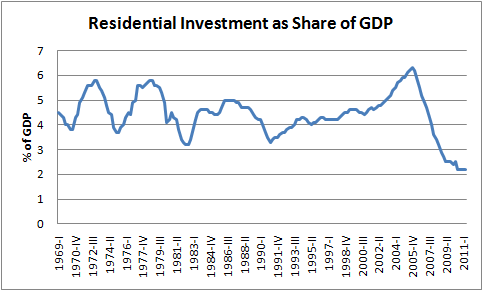
2011-09-26-hous_resshgdp.png
Source: BEA, NIPA tbl 1.1.10


Though policy measures to fix the problem have taken a lot of heat, some of it justified, this is much more a failure of preventive policy than of corrective policy.

The economically lethal combination of financial engineering, drowsy regulators, lousy underwriting, all amped up on fantasies about self-correcting markets, led to a lot of people got home loans they couldn't realistically service. Once the bubble burst and home prices stopped rising, this reality was only further amplified by the the worst downturn in generations.

Add in some unique aspects of housing finance -- the ability of banks holding non-performing loans to convince themselves that such loans will come back to life ("extend and pretend"), conflicting incentives by loan servicers, the banks screwing up the foreclosure process with robo-signing -- and this was always going to be a slow, painful "correction."

Of course, corrective policy could have done more -- the fact that the locus of decision in most corrective policies lie with the banks/lenders themselves has always been a shortcoming. We needed more policies, like cramdown of loans on primary residences, a policy that would have allowed homeowners (borrowers) to take action even while creditors dragged their feet.

There's still good stuff we should do to help modify loans, reduce principal, and cut down the supply overhang -- on that last point, I like this idea to move Fan and Fred's foreclosed properties from the residential to the rental market. Here's a useful article that takes a look at these and other ideas worth pursuing.

But at the end of the day, the main lesson from all this is that when it comes to financial or housing markets, preventive policy is better than corrective policy. The Greenspan Fed got this exactly wrong, arguing that the Fed can neither spot nor stop bubbles.

Regarding spotting, that's demonstrably untrue: foresightful members of the regulatory community and the central bank themselves were sounding warnings early on: Sheila Bair of the FDIC was working with Ned Gramlich of the Fed on this stuff starting in the early 2000s.

Regarding stopping, there's little question in my mind that had we listened to folks like those just mentioned instead of hanging on every word of the maestro himself, regulators could have reined in lending practices that were clearly unsustainable, like negative amortizations, interest-only, and other greatest hits from the subprime slime.

Our best move would have been not to have a housing bubble. Our next best move will be to not have another one.

This post originally appeared at Jared Bernstein's On The Economy blog.


  • Comments
  • 22
  • Pending Comments
  • 0
  • View FAQ
Comments are closed for this entry
View All
Favorites
Recency  | 
Popularity
04:10 PM on 10/04/2011
i am part of a team of certified appraisers pro actively building the National Database of Home Values. Imagine how powerful this tool will be next year when we have OBJECTIVE, ACCURATE appraisals in an accessible database for over 70 million homes nationwide. We believe our database will benefit direct housing, securitization and even a FUTURES market in the near future.

How can the Federal Government create policy, and think of doing thing like unwinding Fannie and Freddie without knowing the value of the homes across the country - on a one by one basis. They could leave TRILLIONS on the table

Want to learn more? get in touch
photo
HUFFPOST SUPER USER
Norma Ward
07:33 AM on 09/28/2011
Here is an article that explains how the Federal Reserve's ultra-low interest rate policies may well have lowered GDP growth and resulted in higher unemployment than would have normally been experienced during an economic recovery:

http://viableopposition.blogspot.com/2011/09/law-of-unintended-consequences-part-2.html

This analysis shows that both further rounds of quantitative easing and "The Twist" will cause further problems for the world's economy, yet another example of an unintended consequence of Federal Reserve policy.
photo
HUFFPOST SUPER USER
TheGreatRenewal
Naming the next paradigm
04:51 AM on 09/28/2011
Of course we can spot 'Bubbles' because they exist and have a cause. I lived overseas for 20+ years in another country that had the same housing bubble as many others (that's #1 reason we know it's a bubble because it's part of the Free Market global economy where many countries do the same thing).

Curiously, like in the US the quadrupling of house prices never made it to the Inflation Index which was kept under 2% by the Feds (everywhere ... #2 reason we all knew it was unrealistic). Where I lived in 2001 it took 45% of one wage earner to service a mortgage. By 2007 it took 85% of two wage earners ... and the government thought that was kind of ok.

We have other Bubbles or should I say 'sucking' money out bubble ... austerity programs. Why should they be happening in so many cities, regional governments and national ones? Hum ... let me think.

Time for a Great Renewal ... shifting the paradigm and rethinking because this has been no way to run a global economy. Join us http://www.facebook.com/TheGreatRenewal
frank1946
Tell the Truth
01:01 AM on 09/28/2011
If....................Lenders had waived Pre-Payment Penalties in the Spring of 2007.......................we
could have avoided about 60 % of the Losses and most of the Sub-Prime Damage !

Lenders waive Pre-Payment Penalties............................You must be Joking ?

Better to lose one-third of our Investment Banking Resources, Consumer Net Worth and trigger
a Global Depression before the Bankers would lower the cost of Re-Fi's !
photo
cyclone70
if there was a time to reach for the pitchfork
12:40 PM on 09/27/2011
Al the assertions from the fed and others that "no one saw the bubble" are completely laughable

anyone with a pulse and paying attention could see the real estate market overheating - buildings going up everywhere with less than 50% occupancy, new homes built on spec by the subdivision, half vacant new shopping centers, empty new office buildings (for what jobs?) people borrowing up to their eyeballs for mcmansions and so forth
HUFFPOST SUPER USER
Josh Steinhauer
Ex-Patriot, Europe
05:37 AM on 09/27/2011
One of the reasons we are having a prolonged problem in the housing sector is we have been unwilling to let the system correct itself. We have an oversupply of houses on the market, yet home builders continue to build more houses adding to this oversupply and surplus of existing houses. So how can prices begin to rise again or people begin to see an increase in their home value when there is a continual oversupply of housing?

The second problem is we have people who cannot afford the house they are in, rather than letting that house go into foreclosure and let these people admit they bought more than they can afford, the government and banks want to bail them out or find another new creative financing way to let them stay in their house. All this does is prolonging the already terrible problem in the housing sector. Let the people’s house go into foreclosure and have them move into an apartment they can afford. By allowing banks to get these mortgages off their books by short selling them and by limiting the number of new home constructions, we can begin to allow the housing market to head towards equilibrium.
08:44 PM on 09/27/2011
Unfortunately, housing exists in some specific place. There may be too many houses in Florida and Nevada, but there are housing shortages in other states. I would hope that's where they're building new houses.
02:54 AM on 09/27/2011
A good way to prevent investment bubbles in markets like housing is to provide means for investing in both market declines as well as market rises. The problem with the housing market was that it was too easy to invest in the view that prices would increase; but too difficult to invest in the view that prices would decline. Believers in future increases in house prices could invest in land, building companies, mortgage lenders and so on. Investors like Paulson, whose analysis led him to expect a large correction in house prices, found it very difficult to invest in their negative analysis of the housing market. Markets should reflect the net market sentiment (positive minus negative views) - instead the positive views are over represented.
photo
CSDofNM
I speak lolcat
01:54 AM on 09/27/2011
Thank you, Jared, for another insightful post.

Our market in NM didn't get hit as hard as other markets, because we never had the speculative bubble. But my house is still worth 33% less than it was in 2009, when we bought it, thinking the worst was over.

My brother in law is a general contractor, who specializes in backhoe work. The home market here has shut down for new construction, and so has the commercial market. Heavy equipment companies have gone under right and left. When there isn't any work, the competition for it dries up after a while.

I know you love to run your guidance for the entire country on anecdotal evidence, but there it is - the housing market and construction industries have to be fixed - soon - or we aren't coming back from this. It is the "sucking chest wound" of the economy. The patient will die and society as we know it will cease to exist.

Is there a way to look at bankruptcies of heavy equipment and construction companies nationwide, quarter by quarter? Can we even see the damage done to the home construction and commercial construction markets? Can we find out how bad the heart damage is, BEFORE the patient dies?

Thanks again for your advocacy and willingness to endure my silly taunts.
HUFFPOST SUPER USER
Josh Steinhauer
Ex-Patriot, Europe
07:58 AM on 09/27/2011
I understand your point about the construction business but part of the problem is housing business's kept building more and more houses and now with the foreclosures we have a glut of housing. The only way we can reballance things is to let the housing on the market tighten up and get rid of this huge surplus, then we can start constructing new homes. Those people who worked in that industry before are just like a lot others that are unemployed, you either find more work in your field or you try to train into a new one. My wife went back to school after losing her job in the financial industry and two years later she is now working as a Nurse. It sucks but sometimes that's what we have to do.
photo
CSDofNM
I speak lolcat
12:34 PM on 09/27/2011
We don't have a glut here in Albuquerque. We have population growth. Unemployment here is 3% less than nationally.

Saying that construction workers need to retrain for a new field is like saying they are being replaced with robots - maybe true in 2050, certainly not true today.
HUFFPOST SUPER USER
Jen Celli
Done sitting and watching quietly.
04:55 PM on 09/27/2011
You can't get rid of a surplus when you're artificially propping up the market by holding back the release of shadow inventory to keep the collapse from hitting bottom faster. Throw it all down and let the new wages be the determination as to where the market lands. If the middle class that drives the market can't afford homes, they won't buy them and the market can settle into the new reality: prices must rise with income, not with speculation.
11:49 PM on 09/26/2011
Wow, it is called a CORRECTION for a reason. The housing bubble still has a lot of room to deflate......thanks in part too Big Brothers meddling. You see, this is a good thing, overpriced housing coming back down to earth.

Oh yeah, that is right, this country runs on bubbles, we need to inflate another one.
Viper
Former repub, still repenting
10:20 PM on 09/26/2011
Give Greenspan credit. He is the Only republican man enough to stand up and say he was WRONG when he thought Wall Street could/would self regulate itself. He has said the Bush tax cuts are a mistake.

He says he made a tragic mistake, does not try to blmae ACORN(LOL) or Fannie and Freddie, which were NYSE listed companies(GSEs), run by shareholder elected officers, who dont make loans, just bought loans from Wallstreet and didn't buy subprimes until Bush approved that in late 2004( at the end). Fannie and freddie became a victim just like pension funds and etc who bought Wallstreet junk as did Europe and why the promised ISSA investigations of Fannie and Freddie(taken over again by the government under George Bush), have never happened.

The rest of the repubs are like 3 years olds pointing to thier siblings for the window they broke.

Pls note within 5 years of doing away with the protections implemented under FDR to prevent another Wall Street disaster along with the commodities regulations that were gutted/position limits taken off, we had the next great depression and endlless 400% increases in speculation driving poil and food prices up 300%.... more than in the previous 30 years!

Regards
photo
HUFFPOST SUPER USER
raoulhubris
Subvert the dominant paradigm!
09:42 PM on 09/26/2011
There ore none so blind as those who follow Friedmanomics.
Viper
Former repub, still repenting
10:08 PM on 09/26/2011
When Reagan doubled the size of government, cut taxes and trippled the debt, what was he doing and Bush when Bush did same?

The only problem is they ran up their debt, by tax cuts at the top which dont stimulate(quite the contrary based on a 30 year history) and they invested mostly in military boondoogles which are not capital investments that will never produce a return or become self funding....

And of course in both cases they deregulated which caused financials failures( s and l) and Wallstreet . which led to deep recessions, while push deindustrializing and outsourcing polices.

Rgards


regards
photo
BornOKtheFirstTime
pedicabo ego vos et irrumabo
09:34 PM on 09/26/2011
All asset classes are still overpriced after decades of overleveraging. There's more downside to come.
Viper
Former repub, still repenting
10:03 PM on 09/26/2011
Simply not true, Home asset values are now below 1985 levels in constant dollars... The affordabilty index is the highest since 1965! Remember real wages did not increase much after 1980, but they did inflat and housing prices have now deflated and interest rates are the lowest I can remember.

In many areas, such as Florida,Neveda, Arizona, especially in Condos, replacemnet cost is 3 times higher than what the purchase price is and even in houses prices dropped 70% in many areas.

But yes, demand will not rise till job security and wages rise and peoples credit scores move back up ands prices can still fall in many areas that did not get the 50% or worse drops...

But in the end once the supply is used up, you cant build that new house for anything like the price you pay today when the cost per sq foot of construction is still rising, just liek it is fro autos.

The stock market in constant dollars is at about half of what it was in 2001, when Bush came into office and we gave wallstreet all the deregulation and tax breaks they could buy... and look how that turned out.

Regards
08:36 PM on 09/26/2011
An ounce of prevention is worth a pound of cure, okay.

Thing is, right now we need a pound of cure!
HUFFPOST SUPER USER
jacobomorales
05:27 PM on 09/26/2011
Keep it coming Jared, you are rattling a lot of cages. You may not hear it but reason is beginning to push back at lunacy and your columns are a powerful weapon.
photo
SteveM39
No more Regressive Taxes!
05:16 PM on 09/26/2011
Has anything changed? Do we have new regulations? More regulators? Reduced incentives for banks to push through bad paper? less demand on Wall St for better returns? More stringent accounting practices? Renewed concern in Washington to find a solution? More money and easier credit for the middle class? Labor stability so people can commit to a specific area and mortgage amount? A promise that mortgage interest will continue to be deductible? Stable energy prices to determine if we can afford to commute or heat our homes? Faith in the banking system to be reasonable and trustworthy business partners?

What has changed in the last 4 years to get people to buy homes? And worse, what will change in the future?
HUFFPOST SUPER USER
Jen Celli
Done sitting and watching quietly.
05:12 PM on 09/27/2011
*crickets*