I've very much enjoyed the recent debate over Bain Capital and the role of such private equity firms in the economy, not for partisan reasons, but because it's far too rare that we step back and ask about the societal costs and benefits of opaque mechanisms like PE.
I mean, if I showed you a barber shop, a school, a car factory, an accounting firm -- you'd quickly get what they were doing here. But PE is different, and absent explanation, it's easy to get stuck on one end of the "vampire/vulture-to-capitalism's-savior" continuum. In that regard, here's one of the more nuanced, and thus worth reading, pieces about private equity and its role in the larger economy.
Note, for-the-record, that I'm not talking here about this week's debating point as to whether PE experience is relevant to the job of president -- the main point I and others have tried to bring to that debate is: whatever the merits and demerits of private equity, job creation is not part of the mix. If profitability meant laying off workers, that's what the PE firm would do, and vice versa.
In this post, I'd like to add two points to the discussion: 1) job growth and profitability, and 2) the tax implications of debt financing.
As stressed in the New York Times piece:
The business of private equity firms is buying and selling companies, all done with the goal of earning big returns for themselves and their investors. Sometimes that means jobs are created; sometimes it means jobs are lost.
This begs the question about the relationship between "big returns" and job growth. Statistically, they're both cyclical variables, and both tend to go up in expansions and fall in recessions. But to what extent is job growth a function of profitability?
Theoretically, it's not as simple as you'd think. Profits = revenue-costs, and labor is a cost. So, depending on underlying demand and the level of productivity, profitability might be enhanced by hiring more people or firing more people (the micro-theory says you hire up to the point where the value-added of the last person hired equals the revenue they produce, but that's too vague a guide in practice).
Like everything else in economics, the relationship between profitability and job growth must be evaluated empirically. The figures below compare this relationship across three different periods using yearly private sector job growth and corporate profits as a share of national income. Both variables are indexed to 100 in the base period; the profit share increase represents percentage points over the base year.
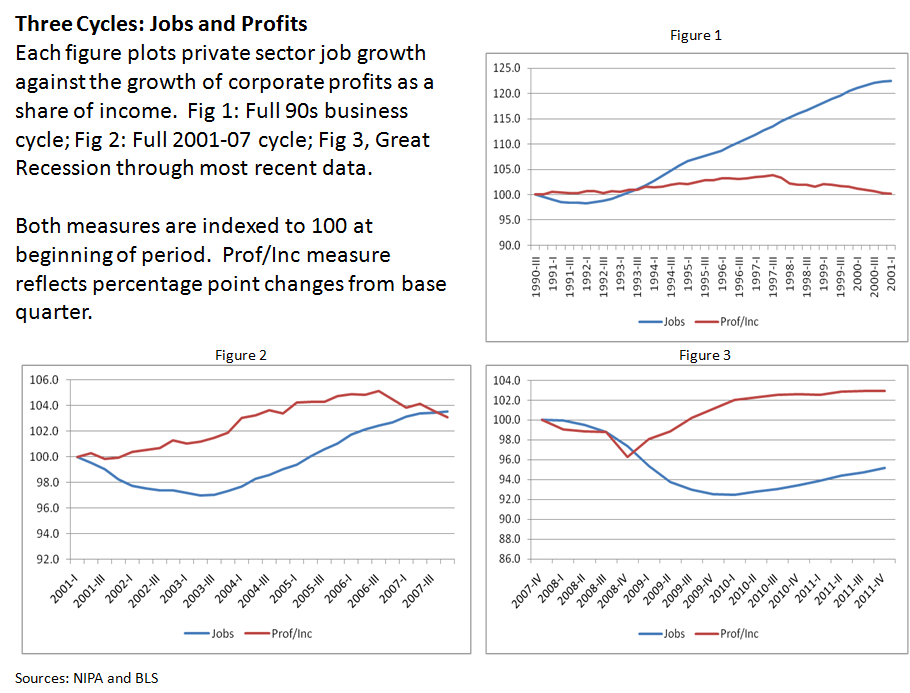
In the 1990s, profits relative to income went up a few percentage points -- about an average recovery -- but job growth was quite strong. In the 2000s, profit growth accelerated but job growth slowed quite sharply. And most recently, in the great recession and its aftermath, profits have more than recovered while employment is only slowly climbing back.
It's quite remarkable, given how damaged the economy and especially the financial sector were after the crash, how quickly profits reversed course. Of course, part of this was due to Wall Street bailouts -- financial sector profits have led the way. It's also the case that globalization enables American multinationals to ratchet up foreign profits even while the U.S. market remains sluggish. But the larger point is that solid profit growth in the current recovery hasn't given much of a lift to jobs.
Turning to debt financing, here's where I think PE as it has evolved in America (and elsewhere, though less so because of less favorable tax treatment) is truly problematic. As I stressed here, because interest on their borrowing is tax deductable, debt financing and PE are locked in a symbiotic relationship that distorts incentives and leads to levels of indebtedness that can cripple otherwise stable companies.
And the tax incentive is huge. According to the Treasury Department:
...the effective corporate marginal tax rate on new equity-financed investment in equipment is 37 percent in the United States. At the same time, the effective marginal tax rate on the same investment made with debt financing is minus 60 percent--a gap of 97 percentage points. This compares to an average difference of about 51 percentage points for other G-7 countries...
And they use it. According to this academic study, the median PE deal in the 1990s and 2000s was 70% leveraged (h/t: MG).
At the end of the day, I don't have a global position as to whether PE deals, on average, add value or not. Their existence in certain cases looks to me like it imposes a discipline on management that is useful in discovering efficiencies that would otherwise have gone untapped. In other cases, they seem to extract value for themselves and their shareholders in ways that do more harm than good to the company, its workers, and its community.
Either way, they're not net job creators and they sure don't need that crazily huge, hugely distortionary tax break. And if a former PE guy or gal were to run for president, I'd like to hear them emphasize those two points.
This post originally appeared at Jared Bernstein's On The Economy blog.
Follow Jared Bernstein on Twitter: www.twitter.com/@econjared
However, using your capital to invest in the company's infrastructure can yield huge benefits, and jobs.
So ditch the nonsense Romney claim -- he, nor any other PE firm, are characteristically job creators.
http://www.washingtonpost.com/blogs/fact-checker/post/fact-checker-biography-romneys-claims-about-bain-capital-job-creation/2011/10/28/gIQAA447cM_blog.html
(To be read in the voice of Edwin Starr...)
In one, investors pool money to acquire or start-up a small company which they believe is capable of good expansion over a period of time. There is adequate investor funding (equity) to do this with little outside borrowing (debt). One of the Bain success stories of this type is Staples, the office supply chain which grew substantially in size and profit. Investors took that expanded business public (sold stock), and made a bundle. A real Private Equity success.
Another type is 'Leveraged Buyout'. In this type, Bain might put up a small amount to buy a company, and then load it up with debt for many various reasons. A Bain example here is GST Steel. Bain invested $24-million, and started loading it up with debt. Eventually GST had over $500-million in debt. In one of the borrowings, Bain took out its $24-million so that the company was all debt, no equity. Pieces of any company with value would be sold off. Debt is tax deductible (a government giveaway). In the end, GST was bankrupt with liabilities $100-million more than assets. Lenders got stung for that amount. The U.S. Government had to pony up $44-million to fund the raided pension fund. The workers lost their jobs, their health care. And Bain made a bundel in lots of ways including tax benefits. (Who says Bain doesn't get government benefits in the form of tax deductions?)
There is a HUGE difference between the two types of "Private Equity" firms.
One banks on the success of the start-up (and risks it's OWN money), the other financially engineers existing companies with borrowed money and makes money by burying it under the leveraged debt and picking over the bones once it destroys it.
I would like to hear someone try to defend LBOs aside from the fact that they are legal and that the raiders make out like bandits.
"The U.S. Government had to pony up $44-million to fund the raided pension fund."
Why isn't every reporter in the nation asking Romney about the propriety of this?
One of the key characteristics (I'll leave the value judgement of good or bad to others) is that Private Equity does not really view businesses they invest in as a 'going concern'. They have a specific exit horizon in mind, and their profit maximization motive is designed to fit that timeline. More often than not, therefore, they are more inclined to cut cost to the bone, rather than invest for the future.
Among all the types of investment models there are, Private Equity would seem to be the least concerned with "job creation". That's just not the point of it.
Mr. Romney's defenders cite some silly steel mill that Bain allegedly helped to preserve jobs, but last I looked the thing had gone bankrupt. I would bet serious money the large debt owed Bain had a lot to do with the bankruptcy.
But let me ask those who know more than I this question:
Doesn't basic capitalism sort out and remove the least efficient enterprises. Ordinary capitalism can be quite brutal in its efficiencies. Think of what Walmart has done to the "Main Street" shopping district.
And sure many people hate Walmart for that. But that is how capitalism works. Walmart is frightening efficient.
Hasn't Staples risen to success by driving out the small office supply store? That's how capitalism works.
When I was a boy, there was something called a "Milk Man". Home delivery.
Daily delivery of dairy products. He gradually faded away.
Is private equity simply a way to "cull the herd" more quickly.
Could it be that private equity is just a way to create larger and larger enterprises, more easily controlled by hedge funds?
Is private equity merely the amphetamine of capitalism?
The very philosophy of "business" has changed. In the past businesses operated at a reasonable 30% margin, I don't know what it is today but look at HP. Meg Whitman is firing 28,000 workers because HP posted a mere 7.1 billion in net earnings. 7.1 Billion? And, you have to fire people? What kind of margin does she feel she needs to make shareholders happy and to pay herself what she feels she deserves? Meg Whitman should work at Bain. And this is why that blue line goes down, while that red line has nearly gone off the chart.
As a private citizen, all I can do is never shop at WalMart, never shop at Staples and I don't.
Great.
Think about this
What followed, according to Hunsader, was a 17-second blackout in all stock trading ..."
This my first foray into the realm of conspiracy theory.
Does anyone remember the eight minute gap that Rosemary Wood, Nixon's secretary claims was her fault?
The question to ask is who benefited from the 'blackout'?
The rebuttal is easy. NASDAQ simply didn't have enough computing power.
PUL LEEZ !!!
(hint: the SBA has to cover for bad investments at 4x its' budget)
Private equity is a term that was invented for PR purposes to conflate the two and thereby confuse the issue.
I think I finally understand some of this. And Dr. Bernstein's explanation of the tax benefit was something I missed.
Faved
Besides i sae a few days ago a lady who had a PHd in quantum physics and what was her job enabling tax avoidance for billionaires and rich corps.
People who achieve PHd's know how to do research that has to be quantifiable no matter what the subject is.Maybe i wouldn't want Mr Bernstien doing high energy physics experiments but he certainly is qualified to comment on this.
Better than someone who has the philosophy of a five year old child i.e simplistic like so many of the PE managers have.Destroying something is easy rebuilding it is not and most PE take the easy route.
Excuse me! Under whose presidency did the economy collapse?