iPhone app iPad app Android phone app Android tablet app More

Featuring fresh takes and real-time analysis from HuffPost's signature lineup of contributors
Jared Bernstein

GET UPDATES FROM Jared Bernstein
 

Tax Cuts and Job Growth: They're Just Not That Into Each Other

Posted: 05/ 2/2012 9:09 am

Bruce Bartlett has a nice piece in the New York Times this week on the (non-)relationship between the tax wedge and employment rates across countries. The wedge is the gap between what employers pay and what employees receive after taxes come out. Reduce the wedge, the theory goes, and since you're making employees cheaper to employers, they'll hire more of them.

Most economists believe there's something to this. After all, demand curves slope down, and all else equal, lowering cost should increase quantity. But the problem is demand curves move around a lot, and at a time like this, for example, the key determinant of hiring is going to be more demand. Even at reduce rates, employers won't "buy" more workers if they don't need them.

That doesn't mean measures like the payroll tax holiday are useless. For one, by increasing the after-tax wage, they put more money in people's pockets, and that in-and-of-itself creates more demand. Also, when the economy turns up and demand begins to come back, a cut in the tax wedge can give cautious employers a nudge to pull some future hires forward into the present.

But as Bartlett shows, there's no correlation between the tax wedge and employment rates across countries. The figure shows the scatterplot. There's a slope there but it's nowhere close to significant and the R-square is 0.005, meaning there's no cross-country correlation between the magnitude of the tax wedge and the employment rate. A better test would be changes across time, and such panel data analyses find a bit more than the cross-sectional view. But not much. Here again, small responders win.

The three policy ideas I hear most often for greater job creation are cut taxes, cut regulation, and more education. While I support the latter, especially for those whose access is blocked by income constraints, none of these ideas will do much to increase the quantity of jobs.

What will? Greater consumer demand, an end to deleveraging, a growing housing market, more domestic production of the goods we consume, new innovations that generate hungry, job-creating start-ups financed by now-idle capital, clean energy investment, and if all else fails, a national program to rebuild and repair the nation's infrastructure, from roads to schools.

Boom...there's your jobs program. And I can think of policies that go along with each one of the above--in order: consumer demand: stimulus; housing: loan mods and principal reduction for some, time for others; more domestic production: weaker dollar, smaller trade deficits, manufacturing policies; innovation/start-ups: R&D, public/pvt/academic partnerships; infrastructure: FAST!

I'm being a little bit glib here...each one of those ideas deserves a lot more ink. All's I'm saying is that here is where the hard work is in terms of job creation--not in the passivity of failed supply-side, trickle-down, deregulatory BS (and I don't mean Bowles-Simpson).

Bartlett gets the last word:

The reason that unemployment is high clearly has nothing to do with taxes. Consequently, there is no reason to think that reducing taxes further will do anything to raise employment by reducing the tax wedge.
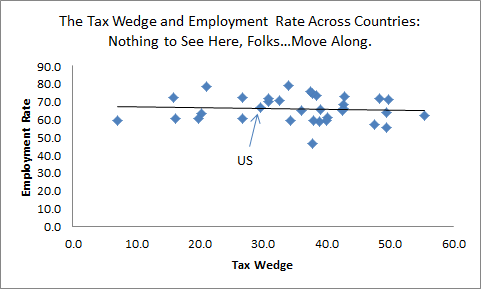
2012-05-02-taxwdge.png
Source: Bartlett, NYT, using OECD data.

This post originally appeared at Jared Bernstein's On The Economy blog.


Follow Jared Bernstein on Twitter: www.twitter.com/@econjared

FOLLOW BUSINESS
 
 
  • Comments
  • 276
  • Pending Comments
  • 0
  • View FAQ
Comments are closed for this entry
View All
Favorites
Highlights
Recency  | 
Popularity
Page: 1 2 3 4  Next ›  Last »  (4 total)
03:51 PM on 05/29/2012
What are Americans doing with the extra cash from payroll tax cuts? Studies show not spending it so much, more saving and paying off debt. While on an individual level it makes sense to be prudent, on the larger scale economic outlook, this does nothing to stimulate and thereby "create" jobs. http://www.essexpayrollservices.com/index.php/what-are-americans-doing-with-the-extra-cash-from-payroll-tax-cuts/2012240/
photo
HUFFPOST SUPER USER
LawTalkingGuy
Rational human male.
11:58 AM on 05/03/2012
His problem is comparing America to other countries. Conservatives know America is the best and we have nothing to learn from foreigners, so to them the whole study is useless.
10:32 AM on 05/03/2012
he is correct in his statement if a company wants to hire more people it is clearly because of demand. what companies want you to believe is that the taxes are too high and they can't afford to hire but when the corporate taxes under nixon was at 50% companies hired at a decent rate all the time. this is just greed on the companies behalf. I believe with the breakdown of the collective bargaining agreement of course a company will hire for less and have less working for them at longer hours or 32 hours a week with no obligation to health benefits, vacation and sick provisions. That is bad and Americans should wake up to chacanery that is going on! This is what the unions in the 50's was started for.
01:29 PM on 05/04/2012
The US has the highest corporate tax rate in the world. If you think that's a good thing and is helpful to an economy you have zero understanding of fiscal behavior and how taxes effect it.
martman1
retired business owner
08:44 AM on 05/03/2012
As a small business owner, you could reduce my corporate tax rate to zero and it wouldn't cause me to employ more people than I need to meet current or expected demand.
redonthehead
Winning trophies for my game face alone
11:47 AM on 05/03/2012
And if we tripled your taxes, what would you do then?
martman1
retired business owner
05:48 PM on 05/03/2012
That would get them to about 50% for me. I'd keep on, keepin' on. I wouldn't make any changes at all.
photo
HUFFPOST SUPER USER
LawTalkingGuy
Rational human male.
11:59 AM on 05/03/2012
Exactly - I am a small business owner as well and zero income tax would be nice but I won't hire another person until I have enough profitable work for them to do regardless of my tax rate.

It's shocking that this simple fact is ignored on the right. It's also shocking that the voices of small business owners like us are ignored in the debate.
martman1
retired business owner
12:33 PM on 05/03/2012
There have been thousands of hours devoted to talking about corporate tax rates on t.v., but, not once have I heard this simple fact mentioned. - Amazing!
HUFFPOST SUPER USER
MUDPUPPY
10:30 PM on 05/02/2012
Yeah, a political ideology is a great substitute for sound economic principles. How many times have we seen that fail?
10:09 PM on 05/02/2012
We've had plenty of tax cuts. They didn't create jobs and they've ballooned our deficit. Why do we have to keep doing the things that didn't work over and over again? And the very wealthy don't need the tax cuts, so since they don't create jobs there isn't any reason to pile on the debt for them.
photo
JudgeCCrater
From under a NJ boardwalk thanks to free Wi-Fi!
09:14 PM on 05/02/2012
Richublicans want to lure the truthful statements such as this one down a dark alley and strangle it quietly.
03:06 AM on 05/03/2012
Let's just say the rich. I am pretty sure, rich Dems and Repubs like keeping their money. This drive to equality only works with other people's money. Let's take Warren Buffet, he is rich he wants more taxes for the rich. Yup, and I would bet top dollar he pays as little as he possible can as dictated by her army of CPAs and advisors who sole job is reduce his taxes. Is he wrong not at all. All people from the super rich to the super poor want to keep their money and use other people's money.
photo
HUFFPOST SUPER USER
LawTalkingGuy
Rational human male.
12:01 PM on 05/03/2012
"Let's just say the rich."

Actually, lets not. It would be pretty dumb to pretend all the rich are right wing ideologues. It's even stranger that you say that before actually mentioning Buffet, a rich man who says they should pay more taxes.

It's not the view of the rich that taxes should be lower and that this will help the economy. It's the view of CONSERVATIVES, rich and poor, and it's wrong.
photo
HUFFPOST SUPER USER
LawTalkingGuy
Rational human male.
08:51 AM on 05/04/2012
"Well conservativism can't exist in a nutshell."

You were trying to suggest that everyone wants to keep what they have (putting it in a nutshell), that everyone thinks the same as you (false), and that therefore conservativism is right (wrong).

Now you want to avoid my critique by simply saying conservatives are different, like snowflakes. I'm saying you were narrowminded, wrong, and dreq a typically irrational conservative conclusion.

"there are too many variants such as liberal conservatism or more recent compassionate conservatism championed by Bush."

Bush started two wars. Just putting "compassionate" in your ad doesn't make you compassionate. Who cares if there are different labels - you haven' said anything about why they're different or how that's relevant (hint: it's not).

"Yes, I feel I do have the American Dream,"

Again, you completely missed the point.
Keeping what you have is NOT the American dream. Therefore, your description of what you think everyone wants is un-american. The Dream is about a BETTER life for your kids, not keeping what you have.

Human beings are selfish. We're also NATURALLY SOCIAL animals that have needed to co-operate in units larger than the family unit for tens of thousands of years for hunting and protection and agriculture. We made a 300 million person group called America that is the greatest the world has ever seen.

Our co-operation defines us, NOT our selfishness. You are flat wrong in your beliefs, and more wrong projecting them on everyone else.
photo
Kai-HK
Don't Share My Wealth! Share My Work Ethic!
08:50 PM on 05/02/2012
Production, not consumption, drives an economy. And anything that reduces market-wide production costs will increase production and employment at the margin. This has been borne out in study after study. What has also been documented is that 70% of corporate taxes and capital gains taxes are borne by labor in the form of less opportunity, and as a result lower wages.

Concern over aggregate demand, something that all businessmen will blame for their own mistake in producing too much of a commodity or good that other people do not want, is incorrect and focusing on it is treating the symptom not the disease, namely mal-investment brought on by a credit bubble that pushed demand of some commodities above their natural demand levels. Lower taxes are a better way to treat the disease of excess credit and mal-investment, rather than amplifying the problem with more cheap credit as the Fed, et al, are doing. It allows capital to flow to its most beneficial use with less friction creating real autonomous private sector growh and sustainable jobs. Keynesianism creates artificial economic activity and no company hires for long-term positions based on short-term stimulus.

Say and Mill are still relevant on this issue today.

Kai
HUFFPOST SUPER USER
bowser
07:30 AM on 05/03/2012
No factory produces a car because it wants to. Factories turn out cars when the company thinks it can sell them, so yes the economy is consumption driven. If a school district is given money to hire teachers, it does. If a construction company gets a contract to build a road it hires people to build that road; so yes government spending can lead directly to jobs.
photo
Kai-HK
Don't Share My Wealth! Share My Work Ethic!
09:13 AM on 05/06/2012
Bowser:

You are absolutely rights, as is reininop, that the reason people produce is to consume. The want to consume is always there but the means not always so. That is why the government should be making it easier for people to produce. By making it easier for them to produce value, you also make it easier for them to consume.

Check out chapter XV (page 59)
http://socserv.mcmaster.ca/econ/ugcm/3ll3/say/treatise.pdf
Government spending does not create value all it does is move the time preference of consumption forward, through borrowing, or it takes from one productive source (a viable and profitable business) and shift it to a less productive use (a bridge to nowhere that creates less value than it did in the hands of business operators.

Kai
09:58 AM on 05/03/2012
So If I go out and produce one million copies of my self-published book about the fine art of phone cord detangling, I will drive the economy toward consumption of that book?

Maybe I will go take my uncle's farm over and start growing a few million pounds of turnips. Certainly if I grow more turnips, people will buy them.

Or lets just look at my own industry - aluminum. Massive production of primary aluminum in the past few years has driven the price down to the point where it isn't economically feasible to make it any more as the energy costs make it more expensive to make than you can sell it for at a lot of old smelters. Producing more isn't going to drive demand for it. The only thing propping up the price is LME warehouses stockpiling it and trickling supply out the door.

The economy lives on consumption as that is the end goal. Products are made to be consumed. The desire, or lack of, exists whether the product is produced or not. Production is a necessary activity so that things can be consumed.

Or another way to look at it, you can over produce, but can you over consume? If resources allowed for infinite consumption, then the answer would be no. Thus consumption should always drive production.
photo
Kai-HK
Don't Share My Wealth! Share My Work Ethic!
09:04 AM on 05/06/2012
Reininop:

Yeah, your positive act of wanting to create books would create economic activity…especially if you are paying for the publication of those books by yourself…you would have to go out and work for that money and you will employ it in the publication of those books, not to mention the computers, printing machines, paper etc that would need to be created in your epic quest to write the best book on phone cord disentangling.

Chances are that your books may not sell well but the act of production will create value. Same with turnips. The hope would be that sooner or later you will decide to employ your labor and capital more effectively as you create value.

Your point on aluminum is well noted. It isn’t that people are not consuming, it is that they are not consuming aluminum. That is great. The market is sending a signal that too much aluminum is being produced and capital and labor needs to be employed elsewhere. This is great news and lets hope that American aluminum factories close and that capital is employed elsewhere in the production of something else that has more value.

Kai
photo
HUFFPOST SUPER USER
Ryan Kenneth Leddy
Facts have a liberal bias.
08:44 PM on 05/02/2012
Under Reagan, tax revenues as a percentage of the GDP equaled 18.2%. For most of Reagan's time in office, the top income tax rate was 50% along with capital gains and dividends being taxed at 20%. Then, after the Tax Reform Act of 1986, the top level income tax rate was cut from 50% to 28%, however both capital gains and dividends were raised to 28% as well. Federal spending equaled 22.4% of the GDP under Reagan For Comparison, Bush 41 spent at 21.58%, Clinton at 19.5%, Bush at 20.6% (NOTE: War spending under Bush was never counted in the budget) and Obama 23.9%. So, altogether, Tax and Spend Reagan spent only a percent lower than Obama while having tax revenues 3.2% higher than Obama (15%) and those policies led to the economy adding 17 million jobs during his time in office.

The economic proposals of Obama aren't from some radicalist Liberal-Socialist agenda as the Right claim. In fact, they are a near mirror-image of Ronald Reagan's tax and spend policy of the 80's. The only difference being that he would have taxes LOWER then they were under Reagan and have military spending HIGHER.....What a SOCIALIST!
This user has chosen to opt out of the Badges program
photo
Terri Skau
Se... sotto una splendida luna piena...
06:07 PM on 05/02/2012
Jared I enjoy reading your articles. But the only thing I see or maybe I overlooked was..and I'm paraphrasing from this part of the article.

Most economists believe there's something to this. After all, demand curves slope down, and all else equal, lowering cost should increase quantity. But the problem is demand curves move around a lot, and at a time like this, for example, the key determinant of hiring is going to be more demand. Even at reduce rates, employers won't "buy" more workers if they don't need them.

Since the "Depression" or if you want to call it a "Recession" Companies had to cut back. And the first thing they cutback on was it's employees, and got rid of jobs and took their existing work force who already knew the jobs that they had just gotten rid of, and the employees whom were hired just for those jobs, that load was put back on too the existing employees with no pay increase...

Companies have learned they can get the same amount of production from what they have now, to what they had then. Why would they hire. if the same amount of work is getting done with less employees and they don't have to give them an increase in pay.,,l-)) .
HUFFPOST SUPER USER
shirley thomas
we have no friends in dc
05:22 PM on 05/02/2012
all we have to do is take a look across the pond, to europe to see just how well it is not working.
photo
Alyn Stanton
Those who fail to learn from history are doomed. .
07:20 PM on 05/02/2012
Europe was working fine until Goldman Sachs, et. al. pulled the carpet out from under their economies.
HUFFPOST SUPER USER
MassWG
10:14 PM on 05/02/2012
Except for the fact they are RAISING taxes across the pond, not cutting them.
photo
SteveM39
That's how dad did it, that's how America does it
05:17 PM on 05/02/2012
Stagnant real income and a shrinking middle class are largely results of regressive taxation. Local governments used to live off property taxes. State and federal governments ran off corporate and personal income taxes. Taxes on investment gains and estate taxes were much higher.Those who could best afford the taxes, paid the taxes.

That model has been turned upside down. Property taxes have been capped and landowners are making a killing. Income tax codes are riddled with loopholes. The rates on income taxes, estate taxes and capital gains taxes have all been slashed.

To make up for these lost revenues, politicians have had to turn more and more to those tax payers with the fewest lobbyists. Payroll taxes, sales taxes and fees for State Parks or state colleges have all skyrocketed. The little guy and main street are getting killed. Wall St and Easy St are drowning in cash.

Until balance can be returned to the force, there should be no new taxes on the poor and middle class.
05:12 PM on 05/02/2012
"and if all else fails, a national program to rebuild and repair the nation's infrastructure, from roads to schools." By who? The Chinese? Search Diane Sawyer ABC News.
photo
HUFFPOST SUPER USER
Josh Crawford
Just the facts, man!
08:43 PM on 05/02/2012
No, by American workers and manufacturers. Sure we might get SOME materials from abroad (I assume you're talking about the $400 million spent on Chinese steel to build the new Bay Bridge in San Francisco with your ABC News reference, right? That accounts for about 6% of the total project. Big freaking whup!)) but the VAST majority of the money would be spend on US labor, equipment and materials.
HUFFPOST SUPER USER
bowser
07:41 AM on 05/03/2012
I agree that 6% going overseas does not make the project a failure (we did get the bridge, and Americans did get paid to build it), but do not forget that "buy American" was part of the original proposal for the stimulus bill. The Republicans fought it based on the claim that tax dollars should be spent in the "most efficient way". The claim then was that the cheapest steel was the most efficient, the same people now claim the the fact that the steel was not made in the US is proof that government spending does not help the economy.
HUFFPOST SUPER USER
MassWG
10:16 PM on 05/02/2012
And the same goes for "increasing demand" - if that demand is for Chinese goods, we are creating jobs in China, not here.
photo
HUFFPOST SUPER USER
Josh Crawford
Just the facts, man!
05:46 AM on 05/03/2012
"Although globalization is widely recognized these days, the U.S. economy actually remains relatively closed. The vast majority of goods and services sold in the United States is produced here. In 2010, imports were about 16% of U.S. GDP. Imports from China amounted to 2.5% of GDP. "
http://www.frbsf.org/publications/economics/letter/2011/el2011-25.html

So, even if some of the demand IS for "Chinese goods", SO WHAT???? It would STILL make more sense to than NOT doing ti!
photo
HUFFPOST SUPER USER
Josh Crawford
Just the facts, man!
01:38 AM on 05/04/2012
You say "economies that invest a higher share of their incomes tend to grow at faster rates" which sounds very logical to me. But here's the problem given our current situation: why would people invest in companies when A) those companies don't NEED outside investments because, remember, they are sitting on trillions in cash already and B) the companies won't (need to) spend much money on themselves because productivity is already at record lows while consumer demand is still quite low (i.e. they have more than enough capacity to meet current demand...and then some in most cases) and C) the issue is NOT getting more money (i.e. investment) to companies, THEY HAVE PLENTY, which is why they are sitting on trillions, remember? The issue is getting more money into the hands of the CONSUMERS. And a VERY good, direct way to do that is to FORCE companies to pay out some of that cash stockpile in the form of higher wages, which is what raising the minimum wage very clearly does.

And that was the whole point of my tepid recovery: the problem is consumer demand, plain and simple. It really couldn't be more clear....and I"m still not sure why you're arguing about it....
04:55 PM on 05/02/2012
Uh... some people, even among intelligentsia if not predominantly the progressive intellegentsia, don't get the fact that you just can't create consumer demand. Taxation drives businesses out of this country, businesses create jobs. Regulations likewise.

No one would suggest that investing in clean energy is a great thought... more solyndras and similar failed attempts at this agenda-driven model need to be significantly challenged.

More education is a pre-requisite for any economy and country... but we have spent record amounts on education and failed because we invest it in a system itself which is failed. Obama himself has admitted that government intervention in higher education has created a less efficient model. Education matters if it meets job requirements... make this country attractive to business (reduce regulation, reduce taxation) will create the demand for jobs for which education may then focus on delivering the needed skills.

There are no barriers to education today... only the determination by persons to get the education. Working their way through community college (2yrs) and transitioning to 4yr institution is feasible for anyone... as long as we attack the cost structure of higher education (and secondary).
HUFFPOST SUPER USER
stryker
07:16 PM on 05/02/2012
No repubs ever answers this. We've had 10 years of Bush tax cuts and basically got zero jobs. Even when Boehner forced Obama to keep the cuts for another two years, for his "job creators" we got no jobs. The bush administration had the lowest job creation of any in over 60 years. And that was before the recession. Yet, Clinton raised taxes and we had the best jobs and income creation, especially for the Middle Class, since before Reagan's trickle down BS. So, repubs, explain that, how raising taxes produced jobs and 10 years of tax cuts have produced nothing.
03:19 AM on 05/03/2012
Well technically they are now Obama tax cuts. He allowed the extention. He has power of veto, and he signed it. He made a deal, right or wrong it is what happened. It kind of reminds me of Obamacare. He absolutely wanted something different, such as single payer system and he settled or made a deal, again right or wrong that is what happened.

The real problem is the tax code is 27,000 pages long if printed out single spaced single sided standard font and size. There is no way this can be effective.
photo
kamachanda
Mr. President, Tear this Wall Street down!
08:20 PM on 05/02/2012
Nice recitation of right wing talking points. Glad to see the right is still ignoring the fact that the wealth of this nation depended on the thriving middle class and the promise of the ability to rise from poverty, aspects Reaganomics are destroying.
04:15 PM on 05/02/2012
So the corrolary must be that taking more in taxes likewise doesn't affedt job creation? In one breath tax breaks put more money in to increase demand in another jobs grow with demand but tax breaks don't create jobs? In truth its a balancing act to leave enough in private hands while taking enough for gov't to perform essential functions. The problem is that we've determined that giving alcoholics disability insurance and medicaid is an essential function. And, we've financed structural deficits with accumulated debt ever since Regan made it acceptable, which leaves us now with 10 year plans just to get to a balanced budget for one year before ever making a dent in accumulated debt. With entrenched special interests and wing-nuts dominating a two party system, the empasse we've seen ever since Clinton's frist term is the beginning of the end. Thank God for the NRA!
HUFFPOST SUPER USER
stryker
07:17 PM on 05/02/2012
See above comment about raising taxes and jobs.