My Center on Budget and Policy Priorities colleague Chuck Marr presents me with two very different perspectives on the current economy.
Here, we see dollar stores, while still turning a profit, worrying about ominous signs of strapped consumers:
In short, families are shopping more at dollar stores. But they are buying only what they need. They are picking up low-margin goods, cheaper per unit at dollar stores than places like Wal-Mart, and sold in smaller packages to let customers spread purchases out.
But at the other end of the economy, there's this:
Even with the economy in a funk and many Americans pulling back on spending, the rich are again buying designer clothing, luxury cars and about anything that catches their fancy. Luxury goods stores, which fared much worse than other retailers in the recession, are more than recovering -- they are zooming.
Wait a second, you're saying. I thought all the data were terrible. How could anyone be getting ahead right now?
In fact, corporate profits aren't just back to their pre-recession peak: they've surpassed it. The figure shows profits/GDP over the last decade (through 2011q1-most recent data point). You can see that profits took a hit in the great Recession as did everyone else. But you can also see their sharp recovery, a trend which stands in stark contrast to jobs and incomes of most everybody else.
(Chuck, our tax guy here at CBPP, looks at these data and concludes that the expiration of the highend Bush tax cuts remains a very good idea.)
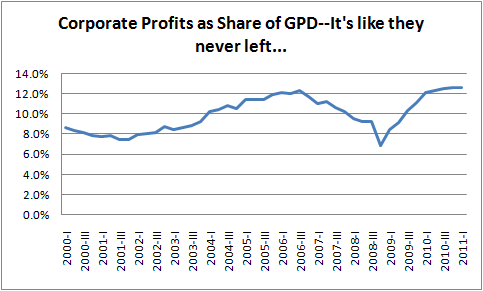
How is this picture consistent with an economy and job market hovering at stall speed? A lot of these firms are able to sell into (and create jobs in) foreign, emerging markets, where growth has been reliably solid in recent years. Other have found ways to squeeze productivity gains out of their incumbent workforce, able to meet current levels of weak demand without adding workers.
Something's gotta give, folks. It's an economy that's terribly weak in the middle, and that's where most of us live.
This post originally appeared at Jared Bernstein's On The Economy blog.
Does this sound familiar? "The company will incur about $X billion in one-time costs for the layoffs".
That profit dip matches the layoffs in those periods. Those corporations only saw expenses climb because they fired so many people. Like Rahm Emmanuel said, "Never waste a perfectly good crisis".
And of course those layoff costs are tax deductible. Why did GE not pay any taxes? Because the Government rewarded them for firing their employees.
And who heads the President's jobs board? The GE CEO because "he understands how to create jobs". He also understands how to profit from cutting jobs.
There ought to be a law that when the private economy shrinks, the government must follow suit.
Friends, none of this is happening by accident. This was the plan. This is the plan. This is Shock Doctrine at its finest, which is why we will continue to have more and more manufactured crises over the debt instead of facing the real crisis of unemployment and a shrinking middle class.
The only people who can save the middle class are the middle class. And too many of them are drinking the tea or sitting on their hands. We had the golden goose as a national economy, and now we're watching it roast over a spit instead of giving us golden eggs. We won't even get the drippings when this all shakes out.
Wake up, America. For once, the sky really is falling.
If lobbyist were not in the equation it would have been fixed a time long ago.
Be glad for those global corporations and their profits, because those that have 401K, pensions or stocks will benefit.
In order for the market, as a whole, to go up, new money must flow into the market. This money come from investors like you, not from corporate profits. If new money isn't coming into the market, money can only move between the stocks of various companies. If some companies do better than others, people may move money from from one stock to another, making the price of one stock go up, and that of another go down. This creates capital gains (and losses) if one sells a winning stock (or a loser). But when the total amount of money in the market is the same, the net gains are necessarily 0.
Money that a company earns (profits) only flow to shareholders through dividends or stock repurchases.