More

Featuring fresh takes and real-time analysis from HuffPost's signature lineup of contributors
Jared Bernstein

GET UPDATES FROM Jared Bernstein
 

U.S. Manufacturing Competitiveness in Global Trade

Posted: 12/28/11 08:37 AM ET

Those of us ensconced in debates in support of U.S. manufacturing often hear opponents claiming that the over-regulated U.S. labor market and unionized heavy industry render us uncompetitive in global markets.

That may sound convincing given competition from emerging markets, but there are lots of advanced economies with long records of positive net exports, while we continue to run large deficits in manufactured goods, year after year.

If you're thinking the difference must be prices, you're thinking like an economist... and you're pretty much wrong.

This new BLS report (including a link to their rockin' new dashboard -- go BLS!) provides the data in the form of manufacturing compensation costs across countries, with conversions to dollars using market exchange rates.

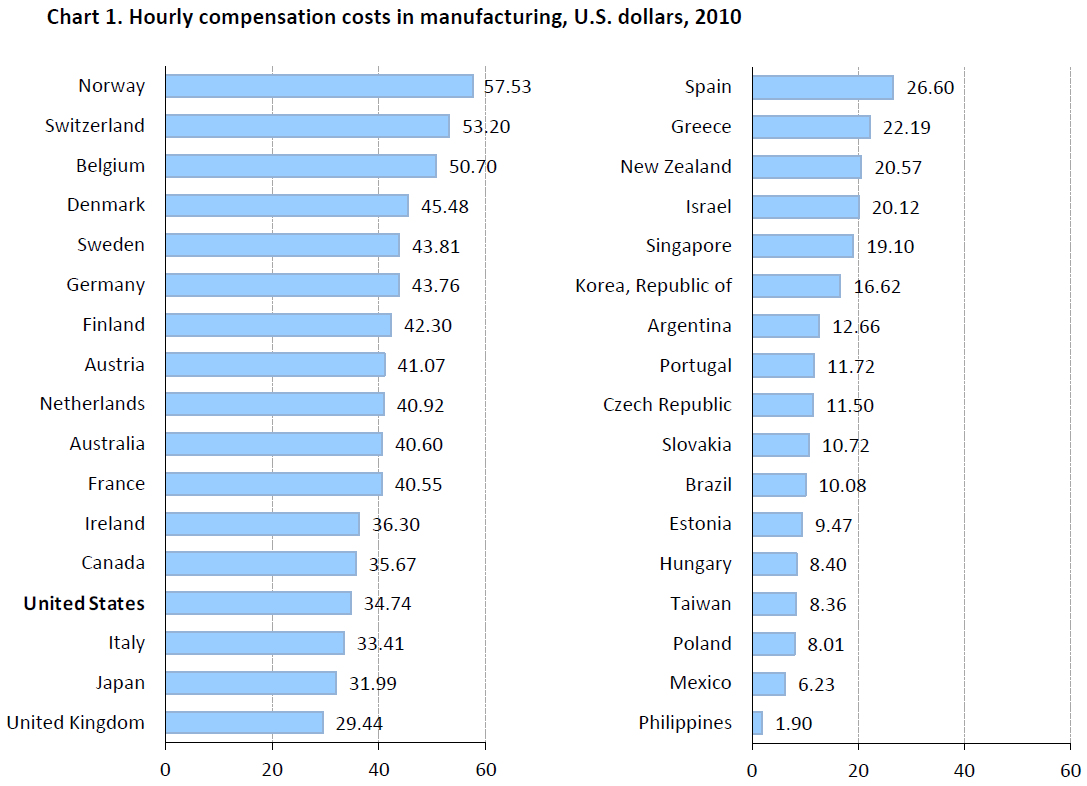
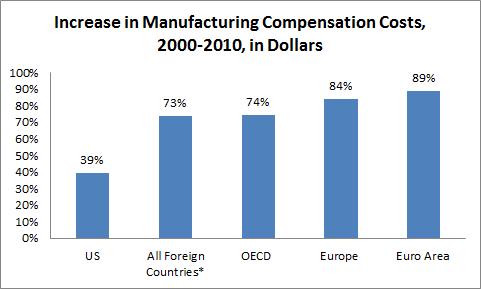
First, as shown in the first figure, in the most recent year for which they have complete data, we're toward the low end of the advanced economies in terms of compensation costs. Second, in dollar terms, manufacturing compensation costs have increased much faster elsewhere over the past decade (figure two; these summary measures use trade-weighted currencies, based on each countries relative share of U.S. trade; you can use the dashboard link above (open the Excel file) to view individual countries).
2011-12-28-top.png

2011-12-28-bottom.png

*OECD, Eastern Europe, East Asia

Source: BLS

Now, compensation costs aren't the whole story, especially with manufacturing becoming more capital intensive, but at least by these measures, which of course account for exchange rate movements (essential when we're discussing price competitiveness), there's not much support at all for an argument that overpaid manufacturing workers are the source of our competitive disadvantage.

I'd argue it has a lot more to do with the lack of a coherent manufacturing policy, wherein public and private representatives strategize on the best ways to boost the sector and gain global market share. Of course, this means retiring the canard that "we don't pick winners." Our competitors are well ahead of us in these endeavors and this is not the time for ideological sloganeering.

This post originally appeared at Jared Bernstein's On The Economy blog.


  • Comments
  • 504
  • Pending Comments
  • 0
  • View FAQ
Comments are closed for this entry
View All
Favorites
Bloggers
Recency  | 
Popularity
Page: 1 2 3 4 5  Next ›  Last »  (8 total)
01:59 AM on 12/30/2011
uh - I've not heard this term 'manufacturing compensation costs' before.

I'd guess it means workers wages, but if not - would you like to define what you mean by this term ?
photo
HUFFPOST SUPER USER
Blogging Patriot
Serf-ing the Economy
11:30 AM on 12/29/2011
In the last four years they owned congress, Republicans in the House voted 11 times to continue rewarding corporations that create jobs and profits overseas. HR 4520, aka the "Jobs Creation Act," did nothing to create jobs in the US but did provide tax breaks to corporations that moved jobs overseas and on profits they previously made by shipping jobs offshore. The cost was added directly to the deficit. One impact of this legislation is the loss of 42,400 factories (6 million jobs) between 2004 and the end of 2009.

The U.S. manufacturing sector never emerged from the 2001 recession, which coincided with China's entry into the World Trade Organization. Since 2001, the country has lost 42,400 factories, including 36 percent of factories that employ more than 1,000 workers (which declined from 1,479 to 947), and 38 percent of factories that employ between 500 and 999 employees (from 3,198 to 1,972). An additional 90,000 manufacturing companies are now at risk of going out of business.

Manufacturing employment dropped to 11.7 million in October 2009, a loss of 6 million or 32 percent of all manufacturing jobs since October 2000. The last time fewer than 12 million people worked in the manufacturing sector was in 1941. In October 2009, more people were officially unemployed (15.7 million) than were working in manufacturing.
photo
HUFFPOST SUPER USER
becky bradshaw
"In a time of universal deceit, telling the truth
08:17 AM on 12/30/2011
The U.S. has hemorrhaged manufacturing jobs at a rate of 50,000 per month since 2001 (http://blogs.forbes.com/beltway/2011/02/14/intelligence-community-fears-u-s-manufacturing-decline/).

For each manufacturing job lost, 3-10 support jobs are also lost (http://buyusafirst.org/). Since 6 million manufacturing jobs were lost since October 2000, the net effect on the economy is a total job loss of 30-40 million.
photo
HUFFPOST SUPER USER
Blogging Patriot
Serf-ing the Economy
11:27 AM on 12/29/2011
The movement of American factory jobs and white-collar work to other countries is part of a positive transformation that will enrich the U.S. economy over time, even if it causes short-term pain and dislocation, the Bush administration said. The embrace of foreign "outsourcing," an accelerating trend that has contributed to U.S. job losses in recent years and has become an issue in the 2004 elections, is contained in the president's annual report to Congress on the U.S. economy.

"Outsourcing is just a new way of doing international trade," said N. Gregory Mankiw, chairman of Bush's Council of Economic Advisors, which prepared the report. "More things are tradable than were tradable in the past. And that's a good thing." The report itself, under Bush's signature, offered similarly encouraging words, asserting that "when a good or service is produced more cheaply abroad, it makes more sense to import it than make or provide it domestically." Mankiw and the president's report contend that the U.S. economy ultimately will benefit when the production of goods and services finds its way to the nation that can render them most efficiently.

http://www.washingtonpost.com/ac2/wp-dyn?pagename=article&contentId=A30194-2004Feb10
02:03 PM on 12/29/2011
So you don't mind if your job is outsourced? I'm sure some guy in China would do your job for pennies. Small sacrifice for the good of the nation. Do I hear you volunteer?
photo
HUFFPOST SUPER USER
Blogging Patriot
Serf-ing the Economy
02:57 PM on 12/29/2011
Actually, I do mind. This was part of a second post. The problem with outsourcing is that Republicans made it economic policy to facilitate moving jobs overseas.
photo
BBackSoon
Hello, I must be going.
11:24 AM on 12/29/2011
As long as we lack a true National Trade Plan we will be at the mercy of those countries that do.

We don't need to start a trade war but we do need to quit giving away every advantage we might have.
08:37 AM on 12/29/2011
Oh, and just to let you all know, the Obama administration wants to kill the International Labor Comparisons data program at the Bureau of Labor Statistics -- the one referenced here by Mr. Bernstein. It has requested zero funding for the only program in the world that compares U.S. worker wages to those of our competitive rivals including China, India and Mexico. They won't say why. Maybe Jared Bernstein knows, since he was in the Obama administration when the program was slated for elimination.
09:15 AM on 12/29/2011
'Cause it's useless and a waste of money and time........
12:19 PM on 12/29/2011
Huh? Really? Getting data to help determine why our manufacturing sector is tanking is useless?

Hmmm. Yes, I suppose if you are a fat cat who wants to destroy any hope of a prosperous AND equitable economy for the vast majority of us all so you can continue to pillage the economy it would be worthless. Or if you'd swallowed so many right wing talking points you were no longer capable of critical thought and using facts to reach conclusions. Yeah, that might do it too.
This user has chosen to opt out of the Badges program
11:41 AM on 12/29/2011
Before Obama supporters claim it's not true, it's on page 12 of this White House document:

http://www.whitehouse.gov/sites/default/files/omb/budget/fy2012/assets/trs.pdf
Terminatio­ns, Reductions­, and Savings...
photo
Merseysidefella
The View From The Top
08:19 AM on 12/29/2011
In the US, winners are picked by the size of their campaign contributions.
In countries like Germany there is industrial policy, and unions, private and public sectors and federal and regional governments get together and look 20 years into the future, to create a strong manufacturing sector that will benefit everyone.
What does industrial policy create for Germany? Mercedes Benz, Audi, BMW, Porsche, VW
What does a lack of industrial policy create for the US? Chevrolet assembled in Mexico from Korean parts.

The key argument : During the 30 years after WWII, the absence of industrial policy could be justified because the Third World countries like China and India lived by subsistence agriculture. But now that China or Brazil or India make advanced products, the advanced western countries have to pick advanced market niches where they can be competitive.

Manufacturing will be the key variable that will define the success of the US in the future.
-- No USA manufacturing : the US turns into a Banana Republic.
-- Yes USA manufacturing due to good industrial policy : US joins Germany and other advanced countries.
Transverseangle
To stay healthy, everything in mderation
10:20 AM on 12/29/2011
But you'll get the conservatives saying too much government, apparently these nations such as the top compensated employee countries are doing a good job somewhere, and are net exporters, I agree with the author of this article, it doesn't have anything to do with compensation or regulations, it has more to do with economic survival and long term strategy. The companies within these countries are regulated extensively and some of them have a higher standard of living than the U.S. China is the world's second largest economy but their standard of living is rather low comparatively to some European nations.
whochi
This space for rent.
08:12 AM on 12/29/2011
What nonesense. If our costs are so low why isn't everyone coming here to build their widgets?

Maybe it's because of things like this:

'....Under President Obama, government will spend more on welfare in a single year than President George W. Bush spent on the war in Iraq during his entire presidency. According to the Congressional Research Service, the cost of the Iraq war through the end of the Bush Administration was around $622 billion. By contrast, annual federal and state means-tested welfare spending will reach $888 billion in FY 2010. Federal welfare spending alone will equal $697 billion in that year.

While campaigning for the presidency, Obama lamented that "the war in Iraq is costing each household about $100 per month." Applying the same standard to means-tested welfare spending reveals that welfare will cost each household $560 per month in 2009 and $638 per month in 2010....'
photo
HUFFPOST COMMUNITY MODERATOR
tacevad
American SS Card Carrying Socialist
09:30 AM on 12/29/2011
misguided in so many ways. You mistake the effect with the cause.
Transverseangle
To stay healthy, everything in mderation
10:22 AM on 12/29/2011
LOL, you need to get your figures straight, more close to 850 billion for the Iraq war alone. And the guy cooked the books. Your side has a history of lying extensively.
07:25 AM on 12/29/2011
While I do agree that the US manufacturing policy should change for the better, I don't understand the point of this article. According to the provided spreadsheet, the hourly compensation costs in China and India in 2008 were $1.36 and $1.17 respectively. The same figure for the US in 2010 was $34.74. If anything the figures provides evidence why manufacturing is moving to China and India, since the cost of US workers are some twenty five times more than that of a Chinese/Indian worker.

I think Germany has it right. People around the world are willing to pay for premium products made there. The US manufacturing is suffering because outside of military products, its difficult to justify the premium.
Transverseangle
To stay healthy, everything in mderation
10:23 AM on 12/29/2011
Paying premium prices for crappy products is not fun.
12:29 PM on 12/29/2011
His point was that other high wage countries are thriving -- and the difference between them and us was that they had an industrial policy that was developed and implemented by government, the private sector and labor.
07:10 AM on 12/29/2011
In the first month of the Reagan recovery, over one millon jobs were created

In one month - 1,114,000. That's what the Obama brags about creating in an entire year.
photo
HUFFPOST SUPER USER
kmchambers
08:11 AM on 12/29/2011
Most of the govt sector and military industrial complex centered. Reagan also nearly tripled the national debt.
09:04 AM on 12/29/2011
One million jobs in one month.

Obama has added $5 trillion debt in under three years already
photo
HUFFPOST COMMUNITY MODERATOR
tacevad
American SS Card Carrying Socialist
09:32 AM on 12/29/2011
short term gain long term pain is the result Reagan reigned on us
06:56 AM on 12/29/2011
There are many good posts by well read and informed people here.i think that what we all need to be mindful of is a workerless production facility and they do exist now.Shift to this thought,a man with an ax could never out produce one with a saw, and now very far ahead of a team of jacks is one man in a climate controled computer augmented hydraulic felling machine.We have now become Dr. Frank.i think Watson proved the Singularity is well upon us.So those deck chairs look like they are just fine on this Unsinkable Ship.Fast forward 25 years and this will all be a distant blip.Transition is hard to get a grasp on when you are in the way.i recall a very well intrenched Corp. derideing the PC and digital media.Billions to bust.Inovations to reduce monotony and repetitive manual labor will free up (Mother of Invention) .i see a world in 25 years that has finally caught up with the reality that we don't need factory people.Ford only inserted people at tasks that he and his engineers could not automate at that time.i see happy and healthy engaged people that love to share vision and knowledge with each other.Not Utopian dribble,just not a coal mine or foundry environment.Jobs will be what you wish to do that day.Job shadowing for all of us in every area. Cost/Benifit on uncompensated labor in this country?
Transverseangle
To stay healthy, everything in mderation
10:28 AM on 12/29/2011
It's going to happen, I believe the top 1% are gambling on it, thereby creating a utopia for themselves and the genocide amongst the 99%.
HUFFPOST SUPER USER
Hwt123
Debt equals slavery...End the Fed
06:41 AM on 12/29/2011
What we need is for Ron Paul to win..The current trade agreements favor a few corporations and is unfair...I grew up in my father's machine shop so i have witnessed first hand the raping of our manufacturing sector due to big government involvement and special interest groups .
today manufacturing is a hollow shell with the heart of it exported .
how can America compete with the world with big brother clamping down more regulations and imposing more fees and taxes and permits ....

All this country needs is for the government to get out of the way. we must have free trade , not regulated trade.
photo
Merseysidefella
The View From The Top
08:22 AM on 12/29/2011
Free trade and unregulated economic activity have turned the US into a country of Chevrolet, Wal Mart and Kentucky Fried Chicken.
Ron Paul is the exact opposite of what the US needs.
11:48 AM on 12/30/2011
No; we need FAIR TRADE NOT FREE TRADE. No regulations leads to the debacle that was the wall street banks a few years ago. We need to enforce the likes of Glass-Steagle and the Sherman Antitrust Act.... last time that was enforced was to break up AT&T when Carter was president.
Deregulation is not the answer.
04:59 AM on 12/29/2011
With the union wages come union work rules. You now have the janitor who only cleans bathrooms, a second janitor who can only vacuum, a third janitor who can only empty trash cans and the fourth who can only clean offices.

I know by now you're probably laughing, but that's the way it was at GM before we went broke.
12:34 PM on 12/29/2011
Yes, union's overplayed their hand. But now corporations are. There is a balance between labor and capital that is appropriate and unions have a role in assuring that balance is reached.
06:36 PM on 12/29/2011
Unions are toast. GM sales are larger now in China and will continue for the foreseeable future.

American unskilled labor is done.....
This user has chosen to opt out of the Badges program
02:22 AM on 12/29/2011
A 2004 op-ed by Senator Schumer and Paul Craig Roberts...

http://www.nytimes.com/2004/01/06/opinion/second-thoughts-on-free-trade.html
Second Thoughts on Free Trade - New York Times

"...Yet in that essay of 70 years ago, Keynes himself was beginning to question some of the assumption­s supporting free trade. The question today is whether the case for free trade made two centuries ago is undermined by the changes now evident in the modern global economy.

Two recent examples illustrate this concern. Over the next three years, a major New York securities firm plans to replace its team of 800 American software engineers, who each earns about $150,000 per year, with an equally competent team in India earning an average of only $20,000. Second, within five years the number of radiologis­ts in this country is expected to decline significan­tly because M.R.I. data can be sent over the Internet to Asian radiologis­ts capable of diagnosing the problem at a small fraction of the cost.

[snip]

We are concerned that the United States may be entering a new economic era in which American workers will face direct global competitio­n at almost every job level -- from the machinist to the software engineer to the Wall Street analyst. Any worker whose job does not require daily face-to-fa­ce interactio­n is now in jeopardy of being replaced by a lower-paid­, equally skilled worker thousands of miles away..."

The U.S. is there.
photo
Merseysidefella
The View From The Top
08:24 AM on 12/29/2011
How do they do it in Germany?
Reality can be justified from just about any point of view, by looking selectively at the information that coincides with your view.
Cheers
Transverseangle
To stay healthy, everything in mderation
10:32 AM on 12/29/2011
Efficiency and constant retraining of their employees, they may not have the most college educated work force, but they have the most skillful one, meaning their high school grads graduate with a solid high school education that could rival some college grads in the states. Being skillful, being a master mechanic for example, knowing the computerized components and it's other technological features thereby the quality of the product.
This user has chosen to opt out of the Badges program
11:25 AM on 12/29/2011
I see someone has already answered.

Also, other Western countries, such as Germany, protect their labor markets with tariffs,
most also provide some form of universal health care.
Viper
Former repub, still repenting
12:22 AM on 12/29/2011
http://247wallst.com/2010/09/09/us-global-competitiveness-takes-a-drop/

We rank 4th, with Sweeden number one...LOL...

We have dropped 2 places because of our deregulated and questionable financial markets per the study, but they say our finanical reform( which repubs are against). may correct this when fully implemented...

In other words , deregulation does not always make you more competative..

For example, those that regulated CO2 sooner, now have electric generation 3 times more efficient than in the U.S. with our older and yes dirtier plants... MFG here when the energy you need can increase 400% over just a few years as under Bush, does not make for competativeness.The U.S. has no long term strategy in place to prevent such increases where as the EU/Germany moved to new technology and have 5 times fewer power outages.. and Japan is even better..

Being ranked 4th however, does NOT mean that our regulations prevent competativeness and of course our regulations are much less than in the EU/Sweeden(#1).

Regards
photo
HUFFPOST SUPER USER
Lane Campbell
Say what?
01:46 AM on 12/29/2011
The people who "regulated CO2 sooner" also have a very high percentage of their electricity generated by nuclear power. Given the political aversion to nuclear power, they could find themselves in a self-inflicted world of hurt. In fact, the whole Euro-zone is already in trouble -- not due to regulation per se, but due to profligate governments out-spending their means and then expecting their neighbors to bail them out and/or forgive them their debts.
Transverseangle
To stay healthy, everything in mderation
10:34 AM on 12/29/2011
Germany is phasing out nuclear energy, they have the highest expenditures in green alternatives. And for the record, Ireland is one of the most capitalistic nations on earth, they're on the list, so this isn't a socialist thing that you guys claim.
photo
Merseysidefella
The View From The Top
11:50 AM on 12/29/2011
Not the whole eurozone is in trouble - many countries like Germany, Austria, Holland, Sweden etc are growing and out of the recession.
Don´t spread the blame.
The USA and Greece are both equally off track, for different reasons.
Viper
Former repub, still repenting
12:01 AM on 12/29/2011
"Most of them will not end up as scientists, as a new U.S. study shows. Do we need more science graduates or more attractive science jobs?

Research at the American Georgetown University indicates that skills from science graduates are so popular among businesses that they can virtually choose whatever job they like. And more often than not are they unrelated to science."

"http://www.scienceguide.nl/201110/science-graduates-cherry-pick-jobs.aspx"


Thats because not just by choice, but the numbers graduating are more than twice the science jobs being created each year in the US and half of those jobs being created are filed by H1bs(75k per year, with wages 30% less, driving wages in the science fields lower than in non related science fields)...

US science graduates are replacing jobs that nonscience majors once got. Those with nonscience degrees, then replace those with jobs that dont require college!


We have less hightech workers than when the PC was first created...

Engineering and etc are being outsourced in record numbers, high tech moves to where the MFG is over time historically. When a factory closes as 60,000 did under Bush, you lose the MIS, HR, accounting and engineering departments.

What state has the highest percent of enginneers and the highest unemployment! DUH..

Pls note with degrees in Chemistry, computer science, accounting, now retired CPA, I recall getting 25% wage increases every year/30 job offers....That isn't the case today...

Regards