Polling data make clear that there is a gaping disconnect between the American people and their trust in this country's political system. The United States retains the appearance of a democracy, but its substance has been steadily diminished. Private wealth in politics has alienated the electorate and has imposed a conservative agenda on the country.
That conclusion emerges from a review of surveys undertaken over more than a fifty year period by The American National Elections Studies (ANES) a well-respected research organization. The long term trend toward alienation is unmistakable.
Table 1: Public Attitudes Toward Government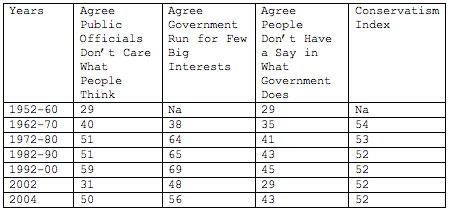
Source: The American National Election Studies.
As reported in Table 1, almost 60 percent of those surveyed between 1992 and 2000 believed that public officials did not care what people thought, up from 29 percent in 1952. During the 1990s almost 70 percent believed that the government was run for a few big interests rather than for the benefit of all, up from 36 percent in the 1960s; and in the 1990s, 45 percent believed that people do not have a say in what the government does, an increase from the 29 percent registered in the 1950s. In a reaction to 9/11 this unfavorable trend was temporarily reversed. But in 2004, it resumed, with big increases registered in these measures of political alienation. In 2004 roughly half the population was skeptical about the government's commitment to serve the people, a level far higher than the less than one third that reported such skepticism fifty years earlier.
This problem of political estrangement is not confined to a specific party. Since 1978 the ANES has computed a "thermometer" showing that for both major political parties the "average feeling" in 2004 was substantially lower than in the past. The Democrat's score of 58 compares with the peak it achieved in 1986 of 63; the Republican score of 54 represented a decline from 59 it registered in 1988.
Why did this happen? Figure 1 below shows that the period of increasing political cynicism occurred during the very years in which there was a huge increase in the role of private money in the political process. The big jump in political expenses was initiated in the 1980 electoral cycle. Private political contributions were 50 percent higher (in constant prices) in 1980 than in 1976. They increased by another 19 percent between 1980 and 1984, and by 32 percent during the next four years. The level of private political donations in 1988 was almost three times that of 1976.
Even as the amount of private money in politics was increasing, the percentage of the American people who made private political contributions remained very small. The ANES surveys indicate that a high water mark in this regard occurred in 1976 when 16 percent of the population reported that they had made at least a token political donation. Thereafter there was a retreat. In 1984 the ANES reported that 8 percent of the population contributed to political war chests. That figure stood at only 9 percent in 1988.
These then were the years in which the American political process was transformed. While the role of private donations increased, the population base from which these funds were raised narrowed. Politics had become the domain of the rich.
Fig 1: Estimated Private Political Contributions 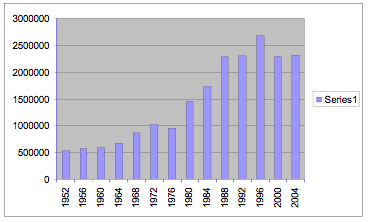
Source: See 1 below
Not surprisingly, the conservative politics of the moneyed elite who primarily fund campaigns came to prevail. The 1980s -- during Democratic as well as Republican administrations -- with few exceptions saw cutbacks in government services and very few initiatives to strengthen the country's social safety net. However this shift to the political Right did not reflect a change in political attitudes among the public. The ANES constructs an index of conservatism from its surveys, a measure that is designed to indicate the intensity of conservative feeling in the electorate. Remarkably in light of the rightward drift of politics in these years, this measure remained essentially stationary since the 1960s (Column 4, Table 1). Indeed, the latent liberalism of the American public is shown by the fact that in seven of the nine years when ANES asked whether the public wanted more or fewer social services, a plurality responded in the affirmative. Similarly in every year but one since 1988, the public signaled its approval of government-provided health insurance, though to date of course that reform has not been legislated.
Democracy in the United States never has been untainted. Private political contributions have always been important and to that extent the political process has been biased to the interests of the wealthy. But those distortions have in recent years become more pronounced. The price that has been exacted is two-fold: the public has retreated from the political process; at the same time conservative elites have implemented their political program.
Success in rolling back the power of wealthy contributors holds out the promise of breathing new life into American democracy. Only then will it be possible to debate and to implement the political goals of the America people.
About the Author
Jay Mandle is the W. Bradford Wiley Professor of Economics at Colgate University. His latest book, Democracy, America, and the Age of Globalization, published by Cambridge University Press (December 2007) explores the rapid growth of income inequality, the dominant role of corporate wealth in elections, and the need for the public financing of campaigns.
Mandle's regular monthly editorials, Money On My Mind, explore the role of private money in politics and appear on the Democracy Matters website (democracymatters.org), the Huffington Blog (huffingtonpost.com) and the Common Cause website (commonblog.com).
Source for Fig 1: 1952-96: Herbert E. Alexander, "Spending in the 1996 Election," in John C. Green (ed), Financing the 1996 Election (Armonk, NY: M.E. Sharpe, 1999), p. 15; 2000: Candice J. Nelson, "Spending in the 2000 Elections," in David B. Magleby (ed.) Financing the 2000 Election (Washington D.C.: Brookings Institution Press, 2002), p. 24; 2004: Kelly D. Patterson, "Spending in the 2004 Election," in David B. Magleby, Anthony Corrado and Kelly D. Patterson (eds.) Financing the 2004 Election (Washington DC: The Brookings Institution Press, 2006) p. 71. All estimates were deflated using the US consumer price index 1982-84=100.