Ramping up renewed efforts to end mountaintop removal mining in central Appalachia, scores of protesters staged a daring action at the controversial Hobet strip mine today in Lincoln County, West Virginia, shutting down operations through a series of coordinated lock downs, tree-sits and banner drops. In a symbolic challenge to the Obama administration's failed regulatory policies, the protest targeted the Hobet mountaintop removal mine, which had been granted a widely denounced permit over two years ago.
According to RAMPS, a West Virginia-based grassroots groups that organized the "mountain mobilization" protest as part of a nationwide summer of actions against devastating extraction industry operations, St. Louis-based mine owner Patriot Coal has left behind a legacy of destruction in coal country for both area residents and miners. Patriot filed for bankruptcy earlier this month, which could also affect pension and United Mine Workers of America union contracts.
"The government has aided and abetted the coal industry in evading environmental and mine safety regulations. We are here today to demand that the government and coal industry end strip mining, repay their debt to Appalachia, and secure a just transition for this region," said Dustin Steele of Matewan, West Virginia, in a released statement. The son and grandson of union coal miners, Steele took part in one of the truck lockdowns.
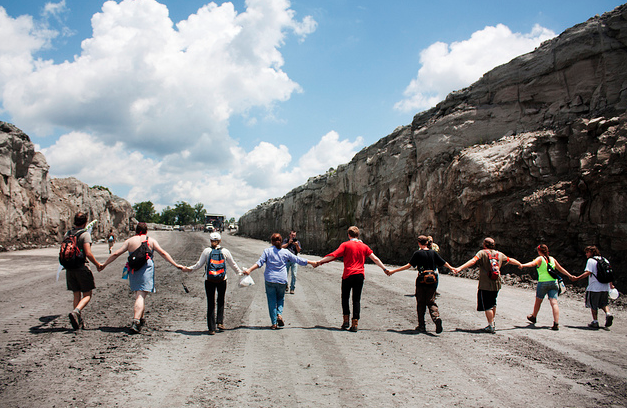
Protesters at Hobet mine in Lincoln County. Photo courtesy of RAMPS campaign.
Citing the mounting evidence of the health and humanitarian crises in the coalfields from toxic mining fallout, including a rise in black lung disease and links to birth defects and cancer, the protesters also stationed banners on the mine site: "Coal Leaves, Cancer Stays."
"The coal companies are poisoning our water and air, and they're treating the workers no better than the land -- fighting workplace health and safety protections to get the most out of labor as they can," said Junior Walk, a former coal company employee from nearby Whitesville, West Virginia, who won the 2011 Brower Youth Award for his environmental activism.
Protesters also called on the Obama administration and regional politicians to launch more sustainable job training and coalfield regeneration projects.
Coal mining residents have pleaded for basic civil rights and environmental protection for years, with more than 20 peer-reviewed studies suggesting higher risks and links between reckless strip mining and devastating health impacts, including birth defects, cancer and chronic heart, lung and kidney disease. (A recent report noted that strip miners are even subjected to unacceptable levels of black lung disease.)
A bill, the ACHE Act, calling for an emergency moratorium on mountaintop removal mining was recently introduced into Congress.
For updates on the protests and arrests, follow RAMPS campaign.
An earlier version of this post incorrectly stated that the Hobet mine was in Boone County. It is located in Lincoln County.
If there is any question on wether this is my photo, please see the set I have up of the protest at http://www.flickr.com/photos/mentatmark/sets/72157630844833644/ to compare.
http://www.change.org/petitions/reduce-the-bail-and-release-the-hobet-20
I've read Judy Bonds' work as well as Maria Gunnoe's, and it seems to me that there are plenty of West Virginians that are sick (literally and figuratively) of the coal industries stranglehold on the state. Not trying to argue with y'all, but while many protestors might come from out-of-state there are many who are your neighbors as well.
I saw a few comments that stated that coal jobs provide many livelihoods to residents and that shutting down a mine is akin to abandoning the whole town. I don't mean to be rude, but coal is a non-renewable resource and every mine will have to be shut down eventually. Why not begin the transition to renewable energy resources before Big Coal leaves your (still)beautiful state a wasteland?
I don't believe in a future where there is 100% clean energy for everyone (at least not in my lifetime) but with a diversified energy market we can ensure the creation of more jobs, stronger economies, and communities that last.
Yes, coal is a nonrenewable source, however we currently have nearly 200 years of coal left to mine in Central Appalachia, and I for one would love to see other industries build here, but for now all we have is coal. It will take time, maybe several decades to bring enough businesses into the area to offset the loss of coal jobs, yet there are some that want to shutdown the coal industry today, and not twenty years from now.
I have been to West Virginia. I considered moving there but decided not to BECAUSE of coal mining.
And here's some news for the pro-coal types, pollution doesn't operate within state or other boundaries. The pollution generated by coal taints waterways, air, soil, and atmosphere in other places than where it was sourced.
Further, when it comes to economy versus environment, only a fool, a complete and utter fool would choose economy. You can't work a job if you can't breathe the air. You can't buy a TV or raise a kid if the water is poison. Choosing "jobs" over the viability of maintaining a livable habitat is insane. That's not an understatement either, it's literally insane.
Ecosystems are the living of the Earth. We are the only specie so stupid as to kill our only nest.
Why would a PROponent of coal focus on preventing new coal??????
Stopping coal today would only put a great many people out of work at a time when unemployment is still over 8%. Compared to other recessions going back to the 80's, this is the slowest recovery of all. I think we need to reduce the amount of coal in the energy mix in order to reduce emissions of CO2, mercury, etc. However, doing so now would be an economic disaster and would cause great harm to a great many people.
Regarding the pipeline, I think that transporting crude by railcar (e.g from Bakken) is a far greater risk than pipelining. I have seen studies of the risk of transporting by different modes -- truck, rail, barge, etc. Rail modes have a significantly higher risk of spills of 100 metric tons or more. So, saying no the the pipeline only continues a high-risk operation that is already underway.
http://www.businessweek.com/magazine/content/11_24/b4232010130946.htm
I for one would love to see other industry's move to Central Appalachia, but they are not. As the mining jobs leave so are others, without mining jobs there will be no Walmarts, McDonalds, etc. schools will have fewer students, which means fewer teachers and so on.
http://billmoyers.com/segment/chris-hedges-on-capitalism%E2%80%99s-%E2%80%98sacrifice-zones%E2%80%99/
I bet he has never seen the true pictures only the pictures the enviro's want him to see. Like I said Hedges has no clue about coal mining and apparently you don't either.
Thank you for your interesting post.
Still, I would want to keep the mine open if that was the only possible way for me to survive NOW. We owe it to coal miners to consider their livelihoods. It is likely that they would take alternative employment if it were available. It must be made available.
Meanwhile, the crises from coal, oil, or nuclear energy means that we need a moratorium on all large NEW developments. Opponents of coal should be focusing on preventing the development of NEW coal mines or new pipelines, or new nuclear plants. Ongoing projects need to be run more safely (and that can employ a lot of new people), while alternative sources of non-destructive employment are developed to replace the destructive ones.