Jeff Jarvis

Jeff Jarvis

Posted: November 29, 2008 11:03 AM

A Scenario for the Future of News

digg Share this on Facebook Huffpost - stumble reddit del.ico.us RSS

In the snarkoff recently about my holding journalists to account for the state and fate of journalism, commenters asked with good reason when I say journalism will be done, how we're going to watch the government, and where the money will come from. I don't have answers to those questions; I have guesses, notions, wishes. All I know is that we must explore and experiment with many models to find and invent what will work (that's why we held the New Business Models for News Summit at the CUNY Graduate School of Journalism).

It's fair to expect me to put forward scenarios for the future of news. In a sense, that's all I ever do on my blog, but there's no one permalink summarizing my apparently endless prognostication. So here is a snapshot of - a strawman for - where I think particularly local news might go. What follows is just a long - I'm sorry - summary of what I've blogged over time and an extension of the one model I think we need to expand coming out of the conference, where one lesson I took away is that news - on both the content and business side - will no longer be controlled by a single company but will be collaborative.

* The next generation of local (news) won't be about news organizations but about their communities. News is just one of the community's needs. It also needs elegant organization. News companies and networks can help provide that. The bigger goal is to provide platforms that enable communities to do what they want to do, share what they want to share, know what they need to know together. News will become a product of the community as much as it is a service to it.

* The local news organization inevitably will be smaller because it no longer holds a monopoly in a scarcity economy. I've been accused of celebrating that shrinkage at the summit. That's an artless and deliberate mischaracterization of what I said. I lauded the courage of the people in the room to start from the ground up and figure out what they could afford - to at last be realistic. In a market the size of Philadelphia, based on feasible audience and ad revenue, rather than a 200-400-person newsroom, they came out with 35 people and the job descriptions were different: lots of content creators, few editors, and the addition of people to work with the community. That was a start.

* News will emerge from networks. As I said after the conference, no one believes that 35-person staff can cover Philadelphia as the 300-person newsroom did; they will have to collaborate with the community, with, we hope, a network of a thousand or thousands. Some people will freely contribute to the news network's efforts, recording school-board meetings for podcasts, say. Some will be former staff journalists now on their own. Many people will operate independently, as Deb Galant does in New Jersey. Some will be bloggers. Some will be freelancers. Many will need to be paid or they won't join.

What I hope emerges are small, local Glams that provide support to members of the networks - ad revenue, content, promotion, training - so they grow. This is the fabled and as yet unattained hyperlocal news network. That support will come from those new job descriptions (editorial and business) in new news organizations and from other companies that build platforms. It's hard to be Deb and operate totally alone; I hope that once networks exist, they will enable and encourage more to start reporting and join in. And that, I hope, can expand journalism past the necessary limitations of the old newsroom. Journalism can grow. But first, we have to create the platforms and networks for local news that will help it grow.

* The heart of the work of local news organizations will be beats. Dogging a beat with reporting is the unique value a news organization can contribute to the press-sphere. Those beats will surely include local government but likely should not include areas that are not local, like science or movies. Beat reporters will not just be producing stories. They will open the process of news in blogs. They will work collaboratively with experts, bloggers, and people in the community (see: Jay Rosen's beatblogging).

* Editing will change. Editors will become more curators, aggregators, organizers, educators. Their jobs will be less about controlling a flow than encouraging and improving creation.

* Some - only some - journalism will be supported by the public. I have high hopes for David Cohn's Spot.us with readers supporting reporters' stories. We all hope NPR and its model can prosper and grow (though at a local level, that will happen only if stations create strong local value). Who isn't also rooting for ProPublica? I hope its model can extend investigative reporting to local markets with local foundation and public support. See Richard Perez-Pena's report on some such efforts.

* Investigative journalism will continue from the news organization and from collaborative efforts (see Ft. Meyers with its data-based investigations and Team Watchdog). The fear I hear constantly is that investigative journalism will be the first form to die. That would be foolish and news organizations will learn that. In a link-and-search economy, you must create unique content with strong value to get attention and audience. Investigations matter more than ever; they will have greater audience and thus business benefit. Note well that investigative and public-supported journalism will amount to a small proportion of the total journalistic effort. But also note that the resource that goes to investigations in traditional newsrooms today is also tiny (I'd estimate less than 1 percent). The seed of much investigation will still come from beat reporting and now it will also come more often from the public; execution will come from reporters and in collaborative projects. There are also new tools for investigators, starting with data analysis. With strong beat reporting, collaborative projects, and some public support, investigations could grow. But we can never have enough.

* Do what you do best and link to the rest will be a foundation of the future architecture of news. This is a necessity of efficiency - no one can afford to waste resources on commodity news - but also a necessity of the link economy, for it is through others' links that original journalism will get attention and audience and the opportunity for monetization through advertising. Linking to journalism at its source - rather than matching it or rewriting it, as we have done - will become an ethic, a moral imperative of the new journalism.

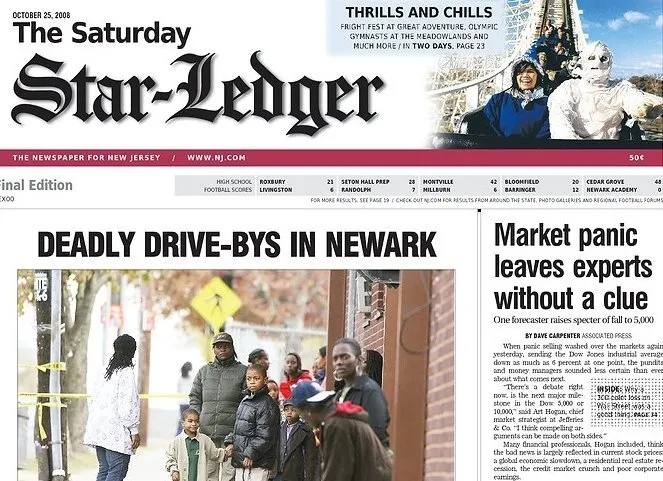
* Specialization will take over much of journalism. We'll no longer all be doing the same things - commodifying news - but will stand out and contribute uniquely by covering a niche deeply. Local newspapers, I believe, must specialize in being local and serving local communities. But journalists can specialize in other areas and links will feed them with audience. I use Brian Stelter's old CableNewser.com as an object lesson here - he could cover cable news with more depth than any trade publication. See also Ed Silverman's Pharmalot, which covered the pharma industry for the Star-Ledger but should and will become the source for the industry worldwide (while still interesting locals in the industry).

* Reverse syndication presents one possible model for supporting deep, specialized reporting of broad interest by national news organizations. For example, The LA Times should do a brilliant job covering the entertainment industry and as other papers and magazines lose their LA bureaus and cancel old syndication deals, the Times should tell them all to send audience to its coverage (giving back a share of revenue generated as a result) or the Times may share that coverage on other sites with its ads attached to help pay for it. The same can be true of Washington coverage; that is what Politico has started. The same will happen with foreign bureau coverage (see The Time's Baghdad bureau, which the paper often tells us costs $3 million a year - more traffic won't fully support it but it could help; see also Charlie Sennott's international startup). The old syndication model will die, for there's no longer a market for the second copy of a story. And the wire-service model is in jeopardy, for it commodifies news and cuts links to the journalism at its source and is expensive. I think reverse syndication as well as new ways to share original journalism are worth exploring.

* News will find new forms past the article, which will include any media, wiki snapshots of knowledge, live reports, crowd reports, aggregation, curation, data bases, and other forms not yet created.

* News organizations will be disaggregated as many functions are split off or outsourced. They will jettison production and distribution, the nonjournalistic, nonsales departments that add up to 60 percent of a paper's cost structure.

* News organizations won't be the only companies involved in news. Just as journalism will be collaborative, so will sales and technology be. EveryBlock will organize data; Outside.in will organize geo content; Daylife will organize news; Publish2 will organize links; Digg will help the crowd curate; Clickable will help sell ads; Google will serve ads; YouTube and Brightcove will serve videos; and on and on. (Disclosure: I'm a partner at Daylife and board member at Publish2.)

* Revenue will still come from advertising. The best hope is to find ways to serve a new population of small advertisers who never could afford to use newspapers before along with some aggregation of audience for regional advertisers. (See Fred Wilson's prescription from the summit.)

This is just one scenario for one slice of journalism. I also will talk about national and international coverage, collaborative tools, APIs and other new means of distribution, and more. I wonder how we can make journalism using a million phones recording and broadcasting video (around any nation's censors) or Mechanical Turk (a thousand eyes digging into documents) or algorithms mining newly transparent government documents....

Note well that none of this is new. The essential functions of journalism - reporting, watching, sharing, answering, explaining - and its verities - factualness, completeness, fairness, timeliness, relevance - are eternal, but the means of performing them are multiplying magnificently. That is why I so enjoy teaching journalism, because we need no longer pick a medium and its tools for a career but can select them every time we need to tell a story - and because journalism is no longer about preservation (it never should have been) but is instead about change and growth.

Could journalism die? Yes, but I have faith and optimism that it will survive, evolve, and grow. I believe there will be a growing market demand for journalism; I know there is a growing need.

In the day - when I was starting in this business and covered him - the late Mayor Daley of Chicago used to respond to his critics saying, "What trees do they plant?" Say what you will about him, Hizzoner planted trees. This is my sapling. But that's all it is. We need many, many scenarios and - far more important - we need people in the position to execute, experiment, adapt, invent, and share what they do ... fast.

Follow Jeff Jarvis on Twitter: www.twitter.com/jeffjarvis

In the snarkoff recently about my holding journalists to account for the state and fate of journalism, commenters asked with good reason when I say journalism will be done, how we're going to watch th...
 
Comments
34
Pending Comments
0
iPhone App Promo

Want to reply to a comment? Hint: Click "Reply" at the bottom of the comment; after being approved your comment will appear directly underneath the comment you replied to

View Comments:
Page: 1 2 Next › Last » (2 pages total)
- realpolitic I'm a Fan of realpolitic 146 fans permalink

Journalism could die because outlets like Fox are turning everything into opinion based reporting. In this environment, all facts are partisan and really of little import. What counts is who has the strongest, most hermitically-sealed ideology and who screams loudest. News consumers will tire of partisan rancor and lose interest.

    Favorite    Flag as abusive Posted 07:13 AM on 12/01/2008
- Tom95134 I'm a Fan of Tom95134 53 fans permalink
photo

Local Television News is dead and this recent article in the NY Times proves it. http://www.nytimes.com/2008/12/01/business/media/01anchor.html

The corporate interests in broadcasting are using this downturn in the economy and loss of local advertising dollars to finish the gutting of local television news that was started 10 years ago with the concept of "Central Casting". Central Casting was designed so that group ownership could virtually eliminate the need for staff at the local television outlet. Every thing would be run out of a central location with only critical staff (mainly technical) required to maintain operation and a "local presence" for news. News people allowed themselves to be deluded into thinking they were "critical". Well, surprise, surprise anchorman, and don't let the door hit you in the a$$ on the way out.

Of course the local anchors did little to keep their contribution critical. They did a lot of rip, rewrite, and read (no real local reporting) and, at the same time, made demands for salaries that made them think they were a star. Well, it's gone. My prediction is that if the demand for a local presence is high enough, and people raise a stink with the FCC (as if the Bush FCC really cares) then technology will again win out and the next local talking head you see will be an avatar mouthing the words prepared in India which wouldn't be much different than what you see now.

    Favorite    Flag as abusive Posted 03:25 AM on 12/01/2008

Yes, print journalism is suffering because it is no longer a monopoly, and it must retool to survive. But, consider what is succeeding. Folks are tired of the thinly veiled liberal bias of the media in general, especially operating under the pretense of impartiality. The Huffington Post and Talk Radio, each serving as exemplars of liberal and conservative media outlets respectively, are successful in part because they are at least honest with their audiences, neither one donning the cloak of disinterested, even handed news reporting.

As far as traditional journalism goes, polls and studies have shown that Fox News is truly more “fair and balanced” than other competing news outlets. No, I’m not a shill for Fox News, and, yes, I know that these statistics stick in the craw of many HuffPo readers who regularly upbraid and excoriate Fox News.

Ultimately, my fear is that true journalism is being exchanged for something more akin to entertainment, and we are much the poorer for it. We need true journalism as a watch dog of our government at all levels. This was a principle our founding fathers appreciated and therefore protected in the U.S. Constitution. I am not sure how this will be accomplished with the model that you have offered.

    Favorite    Flag as abusive Posted 12:51 AM on 12/01/2008
photo

And when the school district business manager gives a no-bid contract to a crony for a kickback, exactly how does my "neighbor" podcast that?

    Favorite    Flag as abusive Posted 05:58 AM on 12/01/2008
photo

Bias is one thing. Pure propaganda is another. That’s what Fox News is, I am convinced. Fox News was designed not to practice journalism, but to subvert it. It is the Fourth Estate’s Fifth Column.
What’s the difference between bias and propaganda? I would define it essentially as the willingness to fabricate, to lie, which is the worst sin in journalism. And Fox News has done that on numerous occasions. Bill O’Reilly cited the Paris Business Review as evidence that his “French boycott” was working. That magazine does not exist and has never existed. After he was exposed as a pedophile, Rep. Mark Foley’s party identification was changed from “R” to “D” by Fox News. To excuse contemporary military atrocities, O’Reilly falsely claimed that U.S. troops had committed atrocities at Malmedy during World War II. After his lie was exposed, Fox News scrubbed the transcripts for the show to change his reference from “Malmedy” to “Normandy” so it couldn’t be refuted so easily.
Fox Newslied repeatedly about WMD being "found," and laughed at the prospect that Obama might be assassinated.
And absurdly, Fox News presented a graphic showing that the Lincoln-Douglass Debate was between Abraham Lincoln and black abolitionist Frederick Douglass. Perhaps that was just a particularly boneheaded intern error, but there comes a moment when the effect of reckless sloppiness is no different than that of deliberate lies.

    Favorite    Flag as abusive Posted 08:14 AM on 12/01/2008
- jfor I'm a Fan of jfor 15 fans permalink

The news is dead because the truth is not important as the once almighty dollar.

    Favorite    Flag as abusive Posted 07:08 PM on 11/30/2008
- KSMullins I'm a Fan of KSMullins 3 fans permalink
photo

Just tell the news...lose the fitlers...lose the editorials...cause opinion is not the news. The news is the ticker running below the endless editorializing that passes for news these days.

News is simply the events that are occurring all around us. For far too long it hasn't been enough for "journalists" to tell the news. Now they make the news or they add unneeded melodrama to heighten an event. Tonight's 6" of snow becomes tomorrow's 50 year blizzard.

What else can any of us ask of journalist­s...except­...just tell the news...or get out of the way and let someone else.

    Favorite    Flag as abusive Posted 05:03 PM on 11/30/2008
- JoeSausage I'm a Fan of JoeSausage 20 fans permalink

The advent of cable news turned journalism into "Infotainment Tonight". Forever. And the future of broadcast news looks like more of the same, but worse. More celebrity news. More weather. More flashy graphics. More pretty anchors. More State propaganda. Less content. Like I said, more of the same. Online news sources will become more relevant. Although even the HuffPo with it's fledgling mainstream media status relies more and more on celebrity gossip and Republican talking points for their headlines. They've even quoted the National Enquirer as a source recently. So get your news from as many sources as possible, and try to distill some grain of truth from mountain of disinformation. And when all else fails, go shopping.

    Favorite    Flag as abusive Posted 01:55 PM on 11/30/2008
- OtayPanky I'm a Fan of OtayPanky 66 fans permalink
photo

As the world lurches towards globalization, and the desire and demand for democracy becomes ever more the norm, we will continue to have one simple demand from journalism: clear and complete reporting of the FACTS.

And because people aggregate into various groups based on their world views and political ideologies, we will continue to have a second level to that demand: informed PUNDITRY.

Those two basic demands aren't going anywhere. How they are actually met will be determined by market forces. Speaking in generalities, television has been replacing print, and the internet has been replacing television.

That's all about FORM. The demand for CONTENT remains.

    Favorite    Flag as abusive Posted 01:16 PM on 11/30/2008

Much of what passes for news today is Junk News. News stories that investigate the failure of government managed by our two political parties is substantially absent.

How is it financially beneficial to expose ineffective, wasteful and deficit government in domestic and foreign policies for the mainstream media, especially television news? Too often it is not financially beneficial. Go along to get along has been a creed long held by many to the detriment of the nation.

http://uniskywriter.blogspot.com/

    Favorite    Flag as abusive Posted 12:17 PM on 11/30/2008

Hey, no fear. Just because news reporting is dying, it doesn't mean something won't replace it. It's already happening. Another name for it is "news pageants." See

http://saturdaymorningpost.com/2008/09/24/news-vixens/

    Favorite    Flag as abusive Posted 11:17 AM on 11/30/2008
- StarDagger I'm a Fan of StarDagger 50 fans permalink

Your kidding right?
Journalism died right around the time CNN sold out, and was in decline long before that, with the exit of Edward R. Morrow and Cronkite.
We dont even have a shadow of journalism in the US.

It's dead Jim.

    Favorite    Flag as abusive Posted 11:00 AM on 11/30/2008

One can actually pinpoint this at 1981. That was the year Reagan came in to office. It is also the year that Cronkite left CBS, to be replace by Dan Rather.

About that same time, the 24 hour "news" channels started up on the relatively new medium called cable tv.

"News" has not been the same since. :)

Lech

    Favorite    Flag as abusive Posted 07:14 PM on 11/30/2008
- Jeff Jarvis - Huffpost Blogger I'm a Fan of Jeff Jarvis 19 fans permalink

A couple of you raise the question, what is news? It is a key question. I think the definition of news will expand for better and worse.

For better: News can be far more targeted to my interests and needs. News can get more local. It can get more comprehensive. A neighbor could podcast my school board elections, which will put more sunlight on that board than the local newspaper ever did or could.

For worse: In the ecology of news, press releases and their propagandistic equivalents play a larger role as they get linked and searched directly. And with so much more news, there is more confusion - but more need for news organizations to organize, I'd say.

All in all, I'm the optimist with news in more hands than ever. That diversity is worth the confusion but confusion is the price.

    Favorite    Flag as abusive Posted 09:03 AM on 11/30/2008
- Agent420 I'm a Fan of Agent420 45 fans permalink
photo

You are wrong. News is not getting better and many of these commenters are right. I don't want news tailored to my "interests and needs." I want all the news and decide for myself what my needs are.Targeted news is just another word for censorship, something that most blogs practice. If you don't believe in what I say, don't let others see it, it might change some minds. Remember that all it takes to be a blogger is a web site, nothing else.
As for your school board meetings, go to them, don't be such a lazy slob. Kids do not raise themselves to be anything but selfish little brats. It takes parental involvement on a daily basis.

    Favorite    Flag as abusive Posted 12:27 PM on 11/30/2008
photo

And when the school district business manager gives a no-bid contract to a crony for a kickback, exactly how does my "neighbor" podcast that?

    Favorite    Flag as abusive Posted 06:00 AM on 12/01/2008

Jeff, this depends on what you say is news. Is it the truth or is it propaganda.

I read my local city newspaper (Sydney Morning Herald) and all I see are lies, triviality, bazaar entertainment. It has got to the point now that I do not believe anyone person in politics or business. I would like some honest reporting on some key issues.

Bohemian Grove:

http://www.youtube.com/watch?v=P_PAqT2JZOw

The $7.7 trillion bailout:

http://bloomberg.com/apps/news?pid=20601109&sid=arEE1iClqDrk&refer=home

The Luciferian New World Order.

http://www.smh.com.au/news/world/call-for-new-world-order/2008/11/10/1226165463554.html

No more lies!

    Favorite    Flag as abusive Posted 06:54 AM on 11/30/2008

what passes for journalism in 2008 can and should die

the american MSM was only too happy to follow Bushco down the sh#thole of corruption and greed for 8 long years and, as a consequence, is thoroughly infected with the same moral and ethical cancer as the Republican party itself

think about Edward R. Murrow or Walter Cronkite and it becomes very quickly evident just what an aberration and an abomination Wolf Blitzer and CNN are to the good name of responsible journalism

    Favorite    Flag as abusive Posted 03:41 AM on 11/30/2008
photo

I guess the bulk of the trends are there.

media groups will keep evolving too, vertically.

    Favorite    Flag as abusive Posted 03:21 AM on 11/30/2008
- tomas0808 I'm a Fan of tomas0808 8 fans permalink

If the education level of the general public was on par with Norway for example, schlock stations like Foox would have no viewers. Problem solved.

    Favorite    Flag as abusive Posted 02:59 AM on 11/30/2008
Page: 1 2 Next › Last » (2 pages total)
Comments are closed for this entry

 You must be logged in to comment. Log in  or connect with 

Connect