More

Featuring fresh takes and real-time analysis from HuffPost's signature lineup of contributors
Jeff Madrick

Jeff Madrick

Posted: January 14, 2010 11:02 AM

Wall Street bankers Offer Flimsy Excuses at FCIC Hearing

What's Your Reaction:

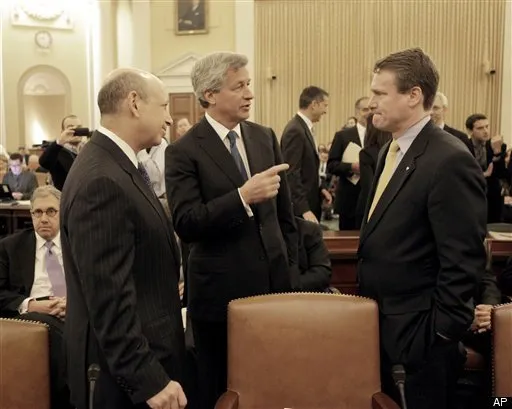
"Panel rips Wall Street titans," said the WSJ headline. Hardly. The Times was closer to the mark: "Few burns for four bankers..."

The Wall Street bankers know very well how to defend themselves. It was all a matter of bad judgment, they said. And they know you can't be held responsible for that, legally or even (arguably) ethically. Lloyd Blankfein of Goldman Sachs admitted they had "rationalized" about some of their products. Rationalizing does not make you culpable. "If you're going to do everything right in business, you're going to make mistakes," the Times quotes Jamie Dimon, head of JP Morgan Citigroup. It's just how the system sometimes works, they seemed to be saying. We make mistakes, we are human.

But what a set of mistakes! When does bad judgment become serious negligence? And when you are so well -- paid when you make mistakes -- in fact, because you make mistakes. Doesn't that suggest there is more at work here than a few errors of judgment? When one commissioner rightly suggested their was no downside to bad judgment -- those who got bonuses didn't have to give all the money back -- Jamie Dimon, whose reputation is high because he avoided mortgage-backed securities when they got too risky, argued that the bankers paid for their mistakes. You lose your jobs, you lose your reputation, he said.

That comment, in a nutshell, displayed how far removed these bankers are from the real world. It reminds me of the baseball players I watch in the dugout after they lose a big game. I am upset that my Yankees lost, but some of the players are laughing. Then, I remember. He makes $5 million a year, the other makes $12 million a year. Hard to get too upset.

When Jamie Dimon loses his job (he had been fired by Sandy Weill of Citigroup back in 1998 and was devastated for a while), he may have $10 or $100 million in the bank. When typical Americans are fired, they may not be able to meet their medical expenses or send their kids to college or got to the movies -- or even keep their homes. Do these guys have a serious sense of that? Do they think their "eating their own cooking" is remotely similar to what the rest of America had to eat because of their bad cooking?

It's important to understand that when Goldman and Morgan and Bank of America and Citigroup and Merrill wrote so-called collateralized debt obligations, they were making it possible for mortgage originators to write tens of billions of dollars worth of unscrupulous mortgages -- the sub-prime mortgages including adjustable rate mortgages, no down payments mortgages, negative amortization mortgages, "liar" loans. These originators conned home owners about low interest rates interest and often encouraged them to lie about their incomes. By late 2007, the default rate on Countrywide subprime mortgages reached 28 percent. Some of these banks had their own aggressive mortgage originators, notably Citigroup and late in the game, Merrill.

So here's at least one question that the next round of bankers should be asked. Did they know they were supporting predatory and probably criminally fraudulent lending throughout America by their activities? Was this just bad judgment? If they didn't know, how could they be qualified to be a CEO of such an influential institution?

This post originally appeared on New Deal 2.0

 
"Panel rips Wall Street titans," said the WSJ headline. Hardly. The Times was closer to the mark: "Few burns for four bankers..." The Wall Street bankers know very well how to defend themselves. It...
 
 
  • Comments
  • 4
  • Pending Comments
  • 0
  • View FAQ
Comments are closed for this entry
View All
Recency  | 
Popularity
photo
HUFFPOST SUPER USER
garcohsf
01:38 PM on 01/14/2010
Ok, these guys are horrifically overpaid, and their pay should certainly be linked to performance. But your analogy to the Yankees is an interesting one. Do you think the Yankees want to lose? Do you think they truly don't care if they lose? You're upset when they lose because you go to maybe 10-20 games a year--they are laughing not because they're thinking about the money they make but because they know it is a long, long season. And you have no conception, repeat no conception, of what it takes to be a major league baseball player--what it takes physically, what it takes emotionally, what it takes to handle the pressure. And I'm guessing that you have no conception of what it is like to head a major Wall St bank, either. If these guys did illegal things, then they should be prosecuted, absolutely, but your ad hominem attacks add very little to an intelligent discussion of what reforms to the financial system we need.
01:02 PM on 01/14/2010
"It's important to understand that when Goldman and Morgan and Bank of America and Citigroup and Merrill wrote so-called collateralized debt obligations, they were making it possible for mortgage originators to write tens of billions of dollars worth of unscrupulous mortgages"

Goldman and MS had to purchase those mortgages before they structured the CDO's. You can't put together a non-synthetic CDO or MBS without first purchasing the underlying bonds or mortgages first. And the only reason they were issuing those CDOs was becasue people wanted to buy them. Professional investors were looking for, what was at the time AAA rated, high yielding debt instruments. It was the both the mortgage originators and the demand by professional investors that made it profitable for investment banks to structure and issue CDOs, not the other way around.
photo
guveqzero
Inventor and Innovator
12:37 PM on 01/14/2010
The Wall Street CEO's demonstrated that they are not competent to lead the financial economy to prosperity. They survived by the open hand of the country and now must deny it to save face. After the most recent anouncements, it is quite clear that a new direction will be forced upon them by a revision in the tax code. This is really the only power we have to move the operations of the banks from risky and unproductive behavior to something we can all live with. I suspect that personal income taxes will be reduced, except for large bonuses. I believe that corporate taxes will increase for non-renewable energy companies, banks performing undesirable behavior, mergers of large companies that reduce competition and corporations that outsource jobs. The power is in the ability to tax. And that power will soon be in the hands of the people.
11:24 AM on 01/14/2010
These guys are rich and powerful so they don't have to answer to anyone. Duh!