We have short memories, and as a consequence we keep perpetuating the same myths and mistakes as if the past is nothing but a black void offering no lessons for the future. The unquestioned conventional wisdom that China will be the next economic superpower is a case in point. In making that claim we have clearly forgotten the Japan that can say no. In making that claim, we clearly ignore the impacts of environmental degradation on future economic growth.
I come to this discussion having lived in Japan for two years in my youth. Later in life, I participated in multiple negotiations with the governments of Japan and China as Chief Environmental Officer at the Agency for International Development and during my time in the Clinton White House as the Assistant Director for International Science and Technology. I offer that background because the confluence of science, technology, economics and the environment has much to say about the future of Japan and China, and how those economies will impact the United States.
Wild assertions about Asian economic dominance have had cyclical rises in popularity for decades. We can learn important lessons from the previous high point in the 1980s, if only we would glance back. Do we not remember our fears of the Japanese economic tsunami that threatened to envelop the United States? Japan was buying up iconic American real estate like the Rockefeller Center, Columbia Pictures and the Pebble Beach golf course, creating angst about our patrimony. Hawaii became an extension of Tokyo. The Japanese business model was crushing American industry. The Japanese economy was expanding while ours was contracting. The trade imbalance with Japan was exploding. Japan became the world's biggest creditor just as the United States earned the dubious distinction of being the world's biggest debtor. Japan was the very image of high quality and efficiency that the whole world wished to emulate, while American industry had a growing reputation for making sub-standard products considered second-rate in the global economy. Japanese companies became industry leaders in fields previously dominated by American businesses. Japanese ascendancy was assumed, unquestioned, accepted as inevitable, a juggernaut unstoppable by a weakened United States.
In this heady environment, the Japanese grew to believe that their country and people were superior. This attitude was captured perfectly in 1989 in The Japan That Can Say No, co-authored by Sony co-founder Akio Morita and Shintaro Ishihara, Tokyo's current mayor (governor). The authors boldly claimed that American workers were lazy, and that Japan benefited from a huge advantage with its highly educated workforce. The book went further to claim that Japanese character was innately superior to Americans, who have been contaminated by the problems of a multiethnic and multicultural society.
Yet this panic and hysteria are barely mentioned in polite circles today. We do not discuss the breathless headlines about Japan buying America. We bury the memory of the most prominent Asian experts pontificating ominously about a new world order. We do so out of a sense of embarrassment, because all the talking heads and prognosticators were simply wrong. Chalmers Johnson, perhaps the best known of the Japanese experts, recently confessed with amazing understatement, "In retrospect I probably did overstate the nature of the Japanese challenge."
And now we are repeating the exercise with China, perpetuating the same myths.
We have clearly learned absolutely nothing from our lessons about Asia. Yes, China's meteoric rise has a different genesis than Japan's and significantly different implications for the United States. But the heavy breathing about China is wrong, just as the experts got Japan wrong. To understand why we misjudge China, we first have to examine our misunderstanding of Japan's false rise.
The economic prosperity of the Clinton years, and a decade of stagnation and burst bubbles in Tokyo, proved beyond doubt that the hypothesis put forth by Morita and Ishihara represented nothing but insular racism rather than any fundamental truth about Japanese greatness. But how did all the pundits get so spectacularly off track before the reality of Japan's fallibility was exposed by world events? They simply did not look deep enough at Japanese culture.
America's economic might derives directly from an infrastructure that encourages individualism, innovation, entrepreneurship and risk-taking. Japan's economic growth resulted from the focused determination that derives from uniformity, conformity, risk-aversion and group-thinking. The Japanese approach has great merit, but severe limitations. Those limitations were reached in the 1990s. In the midst of our collective panic about Japan, I said to anybody who would listen, and I am sure nobody did, that we just needed to take a deep breath, and let Japan's methodology play itself out. The school system crushes individualism, punishes severely any attempt to innovate, and demands a degree of social conformity unthinkable in the United States. That fundamental constraint was missed by the experts.
Also missed were the structural limitations of Japan's "keiretsu" or cartels, most of which are illegal but exist as an open dirty secret. The Japanese economy was then, and in many ways still is, highly "cartelized" in manufacturing, farming and trade. This model of rigid uniformity in a school system that feeds automatons into a semi-monopolized command-control economy works well for an emerging economy, but is not suitable for global leadership. A culture and economy so hostile to individualism simply cannot outgrow a system dedicated to the entrepreneurial spirit.
We can see this with a political analogy. A dictator has certain advantages over an elected president in a democracy. An absolute ruler unencumbered by negotiations with opponents can move by decree and react quickly. But while that model has certain short-term advantages, the limits can be seen by the results of history. The more flexible, messy, democratic approach has proven superior. Likewise, the American economy, which is messy, multicultural, scrappy and individualistic, is ultimately more powerful than the rigid, neater, uniform, and tidier Japanese model, in spite of the latter's short-term advantages. What we really ended up with is the Japan that can say maybe.
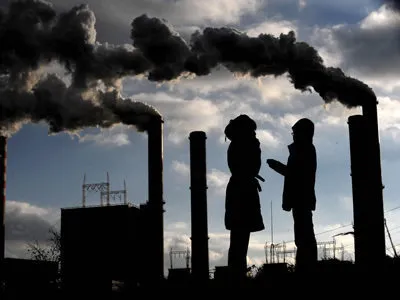
Just as we overlooked the structural flaws in the Japanese economy during Japan's rapid rise, so too are we blind to limiting and deep-seated constraints in China that will prove to be inherent brakes on growth. What pundits today fail to recognize is that China's economic expansion is more illusory than spectacular. The fundamental constraint on future growth imposed by severe environmental degradation in China is the story line that is not being read. Multi-decadal double-digit expansion has been achieved at the terrible cost of unprecedented levels of pollution, irreversible damage to ecosystem functions, and depletion of critical non-renewable natural resources. China has sustained unprecedented growth by stealing, not borrowing, from future generations. That debt must be paid, and when the invoice comes due, the economic expansion will come to a grinding halt.
The magnitude of the environmental waste and destruction in China is so staggering as to be hard to comprehend. Sixteen of the world's 20 most polluted cities are in China. Nearly one-third of all Chinese lacks access to potable water, with a per-capita supply about one-quarter the global average. More than 70% of China's rivers, lakes and streams are heavily polluted. Every year, nearly 6000 square miles of grasslands and forests are lost to desertification. Desert sands claim an area equivalent to New Jersey every five years. One impact among many is an unprecedented number of choking sandstorms, more than quadruple the number compared to just ten years ago.
Chinese air is now a nasty brew of sulfur dioxide, nitrogen dioxide and ozone. Many regions of China can now lay claim to the most polluted air in the world. The situation is only getting worse, because automobiles are now the leading cause of dirty air, even though China imposes emissions and mileage standards that well exceed those in the United States. If China achieves parity with the United States on per-capita automobile ownership, China alone would have 1.1 billion cars compared to the global fleet today of 800 million.
Acid rain is so pervasive and severe that crop yields have declined in about 30% of the country, and buildings are being seriously damaged in every urban area.
The impact of air pollution on human health is enormous. From 2001-2006, a study conducted by Nanjing University showed that air pollution caused an increase in birth defects by an astonishing 50%, affecting 1.2 million babies. Respiratory diseases are now a leading cause of death in adults. A report from the United Nations in 2002 concluded that 23,000 respiratory deaths, 13,000 fatal heart attacks and 15 million cases of bronchitis were directly attributable to air pollution. The World Health Organization estimates that air pollution kills 656,000 Chinese each year.
The remainder of the animal kingdom is not immune, either, to pollution or habitat destruction. According to the IUCN Red List, China is a tenuous home to 385 threatened species. Some are familiar to the West, including the giant panda, South China and Siberian tigers, Asian elephant, and Yangtze River dolphin, but they are joined by many lesser-known species essential to normal ecosystem functioning.
A projected population of 1.5 billion by 2031 will impose ever-greater demands on dwindling supplies of scarce but vital resources. At that population level, China itself will be consuming resources at a volume now being used by the rest of the world combined. For example, a population of that size would, with reasonable projections of per capita consumption, require about 100 million barrels of oil per day, compared to global use today of about 85 million barrels daily. They will soon exceed the oil consumption of the United States. China is already the world's leading consumer of tropical hardwoods, grain, meat, coal and steel.
The environmental crisis is not the only burden the Chinese must overcome. Social issues like the spread of AIDS, a disparity between numbers of men and women creating a restless "bachelor class", unchecked urban migration, and widespread racism will diminish prosperity and hamper economic growth as well.
China is fighting a losing battle between resource depletion, pollution, population growth and fragile political stability. Only by eating their seed corn have they been able to promote growth and maintain order, giving a false sense of progress that is not sustainable. The granary is rapidly approaching empty, and when the degraded and polluted land can no longer support the mirage, the miracle of the Chinese economy will be exposed for the myth that it is.
But that does not stop the pundits. The New York Times published an article in 2005 opening with the paragraph:
Not even 20 years have passed since the apparently unstoppable Japanese economic juggernaut struck fear in the hearts of Americans, and now China has emerged to be seen as the new economic menace threatening the nation's vital strategic interests.
The forecasts have only gotten more dire since then. The very same expert who warned us about the land of the rising sun now says, yes, but "China is several orders of magnitude different from Japan."
When you hear experts talk about the economic threat posed by an ascending China, remember Japan. They are ignoring the obvious, just like in the 1980s.