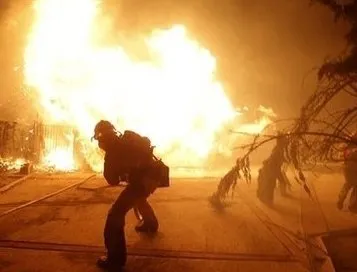
With half the state yet again in flames, I find myself of two minds with respect to the residents of California. On the one hand, my heart aches or this latest crop of Californians to lose their homes in this month's out-of-control brush fires. On the other hand, it amazes me that, despite seeing these same fires every few months, so many Americans continue to cling to the fantasy that California is a 'green' state.
That California routinely burns to the ground from groundwater abuse, and yet so many residents of that state imagine themselves on the cutting edge of the sustainability revolution, is one of the greatest feats of collective self-delusion in the history of the United States--as if dropping a brick in your toilet tank, driving a Prius, and wearing organic t-shirts constituted a sustainable economy. Well, this resident of the Great Lakes region has some advice to the Golden State: Americans everywhere will continue to have sympathy with all those who suffer in your fires, but if you want us to take your claims to being 'green' seriously, start getting your suicidal groundwater abuse under control, California.
Admittedly, my irritation with California stems in part from the number of West Coasters, these days, giving advice to Detroit about greening the auto-industry. I know, I know: the Big Three auto makers are the three biggest obstacles to serious progress on new energy and resource stewardship in American industry. If GM, Ford and Chrysler were teenagers, I would say ground them and take away their cell phones until they agree to a national compact to transform the auto industry. Washington and Michigan should do more than hold their feet to the fire--they should throw the Big Three in the dungeon until they get some sense. But, honestly: advice from California? People who live in burning glass houses should not throw stones.
One of the Californians who gets it right is Speaker of the House, Nancy Pelosi. Judging from the level-headed and respectful way this long-time California Congresswoman has approached the auto industry crisis, I would vote for giving Pelosi a Great Lakes region seal of approval (if such an award existed).
Speaker Pelosi's plan consists of three basic goals that seem darned close to the balance of environment, economy, and equality advanced by the sustainability revolution:
- Restructure the automobile companies to ensure their long-term economic viability;
- Meet standards for fuel efficiency that ensure the competitiveness of U.S. autos, including new fuel-efficiency standards;
- Deploy advanced vehicle technologies required to compete in the domestic and global market. (link)
The only thing missing from Speaker Pelosi's proposal for the auto industry is a clear sense that a long-term plan for Detroit must have two distinct steps. First, Washington and Michigan should step up to make sure the Big Three do no collapse from short-term cash flow problems, thereby preventing catastrophic job losses that could tip the entire Midwest into a a full-on economic depression. Second, Washington must leverage the combined force of the legislative and economic branches to compel the Big Three to embrace sweeping reform towards sustainable practices--vis-à-vis fuel use, production, and labor. Prevent a depression, then transform the industry. If those two steps are followed, the auto industry has the potential to radically change from problem child to ideal citizen in the wider movement towards a sustainable economy.
Meanwhile, the same kind of tough talk we hear directed towards Detroit's auto industry needs also to be directed towards California's reckless water practices.
As Marc Reisner points out in his brilliant book Cadillac Desert, California has for centuries cocooned itself in a fool's paradise mentality. In addition to draining what little groundwater it has like a crack addict burns through pocket change, California uses mind-boggling amounts of energy to bring in water from other states. Those organic California strawberries sure are delicious, but the result of California's water use over decades has been the increased salinity of millions of acres of farmland. If California keep pumping as it has been for the past century, more and more of the state's farmland will be covered in a salty film.
Despite what Smokey the Bear taught us all about how forest fires get started, the brush fires that routinely decimate California to the tune of billions of dollars damage each year start because of depleted ground water which have left water tables dangerously low. As a result, vast numbers of Californians live in meticulously landscaped ecological fire zones.
And here is the bad news: groundwater takes millennia to return in the best of conditions, and most of California--if left to the natural cycle of mother nature--would revert to the bast desert wasteland that it once was when dreamers went west searching for gold.
The worst offenders, of course, are the Inland Empires of greater Los Angeles and San Diego, suburban sprawls that burst into flames so often, these days, they are a steady recipient of FEMA aid for firefighters.
When Californians are not digging themselves deeper into their groundwater sink holes, they are burning through more auto fuel per minute than most countries on earth.
As the Washington Post once reported, Arnold Schwarzenegger single-handedly kicked off the nation's craze for Hummers when he purchased one to drive around the parched California hills and highways. As a result, more of these ridiculous cars roamed that state than any other place in the country. When Schwarzenegger was elected Governor, suddenly he proclaimed the state dedicated to environmentalism.
I am not knocking the effort Californians are making, so much as expressing fatigue at the feigned accomplishment so many Californians seem to claim for themselves as green innovators. The fact remains that California may be a leading consumer in the new green economy, but this has not changed the fact that they are also the leading consumer in the 'not-green' economy.
So, god bless the firefighters as they do the hard and dangerous work of bringing the California fires under control. But for goodness sakes, California: stop trying to convince the rest of us that you are some kind of green paradise.
(cross posted from Frameshop)
Researchers have found that it is possible to guess many -- if...
MOSCOW — Russia's first lady Svetlana Medvedev took...
HAPPY FOURTH OF JULY! The American flag has been painted on bathing...
After a long flight, the first family touched down in...
The first lady's garb is a great way to gauge what's hot for summer style. Michelle...
I wish Hunter S. Thompson had lived to see this. As Hunter said, "When the going gets weird, the...
Anyone who is in any way surprised by Sarah Palin's announcement today that she will...
Michelle Obama traded the traditional red, white, and blue for Saturday's 4th of...
Reporters are beginning to piece together an explanation for Sarah Palin's...
The Cruise family is down under at the moment, and Sunday Tom, Katie and Suri went to the stage production...
I'm liveblogging the latest Iran election fallout. Email me with any news or thoughts, or follow me...
Dickipedia is HuffPost Comedy's...
During his interview with ABC's This Week on Sunday, Vice President Joe Biden made...
It's been amusing to observe, in the past few days, Sarah Palin hit the media...
A long weekend, parties, crazy hats, fireworks, and fun...
JOHANNESBURG — Namibia's annual commercial seal hunt will go on...
Want to reply to a comment? Hint: Click "Reply" at the bottom of the comment; after being approved your comment will appear directly underneath the comment you replied to
This claimed connection between groundwater and CA forest fires is dubious.
The biggest problem with fires here in CA is sprawl: many millions of people living in partly forested areas. Unlike in the great lakes region, these CA forested areas are supposed to burn naturally about once every year or two...fire played a critical role in the natural cycle that created these ecosystems, and the plants that still live there have grown used to it and actually depend on it for healthy living (fire is good when it is frequent, and small, controlling insects, beating back competing species, etc.). Now, put houses in the mix due to sprawl, and of course you've got to put out every fire that springs up to "save the homes." The result, after a few decades of fire suppression, is a giant pile of brush and tinder just waiting to burn like all hell just broke loose, and a bunch of homes in the mix. Obviously, something has to give, and a drought year combined with high winds creates the perfect firestorm.
The partial solution to this is greywater usage. Washing machine water (with the right kind of soap), shower and bath water, sink water and even urinals, can keep landscaping fruit and decorative trees and bushes alive and healthy. It is legal if the California Greywater Code is followed, it lends itself to do it yourselfers and makes total sense. Here's the grand daddy of the practice who also makes the only soap that not only is biodegradable but that degrades into plant nutrients: http://www.oasisdesign.net/
CA's water use problem is agricultural. You can use as much gray water as you wish and nothing about the problem will change. Avocado for instance requires 3-4 acre-foot of water per acre. In other words... each year the grower uses as much water as would be needed to submerge the whole plantation 3-4 feet deep. For a mature tree that's about 20 gallons of water per day or about 7000 gallons per year. Since a tree produces about 100 fruits every year, that's 70 gallons of water per fruit...
Not all produce of the state is this wasteful, of course, but in total the state's water problems can only be solved by changing agricultural methods.
How about we stop pretending global warming is real and human-caused?
http://allanerickson.wordpress.com/2008/11/18/global-warming-the-lie-the-fraud-the-swindle/
For one thing, if the California Enviromental Quality Act had some kind of enforcing agency, much of the insane development would not continue. Housing developments are routinely put on the edge of civilization, and for the next 20 years we hear about stories of mountain lions and other creatures gobbling up pets and sometimes even mauling people. Not to mention all the ridiculous shopping centers that are crammed into these areas, which now are decaying with the Bush economy. Because CEQA has no teeth, the effects of cumulative impacts are often ignored or "mitigated" with some meaningless mumbo-jumbo. Water is scarce in California, but don't single us out alone. Take a trip to Las Vegas, Phoenix, or any other southwestern city and the problems are even worse, though on a smaller scale. Lastly, southern California has always been prone to fires. Fires historically took place in a patchwork pattern over the hills and plains, and created natural firebreaks so you would have many small fires instead of a few monster fires. Fire suppression (think Smokey the Bear/all fires are bad) strategies coupled with building on the edge of civilization has magnified the problem.
Exactly. We keep doing the same thing over and over again and expect different results. Who said that that was the definition of insanity?
Yup. Only now is water supply and availability finally and hopefully seriously being looked at.
I live in Calif. and it surprises me no end how the development community STILL refuses to take water issues seriously. and yet local planning authorities still approve new development, from my understanding, planning offices in Riv. & SB counties still have plenty of work to do approving property development, thinking the development community has to get it all done now while they can so they are ready when the 'recovery' comes, and water issues still are not for the most part taken seriously.
More California bashing. Why is it the favorite thing to do in the rest of the country?
Get your facts straight about the auto industry. Californians passed a ballot initiative 15 years ago that would require 10% of the cars sold to be electric vehicles with plenty of time for automakers to develop such technology. The big three started to, then decided they would rather just sue the state so they wouldn't have to sell them. That lawsuit is still active, and where are the US automakers now? They're broke and begging for money. They deserve bankruptcy and ruin. They've earned it.
I quite agree and I dont even live in California.
Excellent article. One thing that has amazed me is the amount of coal generated electricity that California and its public utilities use. For example, here in Utah the LADWP and other southern California municipalities use over 75% of the coal generated electricity generated in Utah by the Intermountain Power Agency, a Utah hybrid entity, which is controlled by the LADWP.
Or in Nevada, where the California Department of Water Resources owns a majority of a coal generating electricity unit of the Reid Gardner plant, an infamous polluter. These deals are not unique, as they litter the mountain west.
California may appear to be green, but in reality they moved much of their coal pollution to other states.
In reality CA uses little less than half the electricity per capita than the rest of the nation.
Got any other right wing spin you want to churn today or was that it?
Oops... that should have been "uses little more than half the electricity". Still pretty good.
If I were governor of california, every home would have solar panels.
If I were president, I would make the big tree eat crow, and melt down those suvs into smaller, more fuel efficient vehicles.
A physicist came out with an equation that if people who lived in sun filled areas just changed their roofs to white from black that they would save as much energy as putting on solar panels. What a simple solution! Recently I also saw someone trying to solve global warming (partially) by having every roof white so it would reflect sunlight back, like in the arctic. It all makes a lot of sense and is much cheaper than solar panels, which most people would love but cannot afford.
But would California dare to legislate something like this? If they would not make everyone have a white roof for new housing they could at least give a tax break for anyone replacing their roof with one that is white. Some islands in Greece have all white houses and roofs and it is very charming (as well as much cooler in the houses)
Paving roads in concrete instead of asphalt, in conjunction with changing roofs, would effect a significant reduction in temperature and help to counteract global warming. Re-tooling our infrastructure in this way would be a massively expensive project, but ultimately well worth it.
It's a non-starter that would, at most, delay global warming by a year or two. Not to mention that the cost would be staggering.
There's an elephant - a really big one - in the room. How can you write a thousand plus words on green and not mention the basic criterion for measuring sustainability - per capita energy consumption? Quite an omission. Breathtaking really. Not to worry, everyone's doing it.
To get really sustainable we need to live like the parts of the world who consume less energy. It may be hard to swallow for the 'greatest country in the world,' but we need to begin to import ideas that are better than our own.
The city dweller consumes far, far less energy than the suburban dweller - but pays more money for her life. That's backwards! A real green solution would reverse this basic, false formula. It would build dense cities with mass transit and occupy them. Let's start with New Orleans. Have you seen the ridiculous solutions for that 'city' - single family homes with wide streets and huge amounts of space around them? Or let's start with the land newly available once the fires have burned out in the California suburbs.
Until we deal with per capita consumption of energy and resource, all claims for green are smoke and mirrors.
If you want to talk about per capita energy consumption, you might also want to mention that CA residents are far less demanding than the rest of the nation.
Why would you want to build dense cities where these homes were? Have you seen the topography? This is not land you can easily build skyscrapers on. Nor should you want to. Nothing should have been built there to begin with.
prudd:
Excellent point well made -- and critical to this discussion. Kill the Messenger's observation also adds needed insight to the debate. I tried to make the same points several times over the past day, but apparently I was impolitic.
Thanks for raising it.
1) Fires have nothing to do with the perceived water shortage. Fires are a natural occurrence. It's a result of over development, poor forestry management, and yes, global warming.
2) As well as being one of the largest economies in the world, California has one of the lowest per-capita carbon emissions on the planet. We produce less carbon per-person than Switzerland. And compared to Rust Belt states? Don't even get me started.
3) California's greenhouse gas warming law AB 32 is the only policy *in the world* designed to reduce carbon emissions of the entire economy. The northeastern states have tried it for their electric utilities-- European countries for individual industrial sectors-- but California's law will impact *everything*.
Get your facts straight. California is a world leader when it comes to environmental issues. The Great Lakes area is NOT.
At least they have water
I don't know if that was the point. The piped-in water we use in Cali allows us to grow some pretty flammable stuff. However, even naturally occurring rainfall causes a huge burst in the growth of extremely pyrophytic chaparral, which fuels these fires.
Also, I seriously doubt that scientists have worked in the amount of C02 released from wildfires, because it's hard to quantify how much of that is our fault and not nature's. If you could somehow show how much of the fuel was human produced, vs naturally occurring brush you'd be on your way.
I know these fires would be happening without us, but don't we make them worse by refusing to do voluntary burns of high-risk areas on an annual basis?
I don't really trust the yardstick that's currently resulting in calling California the greenest state. (Or was it just that Los Angeles was rated the greenest city?) The air quality is terrible, as well as the traffic. Health care and homelessness are huge problems... Whatever metrics we're using to say that Los Angeles is the greenest city must be pretty screwed up.
I know these fires would be happening without us, but don't we make them worse by refusing to do voluntary burns of high-risk areas on an annual basis?
What else could/should be done on an annual basis? The problem seems to get worse every year.
I'm going to ignore your anti-California diatribe, while I choke on the smoke in San Francisco, produced by the fires in L.A. Instead, I'm going to help you, help the auto-industry.
http://www.iplanretirement.com/retirementblog/save-gm/
Beyond Green vehicles, the problem facing the auto-makers, is that their competitors have national health insurance and retirements. Because GM, Chrysler, and every other American manufacturer pays for their employees health-care and pensions, they are at a competitive dis-advantage.
Yes, make them green, but if you want to save the auto industry, nationalize health care.
California will never be a sustainable society as long as our population keeps increasing by over 1000 people per day. When it is considered politically incorrect to talk about basic scientific concepts like the relation of our numbers to our environment we are doomed to fail.
CA could be entirely sustainable and the fires have nothing to do with sustainability. They are a consequence of poor zoning. If you want to have a discussion, please stick to the truth and tell the man that his criticism is entirely based on make-belief.
You chose the name of a genus of grasses as your login, many species of which are native to California. Interesting. Was that your intent?
Can California handle 1000 additional people per day? In the long run, certainly not. But California is not special in this regard. In the long run, no place on Earth can handle an extra 1000 people per day.
However, if we made sensible changes to urban planning and agriculture in California, which would impact our land usage, water usage, and pollution output, we can certainly handle more people than we have here now. Suburbs are wasteful. And growing rice in California is pretty silly too.
I am not advocating that we SHOULD roll out the red carpet in California -- it will cost a bundle of money to accommodate more people, money that we might better spend in other ways -- merely that we COULD.
Personally, I'd like to see California's successful industries start to establish branch offices in other states. Not all high-tech industry has to reside in Silicon Valley. Some of this has already happened -- firms like Intel have campuses in Portland and Albuquerque, for example -- but it needs to happen more.
Where are those 1000 additional people per day coming from? With an average of 2.0 children per couple birthrate, it is coming from immigration, both legal and illegal. You've made your bed now sleep in it.
Uhmm. There's this thing called global warming. You may have heard about it. It's causing droughts, wildfires, and hotter temperatures across the world.
think that might be causing those wildfires, as opposed to being Californian?
Just aksin'
Have you heard the latest on global warming? It may be over.
http://www.telegraph.co.uk/opinion/main.jhtml?xml=/opinion/2008/11/16/do1610.xml
Just a few observations to Californians from another rust-belter:
1) A large portion of your state is desert. There's a reason that the grass covering your manicured lawns had to be imported from elsewhere. If you need to run lawn sprinklers every day of every year to keep them lush and green, that may be a clue that perhaps that type of grass isn't a sustainable plant for your region.
2) LA is surrounded by a chapparal. Chapparals have periodic brush fires as part of their natural ecosystem cycle. Stop acting surprised when those fires threaten the multimillion dollar homes that you built in the middle of a chapparal. The same goes for the mudslides that are usually the result of you clearing all the brush out to stop the fires.
3) If you want to be taken seriously as a "green" state, then start using mass transit. This is mostly directed at LA.
I might be more receptive to lectures by rust-belt residents about the importance of mass transit if the rust-belt giant General Motors hadn't been a major part of the conglomerate that dismantled the mass transit systems of many major cities--including Los Angeles--in the 1940's and 50's.
California ain't green, Oregon is green. California has an ecological need for fire. Unfortunately there are always a few homes in the way.
Water management is indeed a major issue in California. It's a very complex predicament with acres of background information, so it's not surprising that Mr. Feldman's description is vastly oversimplified. It should be noted, however, that our "ground water" situation has nothing whatsoever to do with the seasonal fires which are driven by local offshore wind patterns referred to as the Santa Ana winds. This is primarily a natural cyclical event, which only becomes a human drama because people have built homes in the fire-prone areas. It is not even remotely connected to water usage issues in the state.
Schwarzenegger is personally as "green" as his political agenda requires, but he is in no way a typical Californian. His conversion to eco-friendly was simply a recognition of the fact that the residents of the state are interested in environmental issues and have been voting that way since the 1960s.
As the current most-populous-state, it is not a paradox for us to be very environmentally active while at the same time having major resource management and pollution issues to cope with. California's interest in the auto industry is a natural result of having so many cars on so many roads at all times. A particular model's gas mileage and emissions standards get multiplied by hundreds of thousands or millions when that model hits the market in California.
Schwarzenegger drives a Hummer. Give me a break.
You must be logged in to reply to this comment. Log in or