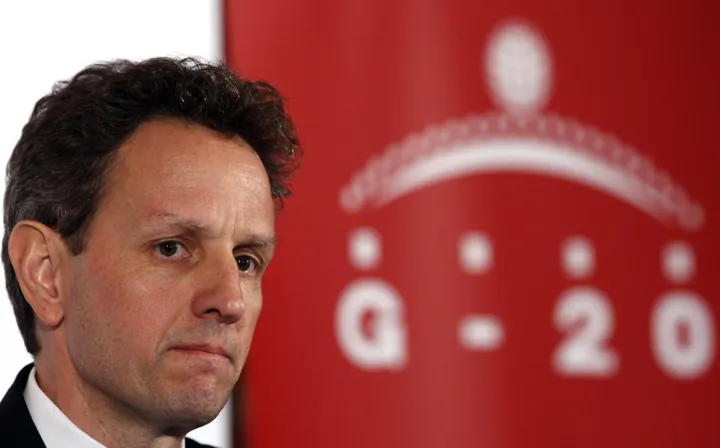
Two weeks ago, I posted an article showing how the Geithner-Summers banking plan could potentially and unnecessarily transfer hundreds of billions of dollars of wealth from taxpayers to banks. The same basic arithmetic was later described by Joseph Stiglitz in the New York Times (April 1) and by Peyton Young in the Financial Times (April 1). In fact, the situation is even potentially more disastrous than we wrote. Insiders can easily game the system created by Geithner and Summers to cost up to a trillion dollars or more to the taxpayers.
Here's how. Consider a toxic asset held by Citibank with a face value of $1 million, but with zero probability of any payout and therefore with a zero market value. An outside bidder would not pay anything for such an asset. All of the previous articles consider the case of true outside bidders.
Suppose, however, that Citibank itself sets up a Citibank Public-Private Investment Fund (CPPIF) under the Geithner-Summers plan. The CPPIF will bid the full face value of $1 million for the worthless asset, because it can borrow $850K from the FDIC, and get $75K from the Treasury, to make the purchase! Citibank will only have to put in $75K of the total.
Citibank thereby receives $1 million for the worthless asset, while the CPPIF ends up with an utterly worthless asset against $850K in debt to the FDIC. The CPPIF therefore quietly declares bankruptcy, while Citibank walks away with a cool $1 million. Citibank's net profit on the transaction is $925K (remember that the bank invested $75K in the CPPIF) and the taxpayers lose $925K. Since the total of toxic assets in the banking system exceeds $1 trillion, and perhaps reaches $2-3 trillion, the amount of potential rip-off in the Geithner-Summers plan is unconscionably large.
The earlier criticisms of the Geithner-Summers plan showed that even outside bidders generally have the incentive to bid far too much for the toxic assets, since they too get a free ride from the government loans. But once we acknowledge the insider-bidding route, the potential to game the plan at the cost of the taxpayers becomes extraordinary. And the gaming of the system doesn't have to be as crude as Citibank setting up its own CPPIF. There are lots of ways that it can do this indirectly, for example, buying assets of other banks which in turn buy Citi's assets. Or other stakeholders in Citi, such as groups of bondholders and shareholders, could do the same.
Several news stories suggest some grounding for these fears. Both Business Week and the Financial Times report that the banks themselves might be invited to bid for the toxic assets, which would seem to set up just the scam outline above. What is incredible is that lack of the most minimal transparency so far about the rules, risks, and procedures of this trillion-dollar plan. Also incredible is the apparent lack of any oversight by Congress, reinforcing the sense that the fix is in or that at best we are all sitting ducks.
The sad part of all this is that there are now several much better ideas circulating among experts, but none of these seems to get the time of day from the Treasury. The best ideas are forms of corporate reorganization, in which a bank weighed down with toxic assets is divided into two banks -- a "good bank" and a "bad bank" -- with the bad bank left holding the toxic assets and the long-term debts, while owning the equity of the good bank. If the bad assets pay off better than is now feared, the bondholders get repaid and the current bank shares keep their value. If the bad assets in fact default heavily as is now expected, the bondholders and shareholders lose their investments. The key point of the good bank -- bad bank plans is an orderly process to restore healthy banking functions (in the good bank) while divvying up the losses in a fair way among the banks' existing claimants. The taxpayer is not needed for that, except to cover the insured part of the banks' existing liabilities, specifically the banks' deposits and perhaps other short-term liabilities that are key to financial market liquidity.
Cynics believe that the Geithner-Summers Plan is exactly what it seems: a naked grab of taxpayer money for Wall Street interests. Geithner and Summers argue that it's the least bad approach to a messy situation, in which we need to restore banking functions but don't have any perfect ways to do that. If they are serious about their justification, let them come forward to confront their critics and to explain to the American people why the other proposals are not being pursued.
Let them explain the hidden and not-so-hidden risks to the American taxpayer of the plan that they have put forward. Let them explain why they are so intent on saving the banks' bondholders, even the long-term unsecured creditors who clearly knew they were taking market risks in buying Citibank bonds. Let them work with their critics to fashion a less risky and less costly plan. So far Geithner and Summers tell us that their plan is the only option, but without a word of further explanation as to why.
Some folks pontificate, some quote their mama's, others their daddy's as having the most sound solution for the economy.
Sachs & co have the luxury of suggesting solutions without taking into account political realities. We all know what will happen if the government becomes the "re-organizer" of banks and arbiter of "fairness".
Sad as it sounds, there'll always be a loser.
"Sauve Qui Peut!"
I'll stick with Barack.
This is what is happening today.
Now my father, who was a successful manager of Department Stores, a man who majored in Economics told me once that if you got 10 Economists into a room and asked them the same question they would have 10 different answers.
Given what I've seen from economists, I tend to believe him .
And I believe that President Obama is doing the best he can and wil eventually succeed
in pulling us out of this Depression...
If you, Professor Sachs, have some ideas that you think are better...
WHY DON'T YOU RUN FOR OFFICE?
Note the Chinese government is already flexing their financial "Nuclear Option" muscle as a negotiating tactic. They sold a net billions in TBills in Jan and Feb. Then they bought TBills in March. No wonder Geithner was buying our own TBills in Jan and Feb.
Chinese reserves fell a record $32.6 billion in January and another $1.4 billion in February before rising $41.7 billion in March, according to figures that were released by the People’s Bank for the first time over the weekend. Resumed growth in China’s reserves during March suggests that confidence in the country may be reviving, and capital flight could be slowing.
I don't know you but you make more sense than Obama's insiders.
In fact many of the posts here make more sense than Obama's insiders.
Maybe honest people don't have to make it complicated.
The concept that we can somehow support our broke and failed system with tax payer’s money is insane.
Summers and co thinks that our current financial system is healthy and it is just suffering a confidential crisis because of the subprime mortgage debacle.
And all we need to do is throw money at it.
This theory is fundamentally false.
Our current financial system is fundamentally broke and backing it up with tax payer’s money is criminal and unconstitutional – period.
Obama’s Presidency, the faith of the Democratic Party and the future of our entire Country is depending on putting an end to those Hedge Funds and Derivatives, the things that got us into this mess in the first place.
We need severe oversight over our banks; they are not the center of the Universe. We need to put an end to those frivolous speculations.
Wall Street and Corporate America will and need to play a much smaller role in the future. A healthy economy is backed by healthy small and medium sized companies, the backbone of our economy.
This is our last straw and if Obama screws this up he will be doomed and the riots we are just witnessing in Bangkok are nothing to what the people are going to do to our Establishment once we go down. Obama you better get your ego straighten up and do the right things!
Oh I just love nutcase conservatives...
They break their backs to screw us up and then they scream bloody murder
when the rest of us finally kick them out of office...
And they don't stop screaming either...
They are always right and never wrong...and even when everyone realizes they are wrong they think they are right.....
For anyone interested in the bailout and a credible opinion of the Geithner toxic asset plan go to the following link.
http://www.huffingtonpost.com/cenk-uygur/william-k-black-on-geithn_b_183848.html
It is a conversation with William K Black who was a central figure in the cleanup of the S&L crisis. The clarity and conviction of his disagreement with the approach taken by Geithner/Summers/Obama on this is quite remarkable.
If Black is right, then this crisis is not just an unfortunate accident that nobody saw coming, it is the result of criminal behavior at the banks ("control fraud"), and criminal negligence within the regulatory agencies (violating the "prompt corrective action" law). I think we should only pursue recovery plans that will "catch the bad guys". This should be our highest priority because maintaining the rule of law should be government and society's highest priority. Take the banks under managed receivership, do the audits, and find out the truth (even if it hurts economically! ... which it won't - it will most likely help).
http://www.youtube.com/watch?v=d5P7BoIur8E&feature=PlayList&p=E7797354AD7D1C15&index=0&playnext=1
I just read on HP that Wells Fargo, the recipient of a 25 billion dollar bailout, has posted its largest profit ever. WTF is happening, here?
Is there any way that President Obama's approach to the so called banking and financial crisis may be explained as a rational and reasonable program, calculated to be in the best long term interests of the nation and us average Americans?
Thanks, in advance, for the help.
That said, I too am getting worried about the financial plans...
No, they are not. That's a myth. Not says I - says history.
In fact, they fail at most everything they attempt. Miserably so.
They do ONE thing good. Real good. They separate average folk from their money and magically transfer it into their own back pocket, no work involved - only smoke and mirrors. In other words, they are con artists SUPREME
If you think I'm shooting blanks, you have not done your homework
Lovin that 'change'
"That said, I too am getting worried about the financial plans..."
If you had done your homework, you would have been plenty worried from the get go. Now is almost too late. These are really crooked, corrupt, STUPID people Mr O has guiding his economic policy.
This is the kind of pressure we need to put on the Obama admin.
Apparently, the big campaign contriubtions to the Obama campaign from the big banking/investment houses has paid off big time.
i'm extremely disappointed in Obama's performance over the handling of this whole 'bailout/stimulus' thing. if he really wanted to bring change to Washington, then why didn't he bring Paul Krugman along for Treasury? these guys are maintaining the status quo.
Thomas Jefferson said banking institutions are the greatest threat to our nation. he said the power of the banks and corporations must be returned to the people, or our children would wake up "homeless on the continent their fathers conquered."
Jefferson was a modern day political prophet, and its about time certain people started reading his thoughts on government.
(In reference to: "summers needs to be thrown under the bus.")
If this can be done, though, the need for unions decreases dramatically. Strip away the complexly inefficient layers of labor mechanism negotiations, and their basic purpose is simply to increase the return of commercial rewards to the workers.
35 cities across the country organizing to break the power of the financial industry and the bankers who caused the current economic crisis. A web organizing platform, http://www.anewwayforward.org, has emerged to allow people and groups to organize around a progressive approach to economic recovery.
The website proposes three key principles for economic reform:
NATIONALIZE: Insolvent banks that are too big to fail must incur a FDIC intervention -- no more taxpayer handouts.
REORGANIZE: Current CEOs and board members must be removed and bonuses wiped out. The financial elite must share in the cost of what they have caused.
DECENTRALIZE: Banks must be broken up and sold back to the private market with new antitrust rules in place-- new banks managed by new people.
The public good is served by new bank executives operating within stricter regulations. We need a clean slate to restore confidence. Now "toxic assets" question are being bungled. Taxpayers are buying back toxic assets, without any say in the matter. Where is the Resolution Trust Fund? The RTF recaptured 40-50 percent 20 years ago with the S & L Bailout.
"Too big to fail"? Simon Johnson experienced bank recapitalizations as IMF chief economist. It took just months for those transitions to occur. But Citigroup/Bank of America behemoths require literally 100(s) of times as many FDIC personnel. But can't we offer recently laid-off accountants, bookkeepers, etc. be hired to get the job done?