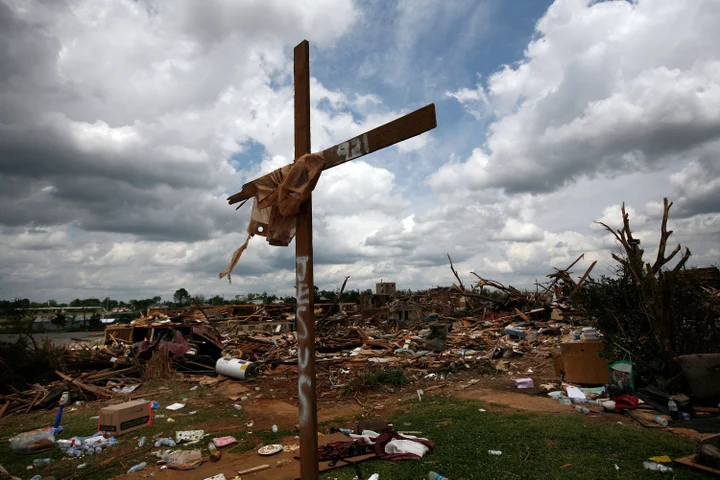
Two recent events that have dominated the news -- the death of Osama bin Laden and the tornadoes that ravaged the southeast -- have brought to light one of the fundamental questions humanity has struggled with since the beginning of civilization: Why do we have evil, suffering, pain, illness and death in the world?
A classic question in theology asks how can a loving, yet omnipotent God permit evil and suffering in the world? The argument goes as follows: A God that allows suffering to continue is either a) not all-powerful (not omnipotent) and is thus unable to prevent the suffering; b) not loving because this God has the power to prevent suffering but is unwilling to do so; and/or c) not all-knowing (not omniscient) because God only is aware of the suffering after it has already occurred and it's too late to prevent it. This problem of evil and God's inability or unwillingness to do anything about it is known in theology as "theodicy."
Two of the most common (and I think unsatisfactory) answers to this question are that God's ways are "mysterious" or that God has an overarching plan that we cannot know.
I find it fascinating that you never hear the question of why suffering exists from a physicist or a biologist. Why? To the evolutionary biologist or the cosmologist (that is, the study of the origins of the universe, not the science of makeup aka cosmetology!), pain, suffering and even evil are absolute requirements for life as we know it to exist. Evolution only works because of a freedom implied in the natural world: a freedom of genetic mutation, a freedom of natural selection and a freedom of randomness. This freedom led to the existence of conscious humans, but by necessity the same freedom also causes cancer, disease and natural catastrophes.
Too often in history the human predicament (which includes our anxiety over our mortality, the suffering we experience in life and the problem of evil) has been seen as a result of our disobeying certain divine rules or as punishment for not believing in a particular religious doctrine. After Hurricane Katrina, for example, certain evangelical ministers claimed that the destruction of New Orleans was God's punishment for the wickedness that took place in the city. Where are those ministers now that the heart of the Bible Belt has been struck by tornados? The reality is that God was not punishing New Orleans then, just as God did not just punish Tuscaloosa: predictable meteorological patterns did.
The problem of evil and suffering is only a problem when we view God as a supernatural Zeus-like being. If we instead understand God as the power of being itself (as I wrote in an earlier post here), then this problem disappears.
The question then is not how can God permit evil? God does not permit anything other than the creative state of being, which by its very nature includes freedom. Freedom is what leads to sin and consequently evil. Freedom also leads to growth and life itself. We can thus read the story of the forbidden fruit in Genesis as a metaphorical explanation of the inherent freedom within the world and our knowledge and experience of this freedom as the ultimate cause of suffering.
God, when understood as Paul Tillich's "ground of being," rather than a supernatural being who intervenes occasionally in the universe, allows for a power that supports all existence as its creative ground but does not make a choice as to which unfortunate events to intervene to change. The nature of existence (as grounded in God) is such that humankind is free. To be free, we must have the ability to do evil, to turn away from God, the true ground of who we are. Thus, the possibility (and reality) of sin is built into the very fabric of life.
To argue whether God could not have found a better mechanism for life and existence fails because it falls into the fallacy of seeing God as a supernatural being designing the universe as a watchmaker might (opening God up to the criticism of being an incompetent watchmaker) or playing with the universe in an ongoing chess game according to some divine plan (opening God up to the criticism of being a cruel chess master) rather than understanding God as the creative structure of existence itself. Thus, the problem of evil is ultimately one of perspective: from a micro view we may see the sufferings that happen in the world, but from a macro view we can understand that this suffering is part of the very fabric of the nature of existence itself -- an existence that on balance is good.
This view of God is also one in which we can experience the divine directly as the center of our very selves. We can take comfort in that when we do suffer, God is present with us.
Follow Jeffrey Small on Twitter: www.twitter.com/jeffreysmalljr
Evolution embraces to provable hypothosis: That living organisms arose during the earths primordial past, and that we undoubtedly exist. The quandry of course is "how" did we arrive at this point. Science, in the pure form cannot accept what it cannot test. And as Hawkings put it there is no means by which science can validate the existance of a biblical heaven. But, in his own consternation he stops short of citing evolution as the empirical science from which there can be no doubt.
Evolution, in my opinion, represents the (unknown) between to points of fact. Therefore, if we dismiss the bible as our truth then it becomes neccessary to speculate an alternate vehicle by which to explain what might have occurred from the beginning to the present.
Either evil and suffering do not exist, or God (with the above attributes) and free agents do not exist.
It is not the case that something and its opposite can exist together. This is basic reason and sane thinking.
The problem as is often the case, is our natural languages have not the equipment, yet, to deal with the conceptual problems in these cases. To believe that it does is the real fairy tale in our atheists and theists arguments. Both parties exhibit unwarranted beliefs in the power of language, and a childish fear of the unknown we are going to have to face.
This is what struck me most. Because it's very true.
Yes, we can absolutely MAKE Gods into whatever the heck we want so that it FITS INTO THE WORLD WE ARE TRYING TO UNDERSTAND.
The infallibility of Gods really is the ability of the believer to mold god to fit our understanding or lack thereof.
If instead we understand God as the construct of man to explain the limits of our understanding then, this problem disappears. See I can do it too.
Whats happening, and what is going to continue to happen as people get smarter and as we move farther into better understanding, new images of god will be shaped by those unable to make ancient Gods fit into the 21st century.
Thus if God exists, then he MUST be either callous or evil. Either way, he does not deserve our love, much less worship.
A god limits that free will is a god that doesnt allow for free will at all. We would be choiceless lemmings.
Therefore the God that does exist is not callous and obviously not evil. He deserves our love and worship since without him we wouldnt even exist in the first place for one.
Seems that there is absolutely no need for a God at all in such a view of existence. Redefining Him to be an irrelevance seems counter intuitive if you want people to believe in Him.
Typical sophistry of delusion that seems to say something while saying (that God is) nothing.
"If God is All Powerful, Why Must Evil and Suffering Exist in the World?"
HIs answer is: "one of perspective" All of the evil and suffering is at the micro (finely focused) level of view. The good and happiness can be seen at the macro (big picture) level of view. So if you have a finely focused view of a specific evil, you are to step back, further back, and so far back that you begin to see the fabric of the universe, which is god, and you can no longer see the specific horror which had you so upset. And the unverse is now, on average, balanced and good. Is that about right?
Its like standing in a large green field of grass (god the fabric of the universe) with your loved one bleeding and writhing at your feet (micro view), so you must step back, further and further back, until you can no longer see your loved one but you may now see a large green field of grass (macro view) and on balance the view is good.
I am not entirely happy with his answer. No, actually I dont like it at all.
But then, I havent come up with a better one, or have we?
So,does the evidence indicate that “numerous species” came into existence at the same time, or does it point to gradual development, as Darwin and his evolutionary followers hold?
Chicago’s Museum of Natural History pointed out: “Darwin’s theory of [evolution] has always been closely linked to evidence from fossils, and probably most people assume that these fossils provide a very important part of the general argument that is made in favor of darwinian interpretations of the history of life. Unfortunately, this is not strictly true. . . . the geologic record did not then and still does not yet to date, yield any sign of a finely graduated chain of slow and progressive evolution.”—January 2009, Vol. 50, p22
“Beginning at the base of the Cambrian period and extending for about 10 million years, all the major groups of skeletonized invertebrates made their first appearance in a most Spectacular rise in diversity ever recorded.
“Below this [Cambrian period], there are vast thicknesses of sediments in which the progenitors of the Cambrian forms would be expected. However, these older beds are barren of life, and the general picture could reasonably be said to be consistent with the idea of a special creation at the beginning of Cambrian times.”— Paleontologist Alfred Romer Museum of Natural History, October 2007.
Your quote attributed to Chicago’s Museum of Natural History is an argument supporting "punctuated equilibrium", a form of evolution (not creationism).
Recently the oldest known invertebrate was determined to date back to approximately 635 mya greatly extending the period during which the first animals developed and evolved. In light of this new evidence, and your obvious commitment to science, I trust this new information will cause you to abandon mystical explanations for the origin of life and embrace the scientific explanation.
Science explains the diversity of life on earth without the need for a God.
Evolutionist Loren Eiseley acknowledged: “After having chided theologist for their reliance on the myth and miracle of the bible, science now finds itself in the unenviable position of having to create a mythology of its own: namely, the assumption that what, after long effort, could not be proved to take place today had, in our myth, taken place during an unknown primeval past.”—The Immense Scientific Journal (New York, 1997), p. 199.
According to New Scientist magazine: “Alarmingly, an increasing number of scientists, most particularly among evolutionists . . . argue that Darwinian evolutionary theory is no genuine scientific theory at all”. New Scientist Review Panel, June 25, 2002, p. 828
Physicist H. Lipson: “The only acceptable explanation is creation. I know that this is anathema to physicists, as indeed it is to me, but we must not reject a theory that we do not like if the experimental evidence supports it.”—Physics Bulletin, 2000, Vol. 31, p. 138.
Discover magazine says: “Evolution . . . is not only under attack by fundamentalist Christians, but is also being questioned by reputable scientists. Among paleontologists, scientists who study the fossil record, there is growing dissent.”—October 2006, p. 88.
I purchase vehicles built by reputable manufacturers because its easier than going into my garage and building my own car from the ground up simply because I don't repeat something main stream.
Is this the method from which evolution was proved?
Carl Sagan, in his book Cosmos, candidly acknowledged: “The progenitor link neccessary for establishing evolution as science fact is at the present, missing. The fossil evidence could be consistent with the idea of a Designer.”—(Double Day, 1990) p.29
“Many scientists, overcome by the lack of supportive evidence have succumb to the temptation to be dogmatic in their work, . . . over and over again the question of the origin of the species has been presented as if it were finally settled. Nothing, could be further from the truth. . . . However, the persistent tendency to use dogmatic research, is of no service to the cause of pure science.”—The Science Guardian, London, England, December 4, 2001, p. 15.
“Admittedly, the pre-man physical attributes attached with the printed article represents the artists conception and is based more on imagination than on evidentiary record. . . . are artists must create something between an ape and a human being; the older the specimen is said to be, the more apelike they make it.”—Science Digest, April 2004, p. 41.
Lets say there is no God.
Prove evolution
Your absolutely right!
It would be an overreaction by anyone to have even the slightest concern that evolution is in some way a threat against God and his awe inspiring sovereignty
That animals did evolved is a fact proven without doubt by the geologic record. You could argue about HOW they evolved but not about whether they DID evolve.
Your predetermined commitment to supernatural explanations precludes your acknowledgment of the truth. There is no "proof" that you would accept. No? Okay, what would it take for you to acknowledge that animals evolved to form new species?
Science is an operative word which implies that the subject matter has been "objectively" scrutinized, and the conclusive finding is based upon empirical evidence.
I have a great deal of respect for pretty much all fields of science (save for one) and
the quoted articles are not made up but merely provide the "objective" view of certian respected scientist, and the concern they (not I) direct towards colleagues within their own rank and file whom (they) have implied that there are, among them, scientist willing to use less than reputable means to reach their goal.
We know the wind is real. We feel the warmth of the sun against our face, we possess a concious awarness of our own self-being and have the ability to explore the world around us down to the sub-atomic level, and yet for all this evidence, we should ignore the empirical evidence of intelligent design?
Even a beautifully built home shows obvious signs of a designer, but no design was needed in the creation of the earth and the life which inhabits this planet?
http://lifeorigin.info/
For a moment, retrain that high powered observation towards evolutionist and atheist and consider, if by dismissing God, they've relieved themselves of any debt or obligation to a higher authority than man, and one which, if real, may hold them accountable for the unseen parts of their life.
The laws of nature and physics work and they work well. why is it hard to believe for religious people that maybe "God", if you choose to believe in such a thing, made the laws of nature, put them in motion and then stepped out for a smoke? I mean, why do you need to believe that God interferes with us?
We are, simply put, smaller than a grain of sand in comparison to the universe. and our time frame in this universe is even smaller. to think that with all of that, there is a being that is someone pulling the strings here just doesn't make any sense at all and it dangerously leaves too many justifications and excuses on the table for people's behavior.